
Ugreen launches a privacy-focused smart home platform featuring local AI processing and multi-purpose hubs, aiming to reshape connected home control away from cloud dependency and subscription fees.
Ugreen has used IFA in Berlin to make its clearest move yet beyond chargers, power banks and network storage, launching a privacy-led smart-home platform built around local AI rather than cloud processing. The new HomeAgent range puts three hubs at the centre of that push: the HomeAgent HA100, the HomeAgent HA100 Pro and the higher-end MasterAgent MA100, which Ugreen says are designed to handle storage, home monitoring and voice control inside the home rather than on remote servers.
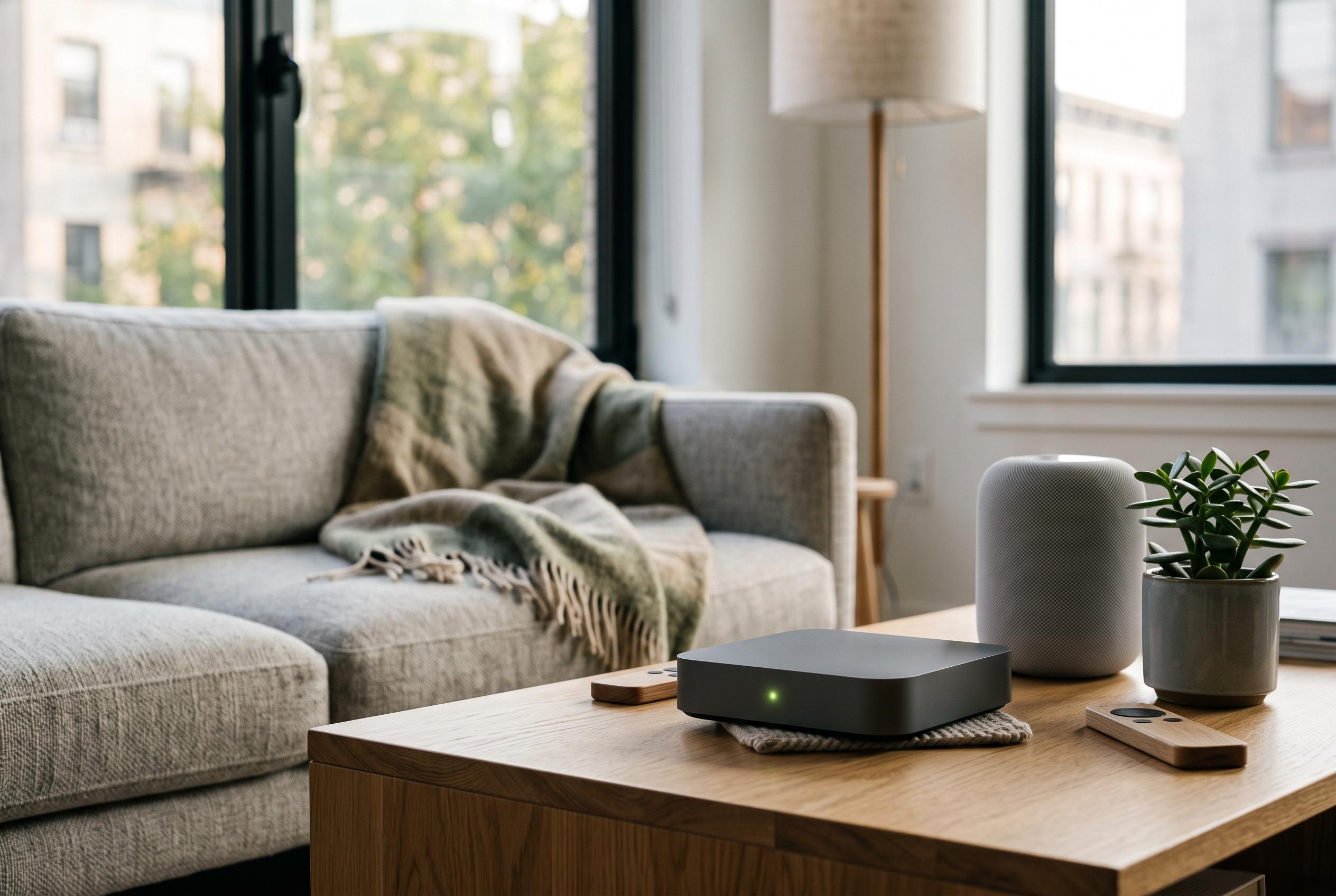
The company’s argument is straightforward. Instead of treating a smart-home hub as a speaker, a camera base station or a storage box, HomeAgent combines those roles. MacRumors and Forbes reported that the system can analyse video on-device, recognise people, vehicles, pets and parcels, summarise events and let users search recordings by keyword. Ugreen is also pitching the hardware as more than a security product: the hub is meant to pull from both camera footage and stored photo libraries to create highlight reels for display on the company’s Gallery smart frames, while avoiding monthly storage charges.
What lifts the launch above a conventional NAS announcement is the attempt to make local AI the control layer for the home. The Verge reported from Ugreen’s IFA booth that Uliya, the company’s new assistant, was used in a live demonstration to control Nanoleaf lights and smart blinds by voice through the HomeAgent hub. According to MacRumors and Forbes, Uliya can also answer questions about live status or past events and issue spoken alerts for things such as a parcel arriving, a car pulling onto the drive or a baby crying. But the local-first promise has limits. Tom’s Guide and The Verge both said remote notifications, remote viewing of camera feeds and some optional assistant features still depend on an internet connection.
The product stack is also sharply tiered by compute power and price. Tom’s Guide said the entry-level HA100 is priced at $899 for early backers, or $1,799 at full retail, and uses an RK3588 processor with 16GB of memory and 6 TOPS of compute. The HA100 Pro rises to $2,999 early bird or $5,999 retail, with a CIX-P1-CP8180 chip, 32GB of memory and 30 TOPS. At the top end, the MasterAgent MA100 is listed at $9,999 for early supporters and $19,999 thereafter, with Nvidia’s Jetson Thor T5000 and 128GB of memory. The Verge said the base model is intended for rule-based voice commands and straightforward automation, while the Pro adds more semantic and context-aware control.
Android Central’s early hands-on report suggests Ugreen understands that specification sheets alone will not sell a home server to mainstream buyers. Nicholas Sutrich wrote that he set up the HA100 together with SynCare camera hardware in under five minutes without reading the manual. He described 3.5-inch drives that slot in without a screwdriver, a magnetic filter over the cooling fan, and a setup flow that begins on the unit’s own touchscreen before the mobile app discovers it on the local network. That kind of friction reduction matters because Ugreen is effectively asking buyers to install small-scale infrastructure, not just another smart speaker.
The surrounding ecosystem is nearly as important as the hub itself. Ugreen is launching SynCare cameras, a dedicated smart speaker for Uliya and Gallery display frames as part of the same platform. MacRumors and The Verge said HomeAgent is intended to work with third-party devices across a wider set of technologies than a simple Matter badge might suggest, including Wi-Fi, Zigbee, Thread, Bluetooth, NFC and ONVIF/RTSP. Both outlets also noted that the compatibility list is currently narrow. Aqara, ThirdReality, SwitchBot and Eve were named as supported brands, while the first phase covers only lights, switches, sensors and curtains. That means interoperability remains a promise to test, not a problem fully solved.
On timing, Ugreen said pre-orders opened on September 4, 2026 through its AIoT online store and will run until the Kickstarter campaign begins on October 27, 2026. The company’s launch statement, issued from Berlin on September 5, said deposits start at $50 and secure a 50% Super Early Bird discount on the three hub models. It also framed the release as part of a wider consumer-electronics expansion, with HomeAgent launched alongside a new MagFlow range, rather than as a one-off experiment from its storage division.
That broader ambition may be the most important part of the announcement. Ugreen is trying to persuade buyers that privacy, local processing and the removal of subscription fees justify a much higher upfront spend, while also convincing them to trust a new assistant in a market still dominated by Amazon, Google and Apple. “HomeAgent proactively recognizes moments that are truly worth remembering and organizes them into a personalized daily briefing for every family,” Samuel Zhang, Ugreen’s chief executive, said in the company’s launch statement. Whether consumers accept that vision will depend less on the idea itself than on execution: how reliable Uliya proves to be, how fast compatibility expands, and whether a company known until now for accessories can become the operating layer of the connected home.
Disclaimer: This content is intended for informational purposes only. Readers are advised to exercise their own judgement, conduct due diligence, or consult a qualified expert before acting on any information provided.