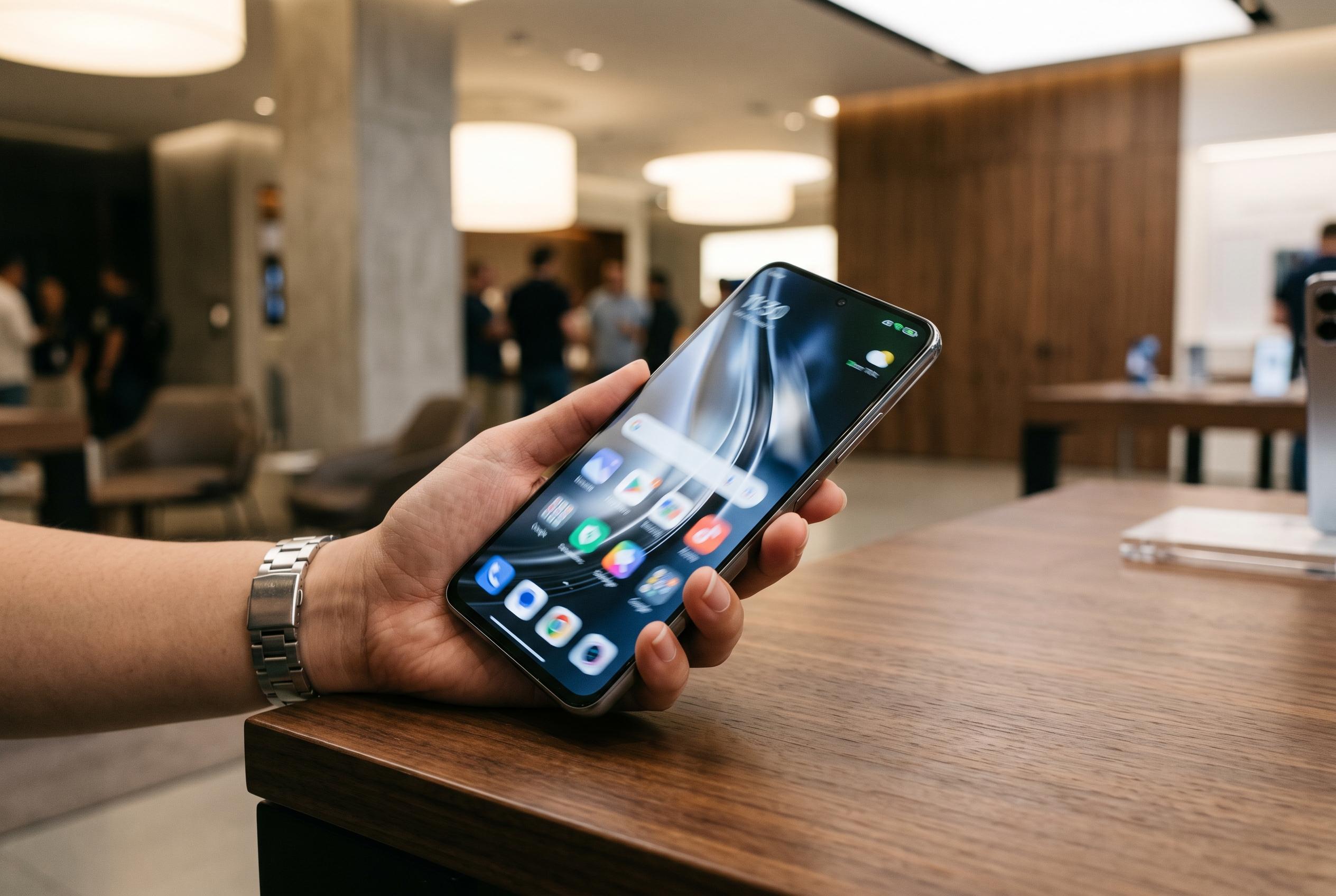

Poco launches the F9 Ultra globally with an unchanged Qualcomm Snapdragon 8 Elite Gen 5 processor, focusing instead on battery life, display speed, and premium features, signalling a shift in its flagship approach amidst rising component costs and pricing.
Poco’s new F9 Ultra has been launched worldwide with an unusually pragmatic message for a flagship handset: Poco is not trying to win this cycle by debuting a newer Qualcomm chip. Instead, the company has kept the Snapdragon 8 Elite Gen 5 used in the previous model and redirected attention to endurance, display speed and price positioning. Coverage from Android Central says the phone is heading to 25 countries including the UK, Germany, Spain, Italy, Thailand, Malaysia, Indonesia, Mexico and the UAE, but not India. Spain’s Cinco Días, reporting on the official announcement, framed the F9 line as a performance-led release built to deliver maximum power in current conditions. (androidcentral.com)
That choice looks deliberate rather than accidental. In comments published by TechRadar after Poco’s launch briefing, senior product manager Kang Lou said “performance is not always about chasing the latest chipset” and linked the decision to higher component bills, saying memory inflation was squeezing the industry. Global PR lead Olivia Jiang said the company no longer regarded launch timing as fixed and would release products when they were ready. That is a meaningful change for the F-series, which has typically leaned heavily on annual silicon upgrades. Digital Camera World noted that the F9 Ultra arrived only eight months after its predecessor, making the lack of a next-generation processor easier to understand. (techradar.com)
Price is where Poco’s argument becomes more complicated. Android Central reported that the base 12GB/256GB version is priced at the equivalent of $799, with an early-bird reduction to $729, while western pricing starts at €1,099 before launch discounts bring it down to €829. The 16GB/512GB version rises to $949 or €1,199 at list price, and the new 16GB/1TB option reaches $1,199 or €1,399 depending on market. In the UK, T3 put the starting price at £899, a notable jump from the Poco F8 Ultra’s £749 launch price in 2025. Poco is therefore no longer competing on bargain-basement terms; it is asking buyers to accept a higher entry price in exchange for a still-aggressive specification sheet. (androidcentral.com)
The official sales mechanics underline that this is a staged international rollout rather than a single universal release. Xiaomi’s Australian launch page says pre-orders opened on 1 September and that the F9 Ultra will ship from 10 September. That page advertises a $300 early-bird discount during both the 1-10 September pre-order window and the 11-30 September on-sale period, alongside bundled extras for eligible pre-orders including a Xiaomi UltraThin Magnetic Power Bank 5000 and a Xiaomi Sound Play speaker. Those terms are regional, but they show how heavily Poco is relying on launch incentives to soften the price rise. (mi.com)
On paper, the hardware case is strong. T3 reported that the phone combines the Snapdragon 8 Elite Gen 5 with Poco’s VisionBoost D8 graphics chip to push an advertised 185fps gaming experience, while TechRadar said more than 20 titles can use the boosted frame rate. The device also carries a 6.9-inch AMOLED panel, an 8,050mAh battery, 100W wired charging and Bose-branded audio. T3 added further display detail, saying the screen reaches 4,500 nits of brightness in some scenarios and up to 10,000 nits peak HDR brightness, while the audio system uses a 2.1 arrangement with an independent subwoofer. In other words, Poco is trying to justify the unchanged processor by improving nearly everything around it. (t3.com)
Early reviews suggest that battery life and media features may be the most persuasive parts of that strategy. Android Central described the F9 Ultra’s onboard sound as the best currently available on a phone and said the 8,050mAh silicon-carbon battery lasts two days even with heavy use. Digital Camera World reached a similar conclusion, saying it was regularly getting two days per charge despite gaming and camera use, and describing the battery as the largest the reviewer had tested in a phone to date. That review also said the handset can run demanding games such as NTE and Wuthering Waves at high settings, and noted a trade-off that matters at this price: there is no charger in the box. At 235g, it is also plainly carrying the physical burden of its large battery. (androidcentral.com)
The camera story is more mixed, and it is one area where published specifications have not been entirely consistent. Gizmochina’s buying guide described the F9 Ultra as using a 200-megapixel main camera, an 8-megapixel ultrawide, a 3x periscope camera and a 50-megapixel selfie camera. Digital Camera World’s specification list, by contrast, says the phone has a 200-megapixel main sensor, a 50-megapixel ultrawide, a 120mm-equivalent 5x telephoto camera and a 32-megapixel front camera. In use, both reviewers were generally positive about the main camera and telephoto results, but less enthusiastic about the secondary imaging tools. Android Central called the wide-angle camera average and said video remained a weaker area, while Digital Camera World said the ultrawide’s fixed-focus design limited close-up shooting. (gizmochina.com)
Software remains the clearest caveat. Android Central argued that the biggest irritation is the software itself, criticising the phone for arriving with Android 16 rather than Android 17 and describing Poco’s four promised Android version updates as being on the low side for this class. Digital Camera World was milder, saying HyperOS 3 was stable and highly customisable, though it also noted pre-installed bloat that needed removing and said the six years of security support were decent rather than class-leading. The result is a handset that looks less like a traditional “flagship killer” than a carefully rationed premium device: high-end silicon, unusually large battery, very fast display, ambitious audio, but a software experience and price point that make the value case harder than before. Poco’s bet is that enough buyers will still decide that the trade works in its favour. (androidcentral.com)
Disclaimer: This content is intended for informational purposes only. Readers are advised to exercise their own judgement, conduct due diligence, or consult a qualified expert before acting on any information provided.