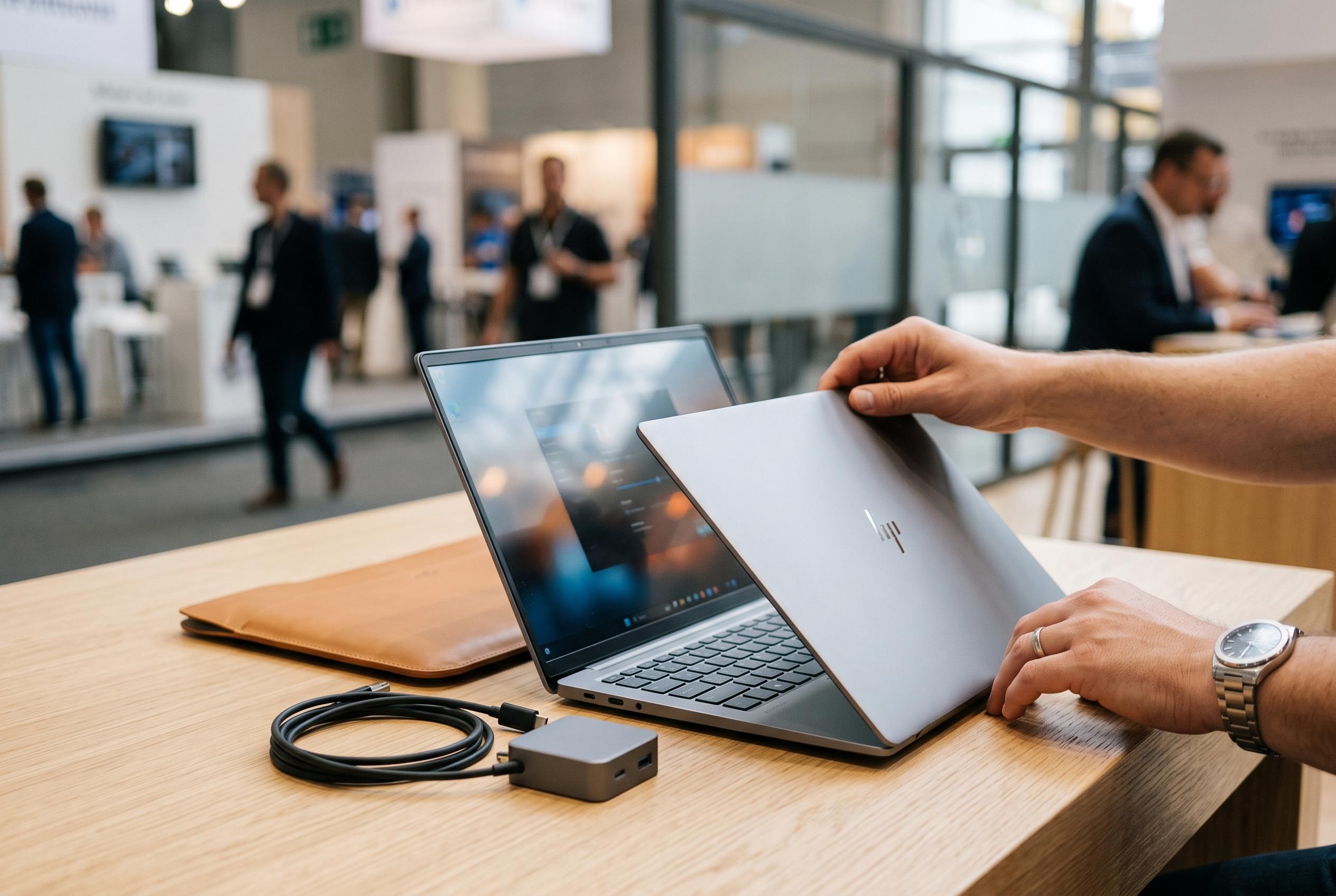

Lenovo unveils its lightest ThinkBook yet at IFA 2026, prioritising portability with a sub-1kg design and high-quality screens, while notably downplaying AI integration amid broader AI-centric product announcements.
Lenovo’s lightest new ThinkBook is reaching markets on different timetables, a detail that says almost as much about its role as the hardware itself. In Lenovo’s IFA 2026 launch material from Berlin, the 14-inch ThinkBook 14x Gen 2 is scheduled to go on sale in Europe in September from €1,079. US-facing coverage, however, reports a later first-quarter 2027 launch at $999.99. Across both versions, the pitch is consistent: a 990g business laptop that trades on portability first, at a time when most of Lenovo’s surrounding announcements are being framed around on-device AI. (news.lenovo.com)
That makes the machine an outlier within Lenovo’s own IFA message. The company used the Berlin event on 3 September to unveil a wider commercial portfolio of ThinkBook notebooks, ThinkCentre desktops, ThinkVision monitors and security tools under the banner of “Hybrid AI for Business”. Yet, as TechRadar noted, the ThinkBook 14x Gen 2 is the only computing product in that launch package with no published TOPS figure, no Copilot+ claim and no overt AI performance push. Instead, it sits beside the heavier ThinkBook 14 Gen 9, which Lenovo and 91mobiles say uses Qualcomm’s Snapdragon X2 Plus, carries an 80 TOPS neural processing unit and starts at 1.3kg. Eric Yu, Lenovo’s senior vice-president for the SMB segment and commercial product centre, said: “The value of AI isn’t measured by how many features it adds, but by how naturally it fits into the work people are already doing.” (news.lenovo.com)
Physically, the 14x Gen 2 is built to make that mobility argument visible. Lenovo lists a thickness of 12.9mm to 15.6mm and a starting weight of 990g, which puts it below the one-kilogram mark despite using a full 14-inch, 16:10 chassis. Buyers can choose between a WUXGA LCD panel with a 120Hz refresh rate, 400 nits of brightness and 100% sRGB coverage, or a 2.8K OLED option with 120Hz, 100% DCI-P3 coverage and 500 nits in standard dynamic range. Notebookcheck says the OLED panel peaks at 1,100 nits in HDR, while TechRadar adds that Lenovo is using a bent anti-glare finish. Touch support appears to be reserved for the LCD version. The machine is also one of the more visually varied corporate notebooks at the show, with Luna Grey, Celestial White, Mystic Violet and Veil Blue finishes. (news.lenovo.com)
Inside, Lenovo is using Intel Core 7 Series 3 processors on the Wildcat Lake platform rather than chasing the higher-profile AI branding attached to some other IFA laptops. Profesional Review reports a 25W thermal design in the featured configuration, with integrated graphics, up to 32GB of LPDDR5X-7467 memory and up to 2TB of PCIe 5.0 solid-state storage. The storage layout is more flexible than a simple spec-sheet summary suggests: Notebookcheck says the notebook ships with one occupied M.2 2242 slot and one M.2 2280 slot, while Hardwareluxx also reports room for a second SSD expansion slot. Notebookcheck further notes that Lenovo only introduced the first ThinkBook 14x, based on Lunar Lake, in late June, making this a notably quick refresh. (notebookcheck.net)
The compromises appear once connectivity is examined. Lenovo’s specification table lists two USB-C 3.2 Gen 2 ports, two USB-A ports, HDMI 2.1 and a 3.5mm audio jack, plus Wi-Fi 6E or Wi-Fi 7 depending on configuration, an FHD infrared webcam for facial sign-in and twin 2W speakers with Dolby audio branding. TechRadar argues that this leaves obvious gaps for demanding users, because there is no Thunderbolt or USB4 support, and because the HDMI implementation is limited to 4K at 60Hz. Notebookcheck also points out the lack of an SD card reader, which reinforces the sense that Lenovo sees this as a mainstream office and travel machine rather than a creator-focused workstation. Battery options are 54.7Wh or 65Wh, with 65W charging over USB-C. (news.lenovo.com)
That positioning is repeated across the coverage. Lenovo’s own description is of a notebook built for “everyday work across meetings, classrooms, airports, and shared workspaces”, while Notebookcheck calls it an affordable ultraportable daily driver and Profesional Review says it is not meant to chase outright performance records or compete with laptops carrying discrete graphics. 91mobiles reaches a similar conclusion by contrasting it with the AI-forward ThinkBook 14 Gen 9: the 14x is the model for people who carry a Windows laptop all day and care more about mass, thickness and screen quality than about local AI benchmarks. In a market where many “AI PC” launches are becoming heavier on terminology than on clear product segmentation, that restraint may be deliberate rather than accidental. (news.lenovo.com)
The result is a notebook that looks less like Lenovo’s flagship AI statement and more like a carefully carved-out business subcategory: full-size screen, respectable memory and storage ceilings, but a relentless emphasis on staying below one kilogram. For European business buyers, Hardwareluxx says Lenovo’s starting figure is quoted net of VAT, underlining the commercial focus. For US buyers, the later first-quarter 2027 schedule reported by TechRadar and Notebookcheck suggests regional rollout will matter as much as specification. Either way, the ThinkBook 14x Gen 2 appears to be Lenovo’s answer to a simple question that many corporate buyers still ask before any discussion of AI features: how much laptop do I have to carry? (news.lenovo.com)
Disclaimer: This content is intended for informational purposes only. Readers are advised to exercise their own judgement, conduct due diligence, or consult a qualified expert before acting on any information provided.