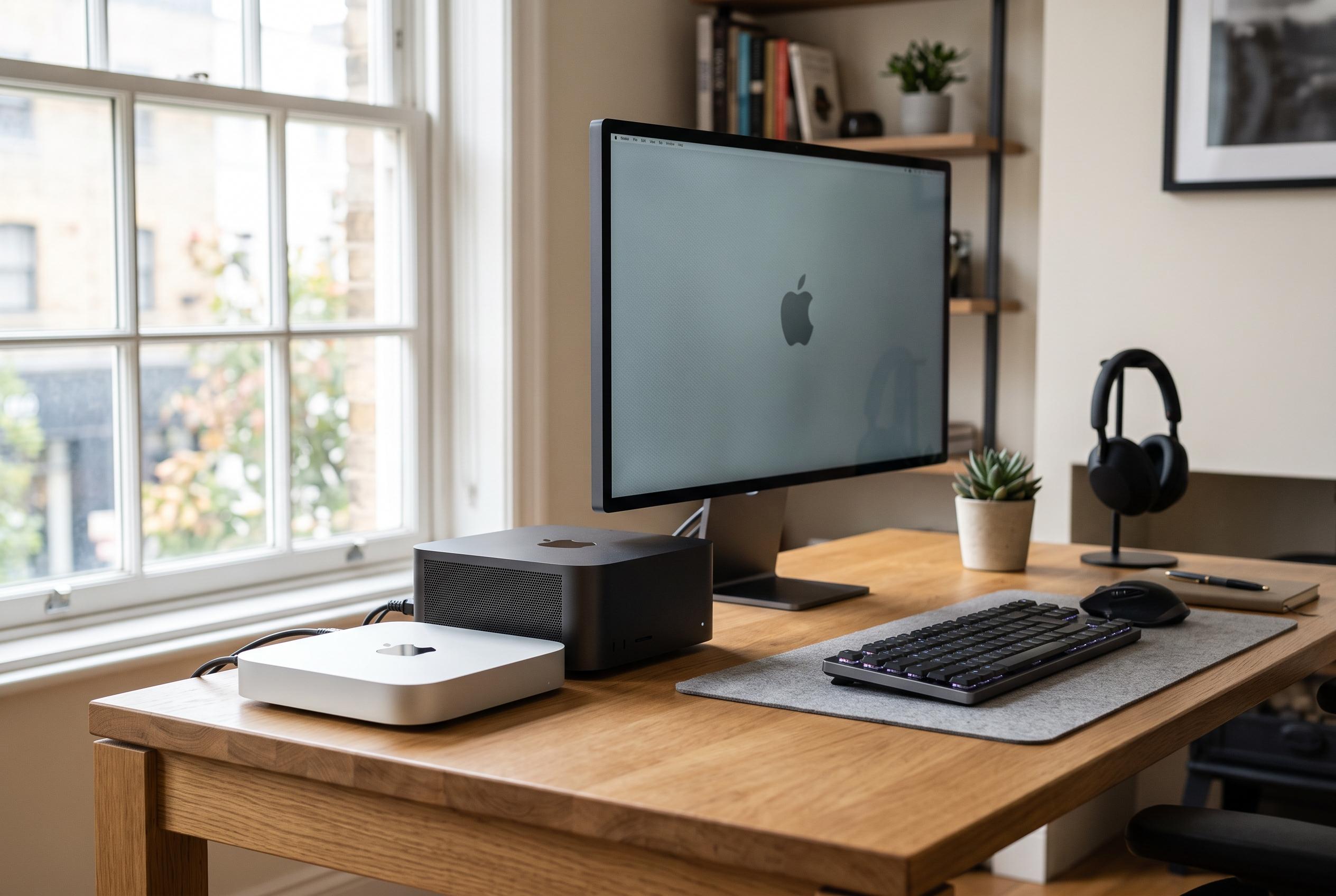

Apple’s recent desktop updates streamline buying choices amid rising AI demands, emphasizing local processing power with powerful new chips and refreshed models for professionals and everyday users.
Apple’s late-August desktop refresh has made Apple’s desktop buying advice more straightforward than its price list suggests. Ahead of first deliveries on 22 September, the range now falls into a clearer pattern: the Mac mini is the sensible choice for most buyers, while the Mac Studio only becomes the better purchase when a user’s work will genuinely exploit far more GPU throughput, memory bandwidth or local AI capacity. Apple opened pre-orders for both machines on 25 August in 30 countries and regions, including the US, after updating the line outside its usual September iPhone cycle. (apple.com)
The Mac mini is where that simplification starts. Apple’s new entry model begins at $899 in the US, or $799 for education, with an M6 chip, 16GB of unified memory and 256GB of storage. The M5 Pro version starts at $1,699, or $1,599 for education, and moves the base specification to 24GB of memory and 512GB of storage. Macworld’s buying advice broadly matches the practical reading of those specifications: it says the M6 machine is the best fit for most people, covering office work, coding, photo editing, video editing and general creative use, while the M5 Pro model is better reserved for buyers who need more CPU and GPU performance, Thunderbolt 5, higher memory bandwidth or support for up to 64GB of unified memory. Apple has also standardised upgraded connectivity on the mini, including Wi‑Fi 7, Bluetooth 6 and 2.5Gb Ethernet, with 10Gb Ethernet available as an option. (apple.com)
The technical case for the cheaper Mac mini is stronger than the word “entry-level” implies. Apple says M6 is its first 2nm Mac chip, and 9to5Mac reports that it uses a 12-core CPU made up of two super cores, four performance cores and six efficiency cores, alongside a 12-core GPU and a dual 16-core Neural Engine. Apple’s separate silicon announcement says the chip supports up to 32GB of unified memory and up to 170GB/s of memory bandwidth. That gives the mini a much stronger foundations story than a routine speed bump, even if Ars Technica argues the machines are, in broader product terms, still “just a specs bump” rather than a redesign. The important change is not the enclosure, but the shift in Apple’s desktop message towards running AI workloads locally instead of treating these Macs chiefly as general-purpose desktops. (apple.com)
The difficulty for buyers is that Apple has refreshed the line at a more expensive moment. MacRumors says the higher prices reflect heavy demand for memory and storage chips as AI data-centre spending accelerates across the industry. It notes that Apple had already raised the price of the previous M4 Pro Mac mini to $1,599 in June 2026, from $1,399 when it launched in October 2024, before adding another $100 for the new M5 Pro generation. The same report says the $899 M6 mini is $300 above the original launch price of the M4 model, even if it is only $100 above Apple’s later repricing. That is why Macworld’s secondary advice matters: buyers who do not need a new machine immediately may still be better waiting for independent benchmarks, autumn discounts or refurbished stock from the outgoing generation. (macrumors.com)
That leaves the M5 Pro Mac mini as the real hinge in the line-up. Once a buyer knows that 32GB is not enough, or expects to work with heavier developer tools, more demanding graphics tasks or larger local models, the M5 Pro mini becomes easier to justify than an upgraded M6. Its extra bandwidth, Thunderbolt 5 support and higher memory ceiling make it the point where Apple’s compact desktop starts to resemble a serious workstation rather than a capable mainstream machine. For many buyers, that also changes the upgrade logic: fast external storage is relatively easy to add later over Thunderbolt, while memory capacity is the specification most likely to define the machine’s useful life. (macworld.com)
The Mac Studio enters only when that workstation argument becomes decisive. Apple’s refreshed model starts at $2,499 with M5 Max, 36GB of unified memory and 512GB of storage, while the M5 Ultra version starts at $5,499 with 96GB of memory and 1TB of storage. Apple says both were announced on 25 August, go on sale from 22 September, and are aimed at professional workloads and on-device AI. The company has also confirmed one important caveat for top-end buyers: the Mac Studio configuration with 512GB of unified memory will not arrive until late October, and Apple had not published pricing for it when the machine was announced. Ars Technica notes that this emphasis on local inference and software development is now central to how Apple is presenting the desktop Mac range. (images.apple.com)
At the top end, the Studio’s premium rests on architecture as much as headline price. Apple says M5 Ultra uses UltraFusion to connect two dual-die M5 Max chips into a quad-die design, while 9to5Mac reports that the chip scales to a 36-core CPU, an 80-core GPU and 1.2TB/s of unified memory bandwidth. Apple’s silicon announcement adds that the GPU includes Neural Accelerators in each core, and that the chip can deliver up to 4.5 times the peak GPU compute for AI compared with M3 Ultra. Apple has also tied the machine directly to clustered local inference, saying multiple Mac Studio systems can be linked over Thunderbolt 5 and RDMA for up to three times the performance of a single system in distributed AI inference. That is the real reason to spend Mac Studio money: not because it is newer or more premium, but because some professional workloads can actually use the scale. (apple.com)
The awkward machine in this catalogue is the 24-inch iMac. Apple’s online store still lists it with M4, with a two-port model from $1,299 and a four-port version from $1,499, which leaves it looking more like the all-in-one convenience option than the value leader in Apple’s desktop range. For buyers who want a built-in 4.5K display and the simplicity of a single, colour-matched machine, that may still be enough. For everyone else, the autumn 2026 desktop decision is now much cleaner: buy the M6 Mac mini for broad everyday use, move to the M5 Pro mini when memory headroom and faster I/O matter, and only step up to Mac Studio when your software, graphics pipeline or local AI workloads will make full use of it. (apple.com)
Disclaimer: This content is intended for informational purposes only. Readers are advised to exercise their own judgement, conduct due diligence, or consult a qualified expert before acting on any information provided.