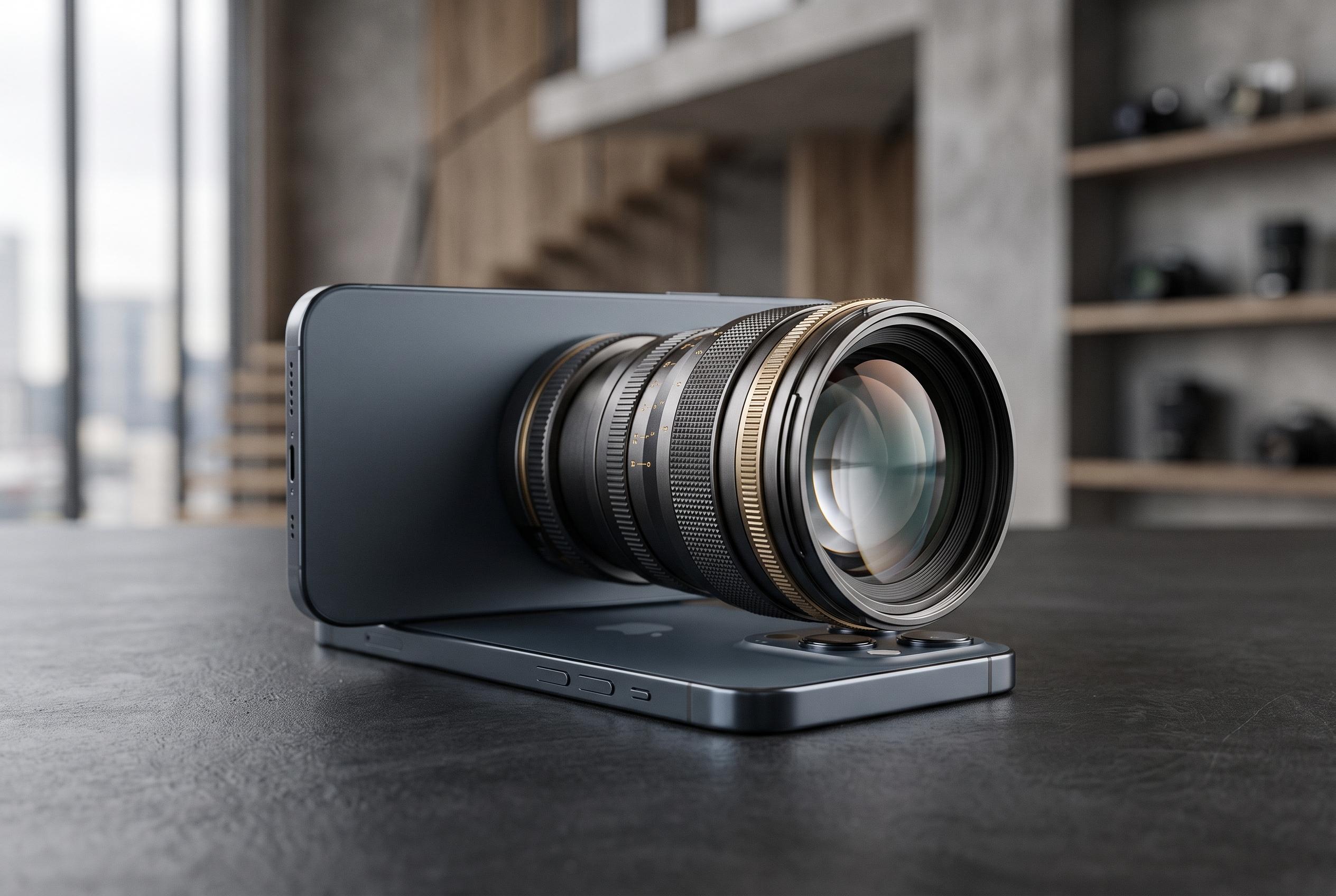

ShiftCam unveils a new range of long-range smartphone camera lenses at IFA Berlin, offering creators modular, high-zoom solutions that expand mobile photography beyond native capabilities, with pre-orders opening soon.
ShiftCam has turned its IFA Berlin appearance into a staggered launch for a new long-range smartphone camera system, with X.Series lenses already on pre-order, wider sales pencilled in for 8 September and first shipments expected in the following week. Coverage from PetaPixel, MYC Media, PixelFlow and Batista70 shows the company is presenting the release as the next layer in a broader creator ecosystem rather than a single accessory: two telephoto attachments, a companion iOS app and a rebuilt ProRig for mobile video.
At the centre are two add-on lenses that mount over a compatible phone’s periscope telephoto camera. On Apple’s iPhone 17 Pro line, PetaPixel and Nexin said the shorter model delivers about a 192mm full-frame equivalent view, while the longer version reaches roughly 350mm; Nexin added that the 3.5x optic can stretch to around 420mm on Samsung’s Galaxy S26 Ultra. The lenses are not universal clip-ons. They need ShiftCam’s S.Mount case or mount, starting at $39.99, and reported support begins with iPhone 14 Pro, Galaxy S24 Ultra, Xiaomi 13 Ultra and Pixel 8 Pro families.
The 2x SuperZoom is the more general-purpose option. MYC Media and Portofon describe it as a 200mm-class lens for sport, action and street work, while PetaPixel places it in events and urban scenes. Its construction is relatively simple by comparison with the longer optic, using five elements in four groups, weighing 140g and focusing no closer than six metres. Retail pricing has been reported at $269 or €289.99, although PetaPixel said early buyers were being offered a lower pre-order price of $256.
The 3.5x version is the more distinctive product, because it pushes a phone into territory usually associated with wildlife lenses or long architectural work. The lens uses 12 elements in six groups, weighs 190g and has an eight-metre minimum focus distance. That makes it a poor fit for casual close shooting, and PixelFlow noted that hanging nearly 200g off a handset materially changes the way it handles. PetaPixel also cautioned that the specification sheet alone cannot settle the key question of image quality; real-world testing will be needed to see how sharpness, autofocus and stabilisation hold up at these focal lengths.
ShiftCam is trying to answer those doubts with system design as much as with headline reach. Nexin reported that the optics use fluorite crystal elements, multiple groups and broadband coatings intended to suppress reflections and keep contrast high, while the phone’s own periscope module still provides alignment and stabilisation. MYC Media and Batista70 both place the new lenses inside ShiftCam’s wider Adapt ecosystem, which is built around swappable filters, macro converters and mounts. That modular approach matters because it lets buyers carry accessories across phone upgrades instead of tying the investment to one handset.
The software layer is supposed to make the hardware less fiddly. ShiftCam One, an iOS app due to be free for owners of compatible lenses, handles initial pairing and sensor calibration, then identifies the attached optic and unlocks lens-specific functions such as AutoSteady for telephoto work and real-time curvature correction for fisheye lenses. Several reports say it also adds AutoStudio, an on-device AI tool that suggests framing, lighting, crop and style changes. Benson Chiu, ShiftCam Gear’s chief executive, said: “Smartphone cameras have become incredibly powerful, but creators are still limited by the optics built into the device, and adding professional lenses can introduce a new level of complexity”.
Alongside the stills products, the company is previewing a redesigned ProRig ahead of an autumn 2026 launch. MYC Media, PixelFlow and Batista70 all describe a new open four-corner frame intended to leave the phone’s edges usable, including access to USB-C and MagSafe, while Batista70 says the rig uses recycled aluminium and interchangeable bumper inserts. A ProRig Essentials Kit is listed at €189.99, with pre-sales due to start on 8 September and shipping from 1 October.
For travellers and mobile-first creators, the significance of the announcement is not that a smartphone will suddenly replace a dedicated telephoto kit. The more realistic claim is narrower. ShiftCam is offering periscope-phone owners a way to reach beyond native zoom without defaulting immediately to digital crop, while keeping the setup smaller than a mirrorless body and long lens. The trade-offs are clear: substantial extra weight, long minimum focus distances, dependence on supported cases and, at these prices, a niche audience. Even so, the X.Series suggests the next phase of phone photography may be less about thinner handsets and more about modular optics built around them.
Disclaimer: This content is intended for informational purposes only. Readers are advised to exercise their own judgement, conduct due diligence, or consult a qualified expert before acting on any information provided.