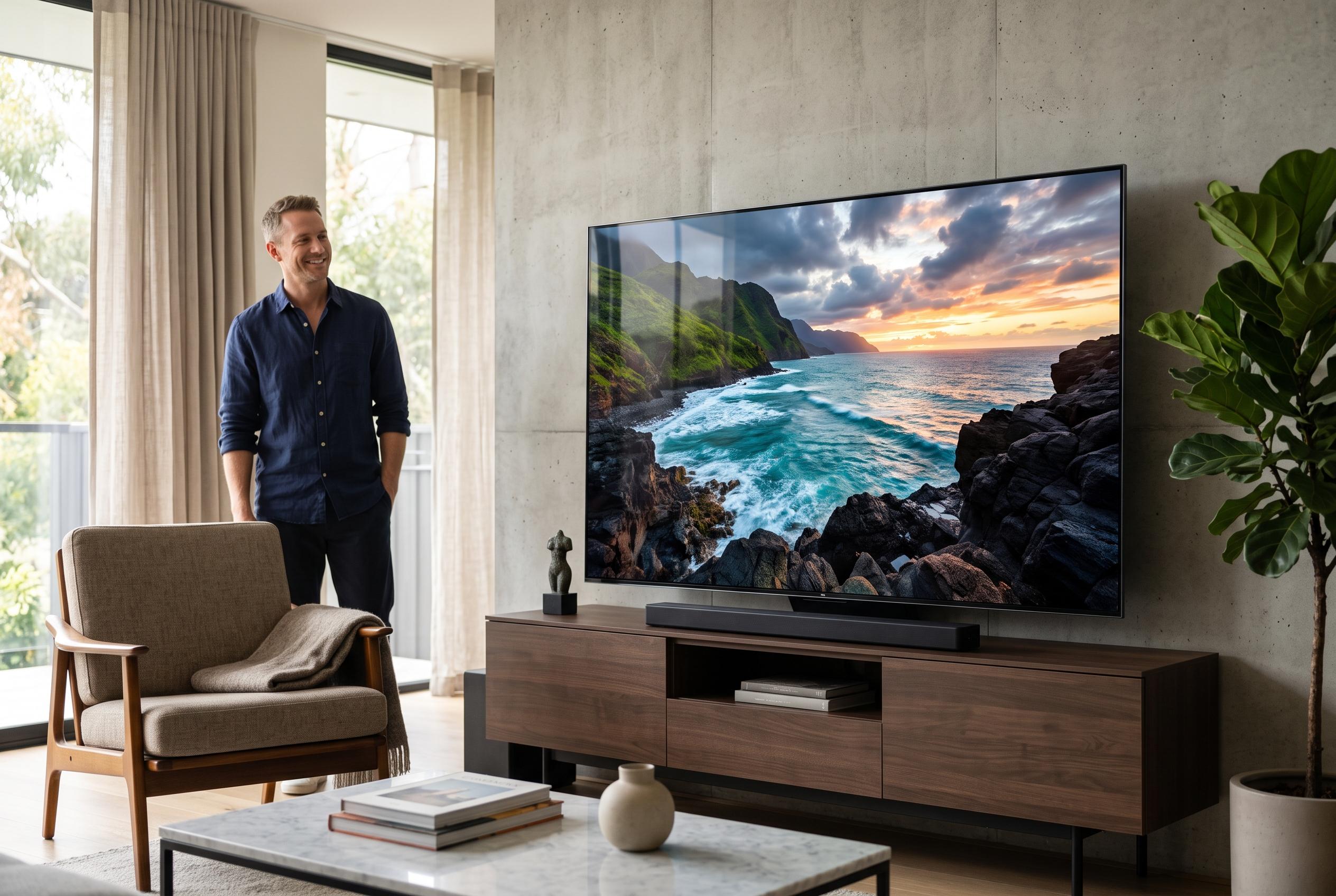

Independent tests reveal the TCL QM8L offers better overall performance and value compared to the Hisense UR9, as pricing improves and technical advantages become clearer in this key flagship contest.
Independent testing is starting to separate the Hisense UR9 from the TCL QM8L in a way that early launch hype did not. RTINGS, which compared the Hisense UR9SG and TCL QM8L under the same methodology in July, concluded that the TCL is the better set overall because it is brighter, has stronger local dimming and works more convincingly in both bright and dark rooms. The same comparison also noted the main counter-argument in Hisense’s favour: its RGB Mini-LED system can produce slightly more saturated colour in some scenes, even if that advantage is not always cleanly delivered.
That is the real contest here. Hisense is pushing a new RGB Mini-LED backlight architecture, while TCL is trying to extract more from a refined quantum-dot Mini-LED design. Tom’s Guide found that a replacement 65-inch UR9 sample materially improved Hisense’s headline numbers, measuring 4,370 nits of HDR brightness, 2,486 nits in SDR and 93.03% Rec. 2020 coverage; in the same results table, the TCL QM8L reached 3,772 nits in HDR. TechRadar, testing TCL’s set separately, measured 3,719 nits in a 10% HDR window, 760 nits full-screen in HDR and more than 2,000 local dimming zones on its sample. In other words, both technologies are genuinely delivering flagship-class light output, but they are doing so with different strengths and compromises.
Price now makes that distinction harder to ignore. As of 7 September 2026, Best Buy was listing the 65-inch Hisense UR9 at $1,699.99 and the 65-inch TCL QM8L at $1,399.99, widening the value case for TCL rather than narrowing it. Tom’s Guide had already argued that the QM8L was both cheaper and better in some respects, while Popular Mechanics framed the pair as the main battleground in the new SQD-versus-RGB contest between brands once known chiefly for aggressive pricing. In the UK, What Hi-Fi? tested the UR9 at £2,999 in May, but its current retail tracker is showing the set at £1,999 from several outlets, which underlines how quickly pricing is softening around these premium LCD models.
The Hisense still makes an immediate visual impression, especially in rooms where sheer brightness matters. Popular Mechanics said the opening round of the World Cup looked “stunning” on the UR9 in a bright living room, and that Gran Turismo 7 night races on a PS5 Pro also looked superb. WIRED’s hands-on review similarly described films, football and games as vivid, with deep blacks and strong contrast. What Hi-Fi? was even more enthusiastic about bright HDR, writing that “Pan looks spectacular here” and adding that the UR9’s skin tones remain natural rather than overcooked. That combination explains why the set has attracted attention beyond its lab figures.
Yet several reviewers also explain why the UR9 is not a straightforward winner. Tom’s Guide recorded a Delta-E colour error figure of 2.72, which is respectable, but still said the Hisense’s colour depth could look slightly “off” in practice despite all that luminance. What Hi-Fi? praised the UR9’s stable backlight control and unusually restrained blooming, but said the sweet spot remains narrow and that OLED still produces a more solid, more three-dimensional image. RTINGS adds the most technical caution: it said the TCL avoids the colour crosstalk that can occasionally appear on the Hisense, meaning the RGB approach is not yet free of side effects.
The TCL’s appeal, by contrast, looks less dramatic on paper and more persuasive over time. TechRadar’s review said the QM8L combines its very high brightness with enough dimming precision to maintain clear separation between light and dark areas, while also keeping haloing under control and preserving shadow detail. It also praised the viewing angle and said daytime sport is no problem because reflections become intrusive mainly in darker scenes. RTINGS reached much the same conclusion from the opposite direction, arguing that TCL’s better dimming system makes it the more versatile all-rounder. For households where people watch from different seats, or where the television has to cope with both sport in daylight and films at night, that may matter more than the novelty of RGB lighting.
Gaming is a closer fight, but it still does not rescue the Hisense. RTINGS lists the UR9 at a native 180Hz and the QM8L at 144Hz, so Hisense has the specification advantage at the panel level. WIRED also highlighted the UR9’s unusual side-mounted DisplayPort connection, which gives committed PC players a route beyond the usual console set-up, and noted that the television supports Wi-Fi 6E. But Tom’s Guide measured 12ms input lag on the UR9 against 9.5ms for the QM8L in the same comparison table. The result is that Hisense looks like the more unusual gaming television, while TCL still looks like the faster and safer gaming buy for most people.
There is also a broader context that tempers the excitement around both sets. What Hi-Fi? said the UR9 is among the best backlit televisions it has tested, and its Devialet-tuned sound system is stronger than most built-in TV audio, but the publication was clear that even this refined RGB Mini-LED model does not displace top OLEDs. That observation matters because the UR9 is often sold as a technological leap forward. It is one, just not a complete one. The more grounded conclusion from the accumulated evidence is that Hisense has produced the more intriguing engineering statement, while TCL has produced the more convincing product.
For buyers choosing specifically between these two 2026 models, the balance of reporting points in one direction. The Hisense UR9 is the bolder experiment and can look spectacular with bright HDR, sport and games. The TCL QM8L, however, is cheaper in the US at the time of writing, benchmarks better in direct comparison, and seems to make fewer compromises in dimming control, viewing angles and responsiveness. The new acronyms are interesting. The buying advice is not: the QM8L is the more complete recommendation, while the UR9 remains a fascinating first-generation proof that RGB Mini-LED has real promise.
Disclaimer: This content is intended for informational purposes only. Readers are advised to exercise their own judgement, conduct due diligence, or consult a qualified expert before acting on any information provided.