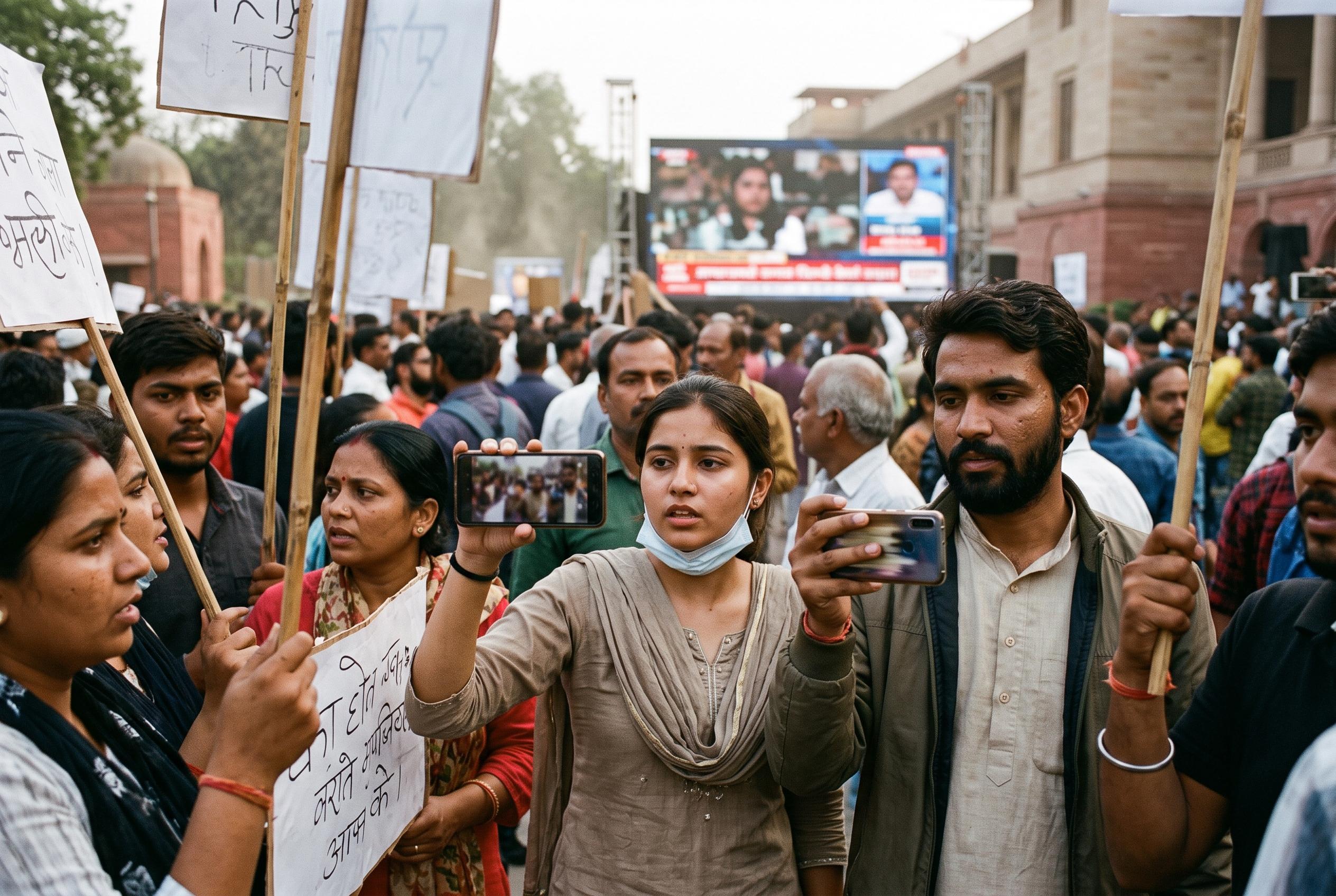

As protests at Jantar Mantar unfolded, a layered information operation involving synthetic media, recycled footage, and anonymous accounts demonstrated the speed and scale at which false narratives can influence public perception and policing strategies, prompting questions on the resilience of digital and physical security measures.
By the time Delhi Police asked Facebook, Instagram, X and YouTube on 28 July to remove deepfakes and other false posts linked to the Jantar Mantar unrest, the protest had already become a test of how quickly synthetic material can shape a real political crisis. The agitation itself had been called off on 25 July, and on 1 September the Supreme Court quashed protest-related cases across jurisdictions after government assurances, prompting organisers to withdraw a fresh march planned for 5 September. Yet the police case remained that the online campaign had outlived the street confrontation and had spread at a scale far beyond ordinary rumour. (indiatoday.in)
What emerged from the official briefings was not a single fake clip but a layered information operation. Delhi Police first said more than 400 misleading handles had been identified and blocked; a later police account carried by The Tribune put the Pakistan-linked figure at 480 and said those accounts had also been active during Operation Sindoor. Police told reporters they had already rebutted at least 18 pieces of alleged fake news, while The Times of India reported that 19 false posts on X were specifically identified and countered with clarifications. India Today added that the fabrications included a manipulated video falsely suggesting Defence Minister Rajnath Singh had threatened students with the “full force of the state”, as well as doctored clips wrongly attributed to former army chief Upendra Dwivedi and Air Chief Marshal Amar Preet Singh. The same reporting said the Indian Army’s fact-check unit and the Press Information Bureau had to publicly deny claims that troops had been deployed for law-and-order duties in Delhi. (ndtv.com)
Those falsehoods spread alongside a volatile situation on the ground. The Times of India reported that police said up to 10,000 protesters were at the site on 23 July, and that clashes broke out at about 4.30pm, 8.30pm and 9pm. Officers used loudspeakers to order demonstrators off the barricades and away from Tolstoy Road before, according to the police version, bottles and stones were thrown. ACP Jai Prakash suffered a head injury and ACP Vivek Bhagat was also hurt. Four additional FIRs were registered, taking the total to 10, and police said mobile internet jammers were activated as they used tear gas to push crowds back. In that setting, fabricated posts alleging political orders, deaths, army deployment or extreme police tactics were not peripheral; they risked changing how people read each new confrontation in real time. (timesofindia.indiatimes.com)
One of the most revealing examples was not a battlefield-style deepfake but a culture-war image tailored for disgust and mockery. India Today Fact Check examined a viral picture falsely presented as showing a woman at the Jantar Mantar protest. Its reporters found the road sign in the background carried distorted, unreadable lettering, a common sign of synthetic image generation, and said OpenAI’s Verify tool detected a signal consistent with OpenAI-made content. The creator later acknowledged that the picture was “totally AI-generated” and said it had no link to the protest or to any political campaign. The false captions nevertheless tried to recast the demonstration as moral decline rather than public dissent. (indiatoday.in)
Another viral item worked differently: it recycled genuine footage from somewhere else and relabelled it for maximum alarm. AFP Fact Check traced a nine-second video, shared on Facebook on 19 July with the claim that Nihang Sikhs had joined the Jantar Mantar mobilisation, to an unrelated Sikh march in Uttarakhand. Using reverse image search on video keyframes, AFP linked the clip to an eight-hour live video uploaded by DailyPost TV on 25 June. The accompanying text warned that “The game will begin on Jantar Mantar now”. AFP’s reporting also showed why such material travelled easily. The protest had begun over a leaked medical entrance paper and a failure in an online marking system, then widened into anger over unemployment, opportunities for young people and the Modi government’s style of rule. In that atmosphere, unrelated footage could be repurposed into apparent proof of escalation. (factcheck.afp.com)
The digital struggle was matched by a physical one over visibility and identification. The Indian Express reported that two Delhi Police surveillance vans were stationed outside Kerala House near the protest site, including the Ikshana vehicle, which ran AI-aided facial recognition across live CCTV feeds. A senior officer told the newspaper the aim was to identify known criminals by matching faces against police databases. Students interviewed by the paper said the effect was intimidating enough that many covered their faces while holding placards because they feared later profiling when applying for government jobs. In court, however, Delhi Police, represented by Solicitor General Tushar Mehta, said the filming and photography were “not for surveillance or snooping” but for public safety and order. The same report noted that an earlier RTI disclosure showed the force treated an 80% match score as positive. (indianexpress.com)
Taken together, the reporting suggests that Jantar Mantar was not simply an example of bad content moderation. It showed how protest politics can be reshaped by a mixed ecosystem of AI audio, synthetic imagery, recycled video and rapid amplification by anonymous or foreign-linked accounts, while the state’s answer relied on debunks, blocking orders and post-facto takedowns. By 28 July, according to India Today, the police IFSO unit was still sending notices to major platforms and claiming that thousands of false posts had circulated, with some social-media-based news portals helping to amplify them. That is a reactive model: necessary, but usually slower than the viral cycle it is trying to catch. (indiatoday.in)
The story has since moved from the street to the courts, but not to a clean ending. On 1 September the Supreme Court quashed the July protest FIRs after the Centre and several states said they would not pursue them, and the organisers withdrew a planned 5 September march. At the same hearing, however, the Centre said Delhi Police wanted scope for a fresh case against 2,873 people said to have serious criminal records if later investigation established involvement in violent offences. That leaves the lasting lesson of the Jantar Mantar episode intact: once protest, policing and platform systems fuse into one event, the key questions are no longer only who marched or who threw a stone, but who fabricated the evidence, who amplified it and how quickly institutions could prove what was real. (indianexpress.com)
Disclaimer: This content is intended for informational purposes only. Readers are advised to exercise their own judgement, conduct due diligence, or consult a qualified expert before acting on any information provided.