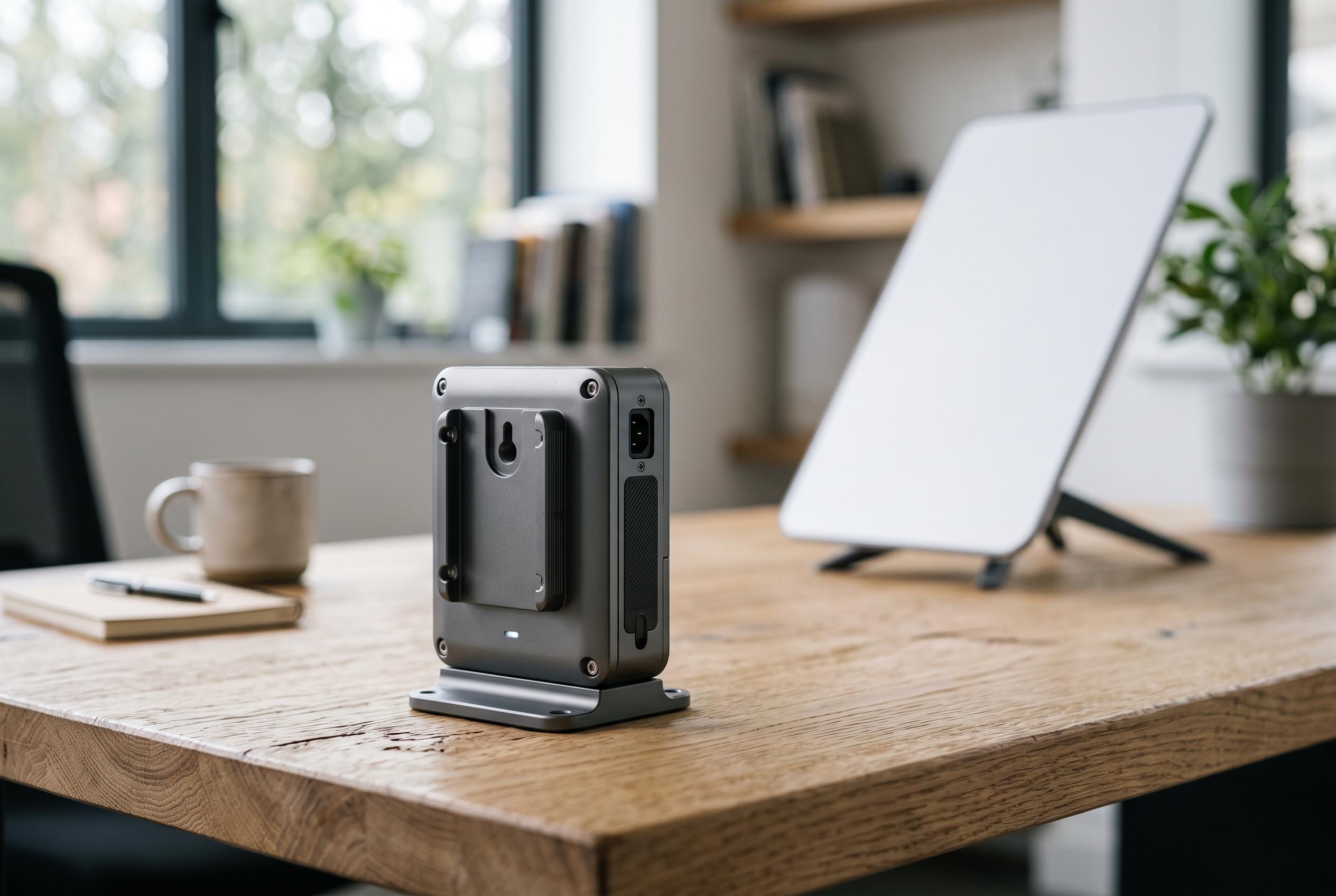

The LinkPower Pod 1 redefines portable satellite internet support with its mountable design, remote management, and compatibility features, offering users a flexible alternative to traditional power banks.
PeakDo has begun selling its LinkPower Pod 1, a field battery built around SpaceX’s Starlink Mini but designed to do more than simply sit in a bag beside the terminal. The new unit combines a 99Wh battery with a folding support stand, a camera-style mounting point and app-based monitoring, giving Starlink users a power source that also functions as part of the physical installation rather than as a separate brick.
That positioning matters because the Pod 1 is a clear design break from PeakDo’s earlier LinkPower models. Pre-release coverage in late August showed an unnamed cylindrical device replacing the company’s older, more angular battery format, with a built-in tripod and covered side ports. PeakDo’s live product page now fills in the missing details: the Pod 1 is a 251mm by 60mm cylinder weighing about 835g, with a hidden tripod inside the body and a standard 1/4in threaded mount for tripods and other accessories. That makes it closer to a piece of camera support gear than a conventional consumer power bank.
On paper, the electrical specification is aimed squarely at mobile Starlink use. PeakDo lists a 27,500mAh, 99Wh pack based on 21700 lithium cells and says it can run a Starlink Mini for more than 4.5 hours. Elsewhere on the same page, the company says the terminal typically draws about 15W to 30W, implying a practical runtime range of roughly 3.3 to 6.6 hours depending on load and conditions. DC output is rated at 15V to 21V and up to 65W. The USB-C port is bidirectional: it can power other devices at up to 65W, while charging input is shown as 65W by default and up to 100W when software-enabled.
PeakDo is also trying to distinguish the Pod 1 from generic high-capacity batteries by adding remote management features. The company says the unit supports both Bluetooth and Wi-Fi control, with Wi-Fi monitoring available once it is connected through the Starlink network. Its 1.47in LCD shows battery level, voltage, current, input and output power, while outside reports add that the screen also displays the connection state for Bluetooth, Wi-Fi and Amazon Cloud. In the product FAQ, PeakDo says the Pod 1 supports pass-through charging, can take power from a solar panel over USB-C while keeping the Starlink Mini running, and allows scheduled remote power cycling and reboot functions through a web-based application.
The modular aspect is central to the product’s appeal. PeakDo says two Pod 1 units can be stacked together to increase available capacity, and the company also presents the battery as compatible with other LinkPower products as well as both current and earlier Starlink Mini pipe adapters. Russian coverage published as the product went on sale cast that compatibility as the main story, treating the Pod 1 less as a single accessory than as another part of a growing LinkPower ecosystem for mobile satellite set-ups. PeakDo’s FAQ adds a technical detail absent from most launch write-ups: when two Pod 1 units are linked, the DC side operates as a combined higher-voltage output system, while each unit’s USB-C port continues to work independently.
That broader mounting and accessory story is where the Pod 1 moves beyond Starlink alone. PeakDo includes a storage bag, a 30cm DC cable, a 1m USB-C cable, a ball head, a silicone anti-slip ring and a 1/4 screw in the box. The ball head and threaded mount mean the battery can be attached to camera rigs or tripods, and some launch coverage highlighted that as a practical way to keep a camera powered during outdoor shooting. PeakDo also claims IP65 resistance to dust and water, an operating range from -20C to 60C, and compliance with airline carry-on limits for batteries under 100Wh.
The launch also appears to have followed a long documentation trail. A Manuals.plus index lists a Link Power Pod 1 guide dated 4 June 2026 and another dated 27 June, suggesting the product name and basic positioning were settled months before the wider news cycle picked it up. When the first outside reports surfaced on 27 and 28 August, publications were still describing the device as an upcoming model and in one case speculating that its capacity might be lower than the larger-looking LinkPower 3. The finished product did not take that route: PeakDo has kept the Pod 1 at 99Wh, matching the capacity used elsewhere in the LinkPower range while changing the form factor and mounting system.
Pricing is broadly consistent across sources, though not perfectly so. PeakDo’s own store lists the Pod 1 at $169, reduced from $199, and a two-unit bundle at $299 with a DC-to-USB-C cable included as a free gift. One outside report rounded those figures to $200 and $170, while Notebookcheck converted the launch pricing to roughly €171 at list and €145 under the early offer. Taken together, the message is clear enough: PeakDo is pitching the Pod 1 as a more compact, more mountable alternative for Starlink Mini users who care as much about deployment flexibility as raw endurance.
Disclaimer: This content is intended for informational purposes only. Readers are advised to exercise their own judgement, conduct due diligence, or consult a qualified expert before acting on any information provided.