
Huawei unveils the Mate XT 2, its advanced tri-fold smartphone, claiming significant hardware and chip improvements to dominate China’s rapidly growing premium foldable market amidst intensifying global competition from Xiaomi and Apple.
Huawei has unveiled the Mate XT 2 Ultimate Design in China, using its second-generation tri-fold handset to press its advantage in the premium foldables market just before Apple’s next iPhone launch on 9 September and amid a same-day challenge from Xiaomi’s new 18 Fold. The new model starts at CNY19,999 and rises to CNY29,999 for a 2TB privacy-screen package bundled with a stylus; the first four versions are scheduled to go on sale on 12 September, while the most expensive bundle is due on 23 September. Huawei has not announced any international release timetable. (investing.com)
The timing matters because Huawei is no longer defending a niche position at home. Reuters reported that the company held 22.6% of China’s smartphone market in the second quarter, ahead of Apple on 18.1% and Xiaomi on 12.4%, while U.S.-based Smart Analytics Global estimated Huawei accounted for 68% of foldable shipments in China over the same period. Richard Yu, Huawei’s executive director, acknowledged the economic pressure behind that push, saying: “Pricing right now is a real challenge, because memory costs have risen sharply. We adopted a lot of new technology, and the cost pressure has been enormous.” (investing.com)
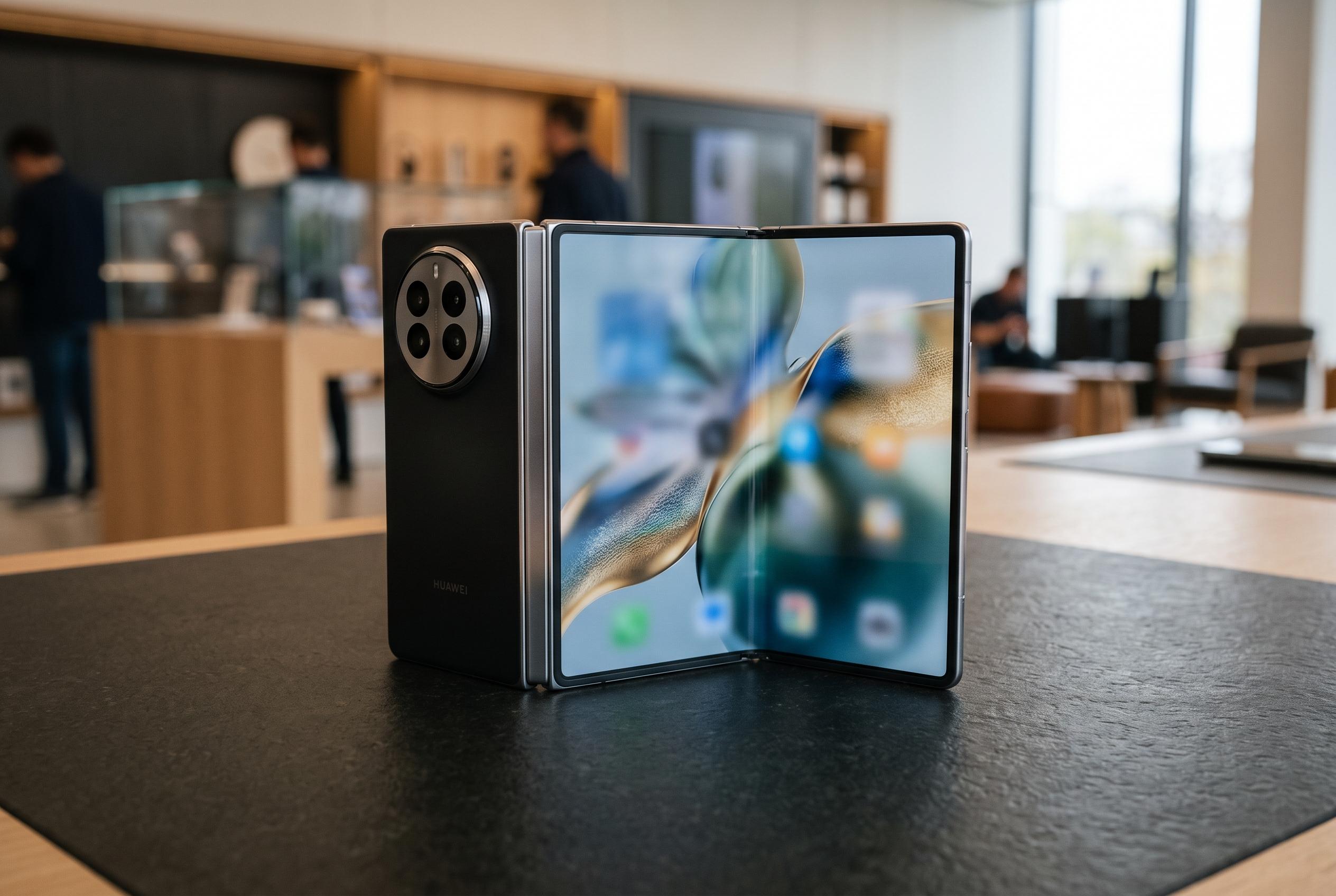
On the hardware side, the Mate XT 2 is a substantial rework rather than a routine refresh. SoyaCincau and Android Authority said Huawei has shifted to an inward-folding tri-fold structure with a separate outer screen, so the flexible main panel folds safely inside when the device is shut. Fully opened, it expands to a 10.2-inch display; partly opened, it can work like a book-style foldable; and when closed it presents a 6.5-inch cover screen. Huawei’s Chinese specifications page lists a folded thickness of 12.3mm, an unfolded profile of 4.0mm, 3.69mm and 3.5mm across different sections, and a weight of about 299g with the battery fitted. ITmedia Mobile added that the phone comes in purple, white and black, with a cloud-pattern rear panel, a 33-facet camera ring made from yttrium crystal, and Huawei’s Xuanwu Kunlun Glass on the outside display. Huawei says the chassis and hinge system have also been redesigned, and ITmedia reported the company is presenting the device as the first in its segment with both IP58 and IP59 dust and water resistance. (soyacincau.com)
Huawei is also using the handset to showcase a new chip strategy. Its official specifications confirm the Mate XT 2 runs on the Kirin 9050 Pro and HarmonyOS 7. SoyaCincau reported that Yu described it as Huawei’s “most powerful Kirin chip ever”, tied to the company’s Tau Scaling Law branding. Huawei’s public performance claims vary by comparison set: ITmedia said the company cited a 42% improvement over the previous generation, while Android Authority reported launch-slide claims of a 46% CPU gain and a 142% GPU improvement with ray tracing against the Kirin 9030 Pro. ITmedia also said Huawei is claiming on-device support for its Pangu 30B-A2B mixture-of-experts large language model, while Android Authority said the local model uses 30 billion total parameters with 2 billion active at a time. Those are Huawei’s own performance figures rather than independently verified benchmarks. (consumer.huawei.com)
The display configuration is more nuanced than the headline size suggests. Huawei’s product page says the standard outer OLED panel runs at an adaptive 1-120Hz with 1,440Hz PWM dimming and 300Hz touch sampling, while the standard inner panel is also LTPO OLED but tops out at 90Hz. The privacy-screen editions raise the main panel to 1-120Hz and add a side-view blocking mode; Huawei notes in its own documentation that the privacy effect does not work from the USB-C edge of the handset. Notebookcheck compared the feature to switchable narrow-view displays on other premium devices, and Android Authority noted that the outer selfie cut-out has moved to a shape resembling Apple’s Dynamic Island rather than a simple punch-hole. Huawei is also promoting large-screen software tools, including split-screen use, translation, navigation and AI-assisted photo editing. (consumer.huawei.com)
Imaging and communications are equally central to the sales pitch. Huawei’s specifications list a 50-megapixel main camera with a variable aperture from f/1.49 to f/4.0, a 40-megapixel ultra-wide camera and a 50-megapixel periscope telephoto module; Notebookcheck said the telephoto lens offers 3.5x optical zoom, while Huawei’s own page adds 7x optical-quality zoom and up to 100x digital zoom. There are two 8-megapixel front cameras, one for the outer screen and one for the main display. The battery is rated at 5,600mAh typical capacity, with 66W wired charging, 50W wireless charging and wireless reverse charging. Huawei’s Chinese product page also lists Wi‑Fi 7 class support under the 802.11be standard, Bluetooth 6.0, NFC, GPS, side-mounted fingerprint recognition, TianTong satellite calling, satellite paging and two-way BeiDou satellite messaging. The company says carrier support is required for some of those features, and its mainland China note for BeiDou messaging makes clear that availability is not universal. Notebookcheck added that ECG analysis is supported, using the frame as part of the sensing system. (consumer.huawei.com)
Commercially, the Mate XT 2 remains a China-first statement device. SoyaCincau pointed out that last year’s Mate XT Ultimate Design eventually reached Malaysia at RM14,999, but no equivalent global plan has yet been outlined for the new model. Reuters said Huawei is still the only major brand actively selling a tri-fold phone, even though Samsung remains the world’s largest foldable vendor overall; Samsung, according to Reuters, launched a tri-fold device in December, reportedly withdrew it after three months, and then broadened its foldable range again in July with a passport-sized model. That leaves Huawei trying to turn engineering theatre into sustained sales at the very top of the market, where price, memory costs and competitive pressure are all rising at once. (soyacincau.com)
Disclaimer: This content is intended for informational purposes only. Readers are advised to exercise their own judgement, conduct due diligence, or consult a qualified expert before acting on any information provided.