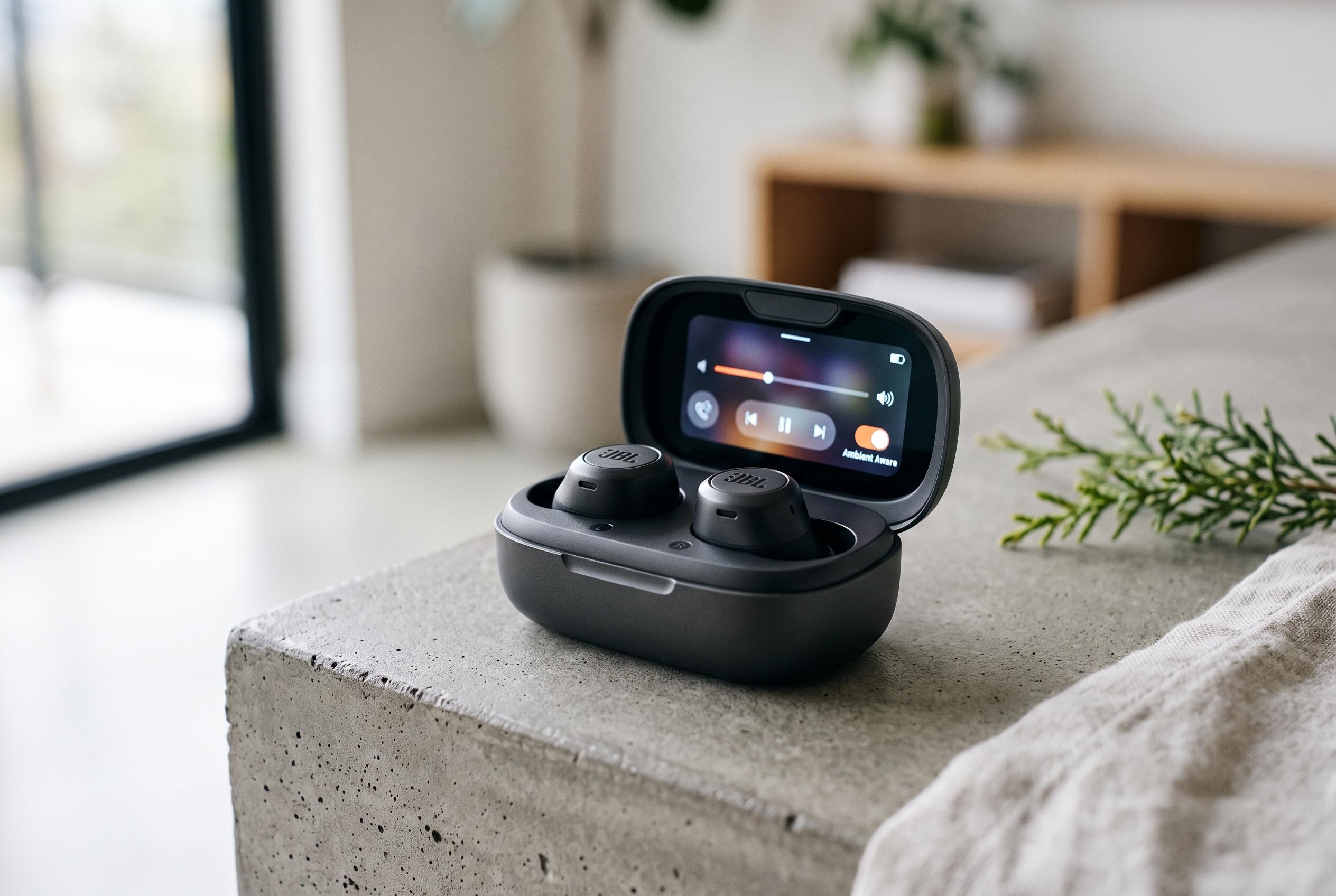

JBL’s latest Live Beam 4 earbuds introduces a revolutionary touchscreen case and comprehensive features at a competitive price, aiming to redefine in-ear audio performance and usability amidst mixed opinions on practicality.
JBL’s Live Beam 4 is best understood as a feature-led challenger rather than a simple sound upgrade. In New Zealand it arrives at about NZ$289, well below some rival flagship earbuds, but with a specification sheet that reaches further than the price suggests. The central idea is unusual: the case is not just for charging and storage, but a secondary control surface intended to reduce how often the listener has to reach for a phone.
That idea has been developing for some time. Tom’s Guide reported when JBL first expanded the touchscreen case concept beyond the Tour Pro 2 at CES 2024, presenting it as a broader design direction for the Live range rather than a one-off experiment. By May 2026, the company had turned that concept into a full three-model family: Buds, Beam and Flex. The Beam 4 is the stemmed in-ear version with silicone tips, while the broader line matters because JBL is offering near-identical premium features across different fits. Tom’s Guide argued that buyers of Apple, Sony, Bose and Samsung products often have to accept compromises if they dislike a particular earbud shape; JBL is trying to remove that trade-off.
The case remains the product’s clearest point of difference. What Hi-Fi? says the Live 4 generation improves the earlier smart case with a larger screen, a revised interface and swipe controls for notifications, track changes and EQ adjustments, alongside home-screen shortcuts and background customisation. Tom’s Guide said users could control almost all major functions without opening the JBL Headphones app. Yet the practical value is not unanimous. FutureFive’s own hands-on review found the case bulkier than ideal for a pocket and said a phone still felt easier for everyday music control. That stands against the view from Les Numériques and CHIP.cz, both of which concluded that the display case does materially change day-to-day use rather than serving as a gimmick.
On sound, the balance of opinion is favourable, but more nuanced than a simple “big bass” verdict. FutureFive praised the earbuds for strong low-end weight and clear mids and treble. TouchReviews, comparing the model with the previous Live Beam 3, said the new tuning brings “less aggressive bass and more pronounced treble”, making the presentation clearer and more broadly appealing without abandoning JBL’s character. Les Numériques also found the 10mm driver capable and reasonably detailed, but said the default bass emphasis could become overbearing until the Studio EQ preset reins it in. Taken together, the picture is of a lively, consumer-friendly sound with more polish than the older model, but not necessarily the last word in neutrality.
Noise cancellation appears to be another area where JBL has moved forward, even if it is not setting a new class benchmark. Tom’s Guide lists True Adaptive Noise Cancelling 2.0 across the Live 4 family, together with a six-microphone call system and AI-assisted voice processing. TouchReviews judged the ANC highly effective at lower frequencies and said the adaptive behaviour worked smoothly as surrounding noise changed. Les Numériques was broadly positive too, describing the active suppression as strong on bass and midrange noise and better than earlier JBL efforts higher up the frequency range. Its reservation was different: passive isolation was weaker than expected for an in-ear design, meaning sharper sounds and vocal overtones could still intrude.
Battery claims are strong, and other reviews broadly support them. Tom’s Guide puts the Live Beam 4 at up to 40 hours total with noise cancellation on and 48 hours with it off, while CHIP.cz and Les Numériques say the earbuds themselves manage up to 12 hours without ANC and about 8 to 10 hours in more realistic ANC use, depending on volume. All three sources agree on the rapid-charge figure of about four hours of listening from 10 minutes in the case. CHIP.cz adds further practical detail: Qi wireless charging is supported, a full recharge takes roughly two hours, the earbuds carry IP55 protection against dust and splashes, and the case measures 61 x 51 x 31 mm and weighs 73g. Les Numériques also notes support for Bluetooth LE Audio and Auracast through the JBL Headphones app, which gives the Beam 4 more technical depth than the New Zealand review alone suggests.
Fit is where the reporting diverges most sharply. FutureFive’s reviewer, who said smaller ears are often a problem with in-ear products, found the Live Beam 4 insecure enough to come loose while walking. CHIP.cz reached almost the opposite conclusion, saying the stem-and-tip design stayed secure even during running and more dynamic movement, though it still stopped short of recommending the model as a specialist sports option. What Hi-Fi?’s description of the Beam format helps explain the split: this is a conventional stemmed in-ear layout, not an ear-hook or stabiliser design. That means success will depend heavily on individual anatomy and tip choice. For a product at this price, that makes an in-person fit test advisable.
The overall result is a capable upper-mid-range set of earbuds whose identity is shaped as much by software and ergonomics as by acoustics. The Live Beam 4 offers a broad modern feature set, a refined version of JBL’s bass-forward house sound, useful battery endurance and a genuinely distinctive case. It is also part of a more coherent strategy than many rivals, because the same premium platform is available in multiple shapes. But the New Zealand review is right to flag two practical risks: if the case feels too bulky to carry, or if the in-ear fit does not suit your ears, much of the product’s advantage disappears. For listeners who want a stem-style in-ear model with strong features and a lower asking price than some of the biggest names, however, JBL has made a serious contender.
Disclaimer: This content is intended for informational purposes only. Readers are advised to exercise their own judgement, conduct due diligence, or consult a qualified expert before acting on any information provided.