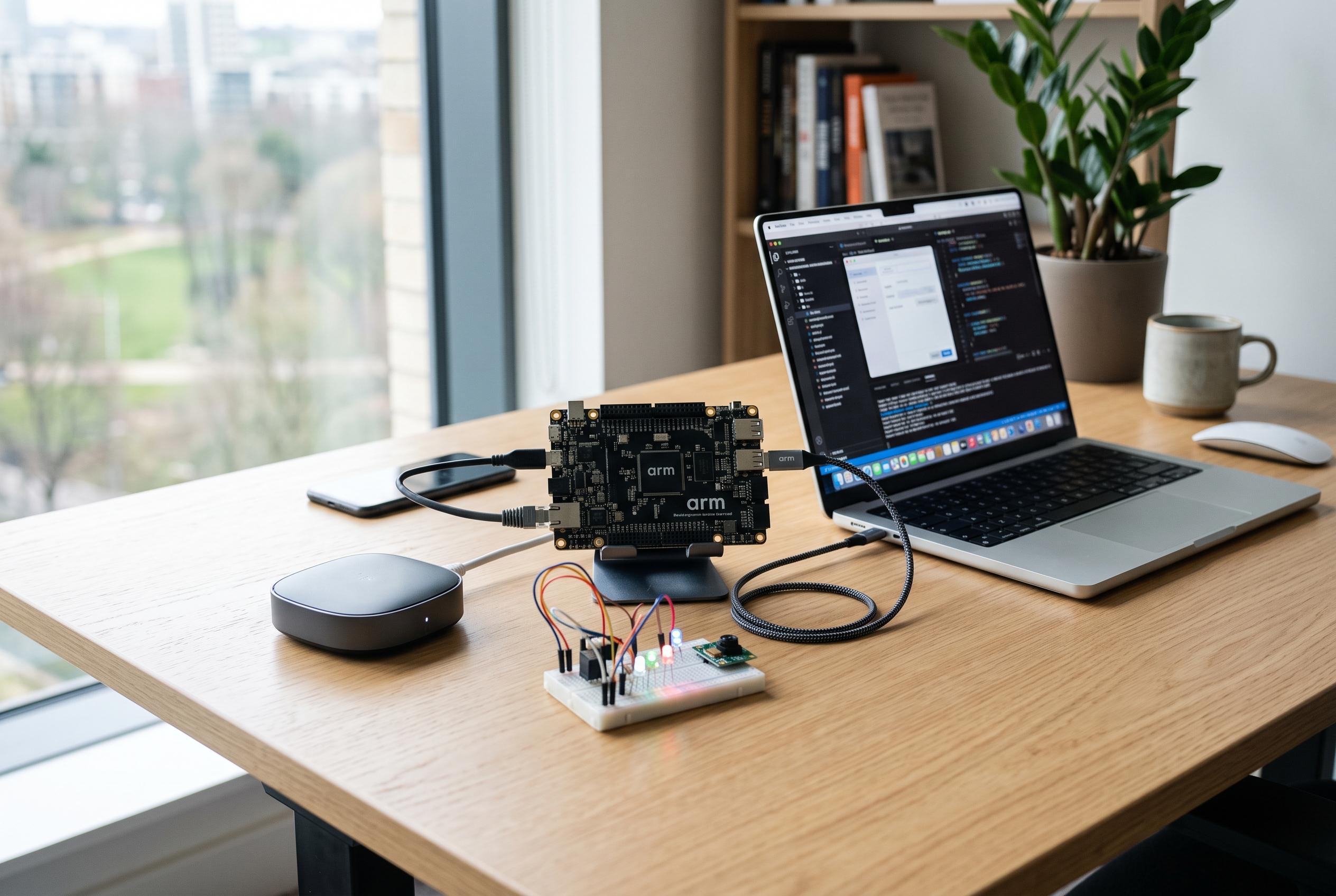

Arm has launched its AI Portal, a unified platform to streamline model evaluation and deployment across cloud, edge, and physical AI devices, signalling a disruptive shift in how developers and agents access and optimise AI models on Arm hardware.
Arm has launched AI Portal on Tuesday, 8 September 2026, presenting it as a shared discovery layer for both human developers and coding agents working across Arm-based cloud systems, edge devices and physical AI. The release followed a press briefing reported by GamesBeat ahead of the company’s Arm Everywhere China event, where Arm executive Sharbani Roy described the service as a “single-entry point” for finding and using optimised models, code and tools. Arm’s own community site also carried a same-day developer explainer by Joe Alderson, indicating that the company is treating the portal as a broader workflow shift rather than a simple product listing. (newsroom.arm.com)
The product itself is intended to shorten the evaluation stage of AI deployment on Arm hardware. At launch, Arm says developers can browse pre-optimised models from partners including Alibaba, Google and Ultralytics, inspect performance and accuracy data, compare latency, memory use and model size, and pull in code examples and deployment workflows. Arm says support for uploading proprietary or custom models for analysis and optimisation is coming later, while agent-ready resources are in early access ahead of a wider release. The portal also ties into existing ecosystems rather than a closed Arm-only stack: Arm says its optimised models are available through Hugging Face, whose documentation shows that MCP-based agents can search models, datasets, Spaces and tools from a range of compatible clients. (newsroom.arm.com)
The timing matters because Arm is tying AI Portal to a wider argument about how agentic AI changes the compute map. GamesBeat reported that the portal was unveiled alongside updates across Arm’s Cloud AI, Edge AI and Physical AI businesses, all framed around a continuum in which intelligence is created in the cloud, becomes personal at the edge and then takes action in the physical world. A separate Arm news article published on 8 September made the same case, describing AI Portal as the mechanism that lets developers and agents discover software across those different targets. In other words, the portal is being positioned as connective tissue between Arm’s hardware ambitions and the software choices developers must make for each class of device. (gamesbeat.com)
Arm’s headline performance claim for language and speech work centres on Qwen3-TTS, which it says ran more than four times faster on a vivo X300 smartphone. The device context matters. Arm’s vivo case study says the X300 series was developed through a vivo-Arm joint lab, is the first flagship line built on the Arm Lumex platform, and uses MediaTek’s Dimensity 9500 chipset with SME2 acceleration on the CPU. Arm says SME2 on the handset improves AI work across vision, speech and language, including up to 20% faster translation and 30% faster gallery search. Eric Xia, vivo’s Chief Chipset Planning Expert, called the result a “full-stack breakthrough”, linking the benchmark to a commercial device rather than a laboratory board. (newsroom.arm.com)
The computer-vision example is similarly revealing. Arm says Ultralytics YOLO26n gained more than 40% on the vivo X300 and Raspberry Pi 5 under the configurations it tested, but the model itself is already designed for lightweight, real-time use. Ultralytics documents YOLO26 as a broader family covering detection, segmentation, semantic segmentation, monocular depth estimation, classification, pose estimation and oriented object detection. For the nano model highlighted by Arm, Ultralytics lists 40.9 mAP at 640-pixel input, 38.9 milliseconds CPU ONNX speed, 2.4 million parameters and 5.5 billion FLOPs. That helps explain why Arm chose it as a showcase for edge deployment: it is a small vision model where memory footprint and CPU efficiency are central, not incidental. (newsroom.arm.com)
The agent workflow claim also has some concrete product backing. Hugging Face says its own Agents framework uses Model Context Protocol, or MCP, to let assistants search models, datasets, Spaces and community tools, and that compatible clients include ChatGPT, Claude Desktop, Cursor and VS Code. Arm’s separate MCP Server product pushes the same model further into development tooling. According to Arm’s developer documentation, it runs locally in a container to keep data private, supports migration from x86 to Arm-based cloud systems, and is designed for cloud-to-edge work on devices such as Raspberry Pi. Arm says it integrates with assistants including GitHub Copilot, Amazon Kiro, Claude Code, Codex and Gemini. Daniel Schleicher of AWS said setup inside Kiro took “less than five minutes”. (huggingface.co)
That leaves AI Portal looking less like a conventional launch page and more like an attempt to organise Arm’s software estate for an era in which both people and agents need machine-readable guidance. Arm is starting with a limited set of named model and ecosystem partners, while keeping some of the more ambitious features, such as bring-your-own-model analysis, for later. The same-day community post by Alderson framed the service around pre-optimised models, performance insight and agent-ready workflows, reinforcing the idea that this is part of a developer-enablement campaign, not a standalone announcement. The practical test will be whether Arm can widen the catalogue, keep benchmark data credible across more devices, and make those agent integrations useful enough that developers treat the portal as infrastructure rather than marketing. (newsroom.arm.com)
Disclaimer: This content is intended for informational purposes only. Readers are advised to exercise their own judgement, conduct due diligence, or consult a qualified expert before acting on any information provided.