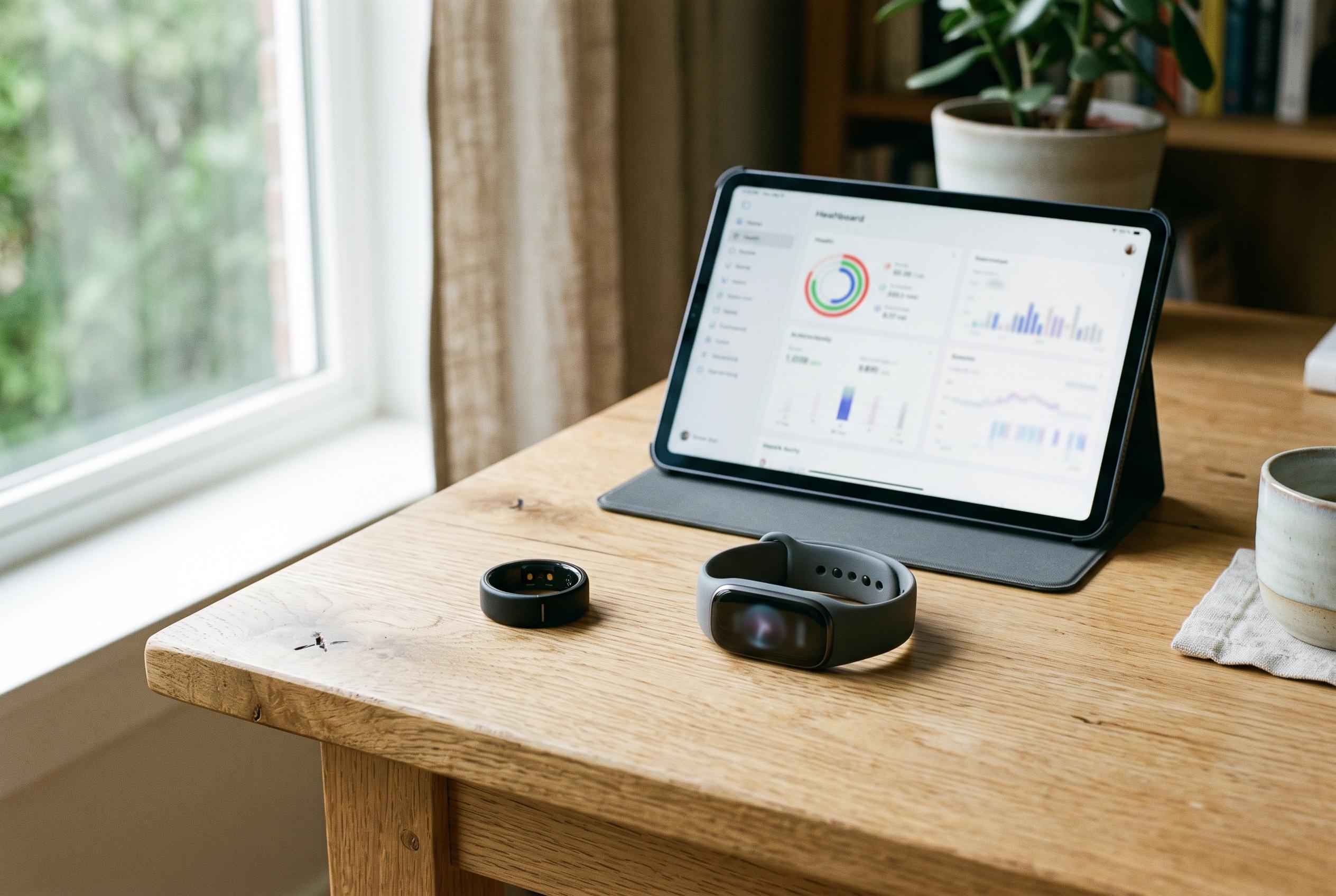

Oura and Whoop are transforming from device manufacturers into health service providers by integrating medical support, diagnostics, and coaching into their wearable platforms, signalling a disruptive shift in the wellness industry.
By the end of summer 2026, the most important change in the Oura-Whoop contest was no longer the shape of the sensor. It was the attempt by both companies to turn a wellness subscription into a health service. Oura began rolling out its Counsel integration in Oura Labs on 16 June for eligible members in 43 US states, while Whoop said medical-record syncing through HealthEx went live on 17 June and, by 18 August, had published details of a separate Connected Care programme tied to the US CMS ACCESS model. The commercial direction is clear: both want to sit between a consumer wearable and a clinician, using the device as the intake layer. (ouraring.com)
Oura’s newest hardware is real progress, but it is not the whole story. The Ring 5 was announced on 28 May, opened for pre-orders immediately and began shipping on 4 June. It measures 6.09mm across and 2.28mm thick, which Oura says is about 40% smaller than the Ring 4. WIRED’s testing found the ring noticeably easier to forget about in daily wear and during sleep, but also noted a catch: Oura has narrowed the size range to 6 through 13, down from 4 through 15 on the previous model, and existing owners may need a fresh sizing kit because the fit can feel tighter. Battery life in that review ran at roughly six to nine days, and the optional charging case costs $99. (techcrunch.com)
The bigger Oura story sits in software. Alongside the ring, the company launched Blood Pressure Signals, live activity tracking and a wider health-records push that lets US members import diagnosed conditions, medications, lab results and allergies. TechCrunch reported that members can also log cuff readings in the app, which matters because Blood Pressure Signals is not a direct blood-pressure measurement; it is a pattern-detection tool based on overnight biometrics. Feature availability is also uneven. TechRadar reported that Lab Uploads were scheduled to launch globally on 30 June, and that not every new feature would arrive in every region or on every supported generation at the same time. WIRED’s hands-on review suggested the app changes are more consequential than the sensor changes, with data quality looking broadly similar to the Ring 4 despite the smaller casing. (techcrunch.com)
Whoop’s 2026 update points in the same direction, even if it starts from a band rather than a ring. Wareable reported on 8 May that Whoop was adding live, on-demand video consultations with licensed clinicians, new AI features called My Memory and Proactive Check-Ins, and voice or text journalling inside the app. The same report noted a new Navigator Band accessory priced at $79, a reminder that Whoop still treats the wearable as a modular sensor rather than a piece of jewellery. On current US pricing, Whoop’s own support pages list One at $199 a year, Peak at $239 and Life at $359, with the higher tiers bundling newer hardware and the medical-grade MG variant reserved for Life. (wareable.com)
What has changed since those May announcements is that the healthcare layer has become more concrete. Android Authority pointed out at launch that Whoop had not said whether clinician access would be included in membership or sold separately. Whoop’s own spring roadmap later answered that point more directly, describing the consultation service as “a new paid add-on service”. Becker’s Hospital Review, covering the same product shift, said the aim was to move from performance tracking towards “clinical-grade health support”, with diagnoses, medications and procedures available through HealthEx integration. By late August, Whoop had gone further, publishing a Connected Care programme for eligible users that includes a 12-month Peak membership, a Whoop device and a blood-pressure monitor at no out-of-pocket cost under the CMS ACCESS model. That does not mean routine clinician access is now free for all members; it means the company is building several medical pathways at once. (androidauthority.com)
The economics still split along familiar lines. Oura remains a hardware purchase with a lower recurring fee: $399 for the standard Ring 5 finishes, $499 for premium finishes, and $5.99 a month or $69.99 a year for membership. Oura’s own support material says non-paying users keep only basic Sleep, Readiness and Activity scores. Whoop reverses the model by wrapping the hardware into annual membership. In straight first-year terms, that keeps Whoop cheaper than Oura’s ring-plus-subscription entry price, but only while the user is content to remain inside a subscription. Oura becomes less expensive over a longer ownership cycle, provided the buyer does not need a replacement ring or decide to upgrade again. (techcrunch.com)
In practical use, the two products still reward different kinds of behaviour. Oura’s smaller ring is the better fit for people who want passive overnight wear and minimal friction; WIRED said it was comfortable enough to disappear for long stretches. Oura has also tried to patch one of the format’s weaknesses by adding Live Activity and third-party heart-rate monitor pairing for exercise. Even so, its training experience is still largely about reviewing data on the phone after or during a session. Whoop remains more interventionist. The app’s coaching, check-ins and journalling are designed to push habits and training decisions in real time, and its band-based form factor avoids the fit and grip compromises that come with wearing a ring through heavy gym work. (wired.com)
The medical claims also need careful separation from the marketing language. Oura’s own disclosures say visits and treatment through Counsel involve extra physician costs, and that Oura Ring and Advisor are “not intended to diagnose, treat, cure, monitor, or prevent medical conditions or illnesses”. Whoop draws a similar line in a different place. Its record-syncing and AI coaching add context, but the company states that Whoop itself does not practise medicine, and its clinician-facing services now sit under the distinct Whoop Physician Services structure. In both cases, the paid value is increasingly the route from an unusual pattern to some form of professional follow-up, not a wearable that replaces established diagnostic tools. (ouraring.com)
That leaves the comparison sharper than it first appears. Oura Ring 5 is the more refined object and, for sleep-led users, probably the easier one to live with. Whoop is still the stronger system for people who want training load, habit tracking and coaching to shape what they do next. But the more consequential 2026 development is that both companies are trying to own the layer above the sensor. The hardware has become the admission ticket. The subscription is now being sold as interpretation, records, escalation and access. (techcrunch.com)
Disclaimer: This content is intended for informational purposes only. Readers are advised to exercise their own judgement, conduct due diligence, or consult a qualified expert before acting on any information provided.