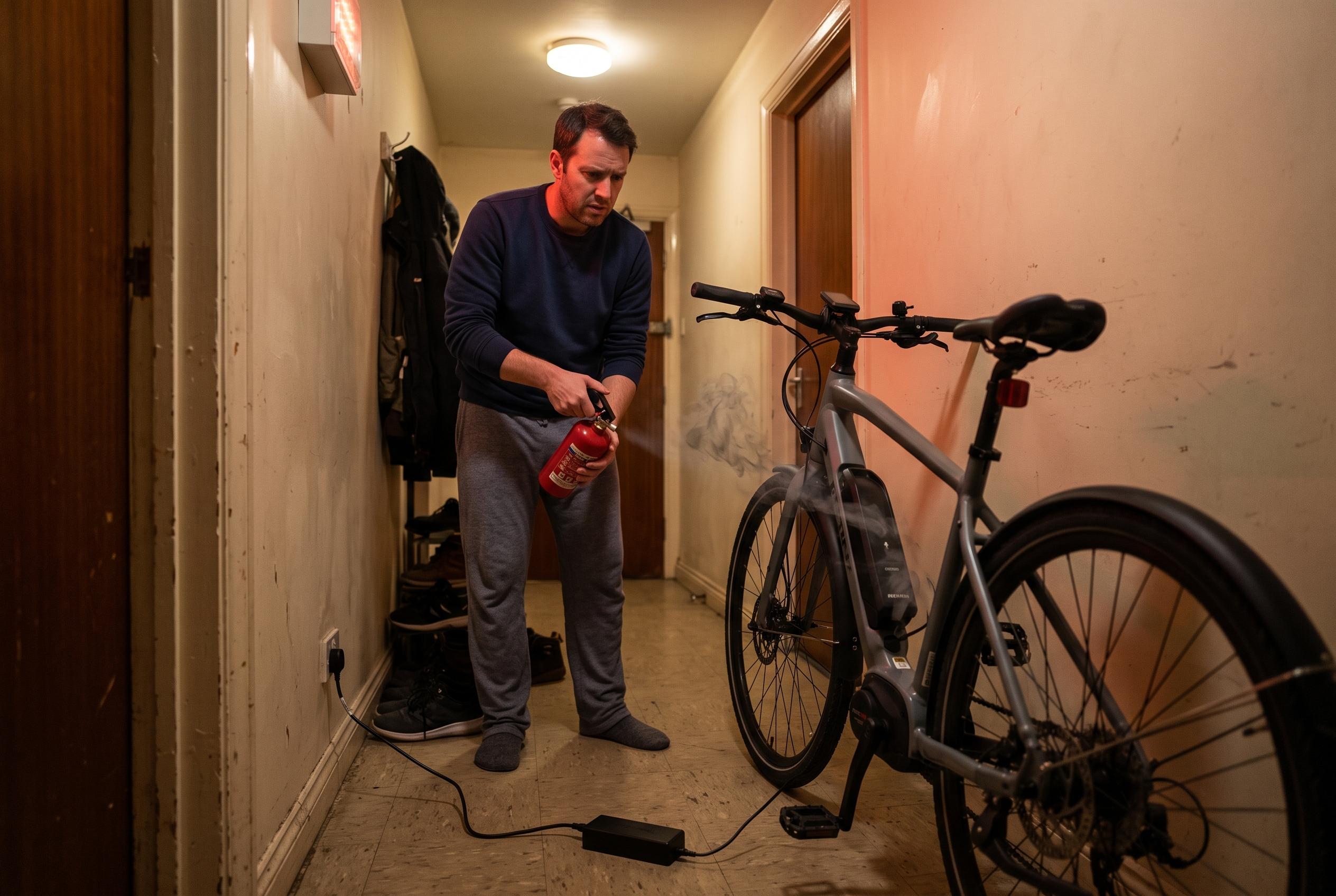

New safety guidelines emphasise careful charging routines, genuine parts, and vigilant monitoring as e-bike fires surge, prompting authorities to reinforce risk awareness among owners and manufacturers.
Himiway’s updated charging guide sets out a careful routine for e-bike owners: switch the bike off, let the battery cool, connect the charger to the battery before the mains socket, and unplug in the reverse order when charging is complete. That matters for battery care, but official fire authorities put the issue in a wider and more urgent context. London Fire Brigade says there is a lithium-ion battery fire involving an e-bike or e-scooter in London on average every two days, and that many of those fires start in homes while batteries are charging. (himiwaybike.com)
The strongest point of agreement across the guidance is that charging should be treated as a home fire-safety task, not just a maintenance habit. London Fire Brigade says most e-bike and e-scooter fires happen while the battery is on charge, and advises charging only on hard, flat surfaces, away from main through-routes and exits, with a smoke alarm in the area. UK government guidance goes further by warning riders not to charge where a fire could trap them inside, not to store or charge batteries in communal areas of multi-occupied buildings, and to charge only while awake and alert, never while asleep or away from home. (london-fire.gov.uk)
The second major rule is to use the right charger and to be suspicious of cheap replacements. Himiway says riders should stick to the original charger and match voltage exactly if they buy another unit, giving typical pairings such as a 36V battery with a 42.0V charger, a 48V pack with a 54.6V charger, and a 52V pack with a 58.8V charger. Official advice reinforces the same principle from a safety angle: London Fire Brigade says an incompatible charger can overload a battery, while Electrical Safety First says replacements should come from the manufacturer or an approved source, not from market stalls, social media or third-party marketplace sellers. Its own investigation found several chargers sold online lacked a fuse, meaning they might not cut out if the supply lead developed a fault. (himiwaybike.com)
For everyday battery life, Himiway’s guidance separates routine charging from occasional full top-ups. It recommends keeping a lithium-ion pack broadly in the 20% to 80% range for daily use, charging to 100% mainly before longer rides, and storing the battery indoors at about half charge if the bike will be unused for weeks. The company also advises leaving a pack for 20 to 30 minutes after a ride before plugging it in, and not charging a battery that is below freezing. Fire-safety guidance from London Fire Brigade and the government supports the temperature warnings, adding that damaged batteries should not be charged at all and that chargers or battery packs should never be covered because trapped heat can raise the risk of failure. (himiwaybike.com)
Official guidance is especially detailed on the signs that a battery may already be failing. GOV.UK says riders should watch for excessive heat, bulging, lumps, leaks, hissing or cracking noises, unusual smells, poor charging performance and smoke. London Fire Brigade warns that when lithium-ion batteries fail they can ignite quickly, produce intense fires that spread rapidly and give off toxic smoke. If a device starts smoking or catches fire, the government’s advice is blunt: raise the alarm, get out, stay out and call 999. (gov.uk)
Recent enforcement action shows why those warnings are not theoretical. On 15 April 2024, the U.S. Consumer Product Safety Commission issued an urgent public warning over Unit Pack Power U004 and U004-1 e-bike batteries, black triangular packs sold online from 2018 through April 2024 for between $280 and $730. The agency said 13 people in the United States had reported the batteries overheating, including seven reports of fire and substantial property damage, and noted reports of multiple fires in the United Kingdom. CPSC told consumers to stop using the batteries, to remain present while charging micromobility products, and not to charge them while sleeping. The broader explanation, as NYU professor Nikhil Gupta put it in comments reproduced by NYU Tandon from The New York Times, is that “The problem is that we’re trying to squeeze too much energy out of these batteries, and that makes them more dangerous.” UK government guidance also warns that modifying an e-cycle’s motor or battery increases the likelihood of fire. (cpsc.gov)
Taken together, the guidance points to a stricter standard than many riders follow in practice. Safe charging means not only watching charge level and battery temperature, but also keeping escape routes clear, buying genuine parts from reputable sellers, registering products so recalls and safety alerts are not missed, and disposing of defective or recalled batteries through the correct hazardous-battery channels rather than ordinary bins or retail recycling boxes. The routine Himiway describes is useful, but the larger lesson from fire services, safety bodies and regulators is that e-bike charging should be planned around containment, supervision and product traceability as much as convenience. (london-fire.gov.uk)
Disclaimer: This content is intended for informational purposes only. Readers are advised to exercise their own judgement, conduct due diligence, or consult a qualified expert before acting on any information provided.