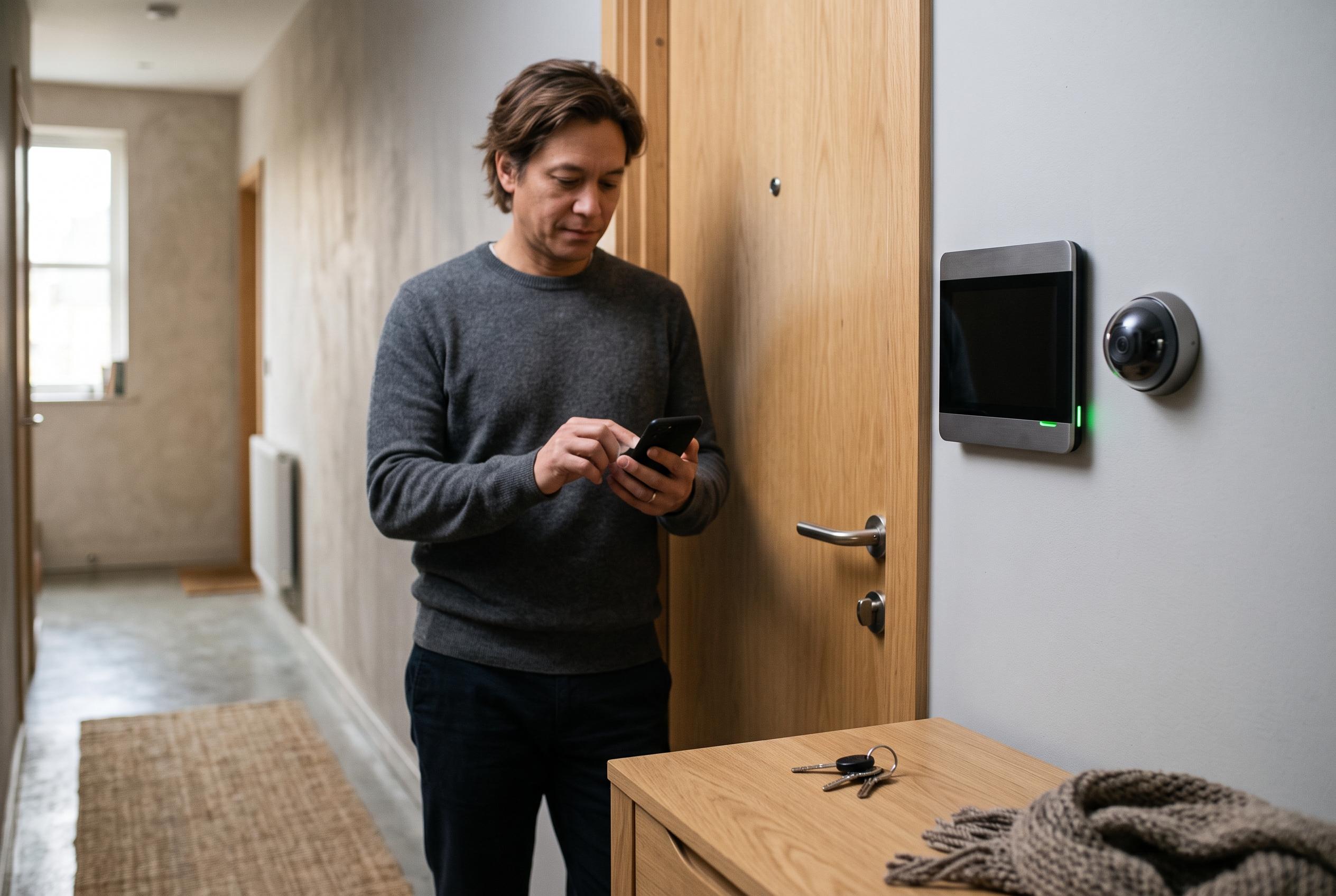

Reolink unveiled its latest home security products at IFA Berlin, emphasising local AI processing, custom scenario detection, and advanced camera features designed to enhance property protection without relying on cloud services.
Reolink used IFA Berlin to shift the centre of its home-security pitch from camera hardware to local AI, saying a new Home Hub 2 will let owners search recordings with natural-language queries and that its ReoNeura software will move towards site-specific alerts trained by the user rather than generic motion categories. Forbes (forbes.com) reported that the system is meant to run on-device instead of in the cloud, while Reolink said in its own IFA announcement (reolink.com) that the most ambitious part of that plan, Custom AI Detection, is not due until a firmware update expected no earlier than December 2026.
That timing matters because Reolink is not just adding another person-or-vehicle classifier. According to Forbes (forbes.com), the company wants users to define scenarios such as a garage door being open or “a car not being on the driveway overnight”. Reolink’s official description goes in the same direction, giving “Side Gate Open” as an example of an event the system could be trained to recognise. The company said (reolink.com) that Home Hub 2 will store and manage footage from up to eight cameras, support as much as 16TB of external storage and offer local AI video search without a subscription.
The clearest hardware expression of that strategy is the new OMVI 2i Ultra, but the more interesting point is not simply that it has two lenses. TechRadar (techradar.com) highlighted that the optics are decoupled rather than mechanically linked: a fixed 130-degree wide-angle 4K camera remains pointed at the full scene while a separate telephoto-style pan-and-tilt unit moves independently. Notebookcheck (notebookcheck.net) and Reolink’s own release (reolink.com) said that lower 5MP camera can pan 355 degrees and tilt 50 degrees, following a detected person, vehicle or animal even after it has left the wide lens’s frame. TechRadar added that users can redirect the moving camera by tapping a point in the live view, or use the two lenses to watch separate areas such as a driveway and a side gate at the same time.
Reolink is also making a strong battery-life claim, though it remains a vendor estimate rather than an independently verified figure. Forbes (forbes.com) and Notebookcheck (notebookcheck.net) said the OMVI 2i Ultra uses a removable 10,000mAh battery and an included 6W solar panel. In the company’s own material, Reolink said (reolink.com) SolarEase improves charging efficiency by 26% and can keep the camera running with 30 minutes of sunlight a day, while the quoted six-month endurance is based on five minutes of recording daily plus all-day standby. That is a substantial caveat for buyers comparing real-world performance with brochure figures.
The pricing picture is clearer for some regions than others. Reolink said (reolink.com) the OMVI 2i Ultra is due in late October at $200 to $250, while T3 (t3.com) put expected UK pricing at roughly £170 to £220 and said launch was expected in the coming weeks. The same T3 report and Reolink’s announcement also place the OMVI X16 PoE higher in the range as the flagship OMVI model, with 24MP resolution and 16x optical zoom, although no price has yet been announced. T3 (t3.com) said that model is coming later in the year.
The third product in Berlin, the TrackFlex WiFi, looks more conventional on paper but fills out the portfolio with a cheaper dual-lens option. Reolink said (reolink.com) it records in 4K, uses 270-degree out-of-view detection, supports 355-degree pan and 50-degree tilt with auto-tracking zoom, and connects over dual-band Wi-Fi 6. BTTR (bttr.reviews) added a practical feature not stressed elsewhere, Quick Event Localisation, which is meant to preserve context around an incident rather than save only a clipped motion segment. Availability appears to vary by market: Reolink said the camera will reach the US in the fourth quarter for $199.99, while BTTR reported an Australian on-sale date of 20 October at A$289.99. (reolink.com)
Reolink is also broadening its integration pitch, saying the platform now works with Alexa, Google Home, Home Assistant, Homey and IFTTT. In its release, the company said (reolink.com) that users can view live feeds on Echo Show and Nest Hub displays, trigger routines from camera events and build more complex automations around local footage. BTTR (bttr.reviews) noted an important limitation for existing enthusiasts: battery-powered Reolink cameras have historically needed a Reolink hub or NVR for Home Assistant support. If that remains true in practice, Home Hub 2 may be more than an accessory for buyers who want a genuinely local-first setup.
Taken together, the announcements suggest that Reolink is trying to compete less on raw resolution and more on where analysis happens and who controls it. The camera specifications are solid, but the larger test will come later in the year, when the promised custom detection arrives and users can judge whether a local model can reliably identify property-specific states rather than broad categories. Forbes (forbes.com) framed that as a meaningful break from cloud-led camera systems, and Reolink’s own timetable (reolink.com) shows why the software rollout will matter as much as the OMVI 2i Ultra itself.
Disclaimer: This content is intended for informational purposes only. Readers are advised to exercise their own judgement, conduct due diligence, or consult a qualified expert before acting on any information provided.