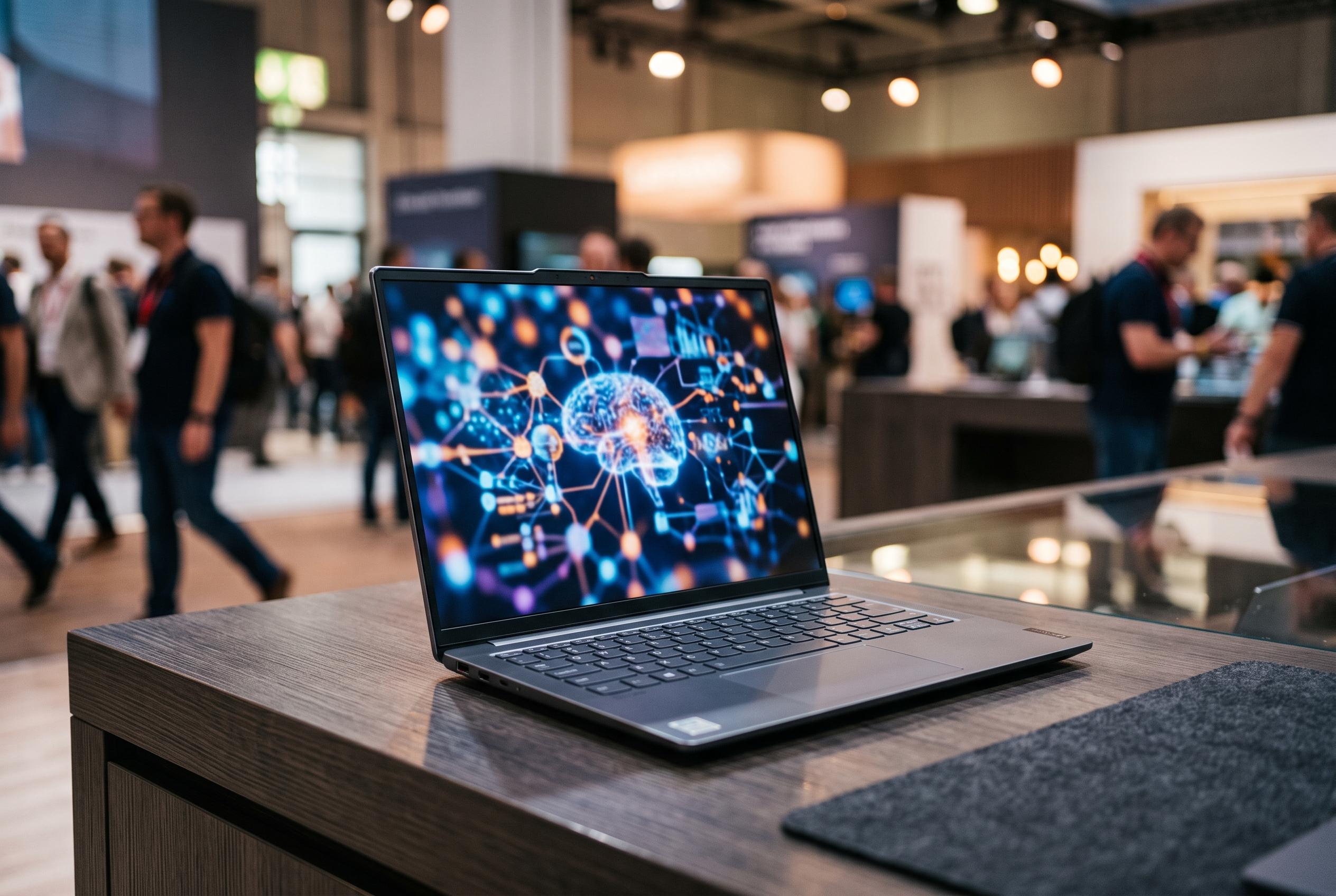

At IFA 2026, Lenovo unveiled the Yoga Pro 9n and Yoga 9n 2-in-1, pioneering large unified memory capabilities aimed at local AI workloads, signalling a market move focused on memory capacity over raw GPU power.
Lenovo has used IFA 2026 to push further into AI-focused computing with two new Yoga machines built around Nvidia’s RTX Spark platform: the 15-inch Yoga Pro 9n and the 16-inch Yoga 9n 2-in-1. The headline feature is not simply the new Arm-based silicon, but the memory ceiling. In the Pro model, Lenovo is offering up to 128GB of unified memory, a specification aimed at users who want to run large language models locally rather than send data to cloud services.
That distinction matters for businesses handling confidential material. Local inference can keep client files, source code, medical records and other sensitive information on the device, reducing reliance on third-party APIs. The Yoga 9n 2-in-1 is more limited, with up to 64GB, but it still sits well above the memory configurations common in mainstream AI laptops. Tom’s Hardware reported that Nvidia’s RTX Spark N1X platform pairs a 20-core Grace CPU with a 6,144-core Blackwell GPU, with the top configuration supporting up to 128GB of unified memory, and Lenovo’s new Yoga pair appear to be among the first systems built around it.
The Yoga Pro 9n is the more workstation-like machine. Lenovo says it includes two NVMe SSD slots, up to 4TB of storage, a 15.3-inch 2.5K OLED panel with a refresh rate ranging from 48Hz to 165Hz, and a 92.5Wh battery. It also carries a broad selection of ports, including USB-A, USB-C with USB4, HDMI 2.1 and an SD card slot. The Yoga 9n 2-in-1 trades some of that flexibility for convertibility, with a 16-inch 2.8K OLED display, a 99.9Wh battery and a lower peak memory cap. Tom’s Guide noted that Lenovo is also leaning into stylus and creator use, including Yoga Pen support and a dual-input design for sketching.
The bigger strategic point is that Lenovo is betting on memory capacity as the bottleneck in practical on-device AI, not just raw NPU performance. That mirrors a broader shift in the market, with Lenovo’s own ThinkCentre X Ultra also framed around large unified memory pools for local model work. For professionals who cannot, or do not want to, depend on cloud infrastructure, these Yoga models are designed to make local AI workloads more realistic. Lenovo has not yet announced pricing for either laptop, but it says more will follow at launch, while other IFA devices such as its new Yoga tablets are already slated to arrive in September.
Disclaimer: This content is intended for informational purposes only. Readers are advised to exercise their own judgement, conduct due diligence, or consult a qualified expert before acting on any information provided.