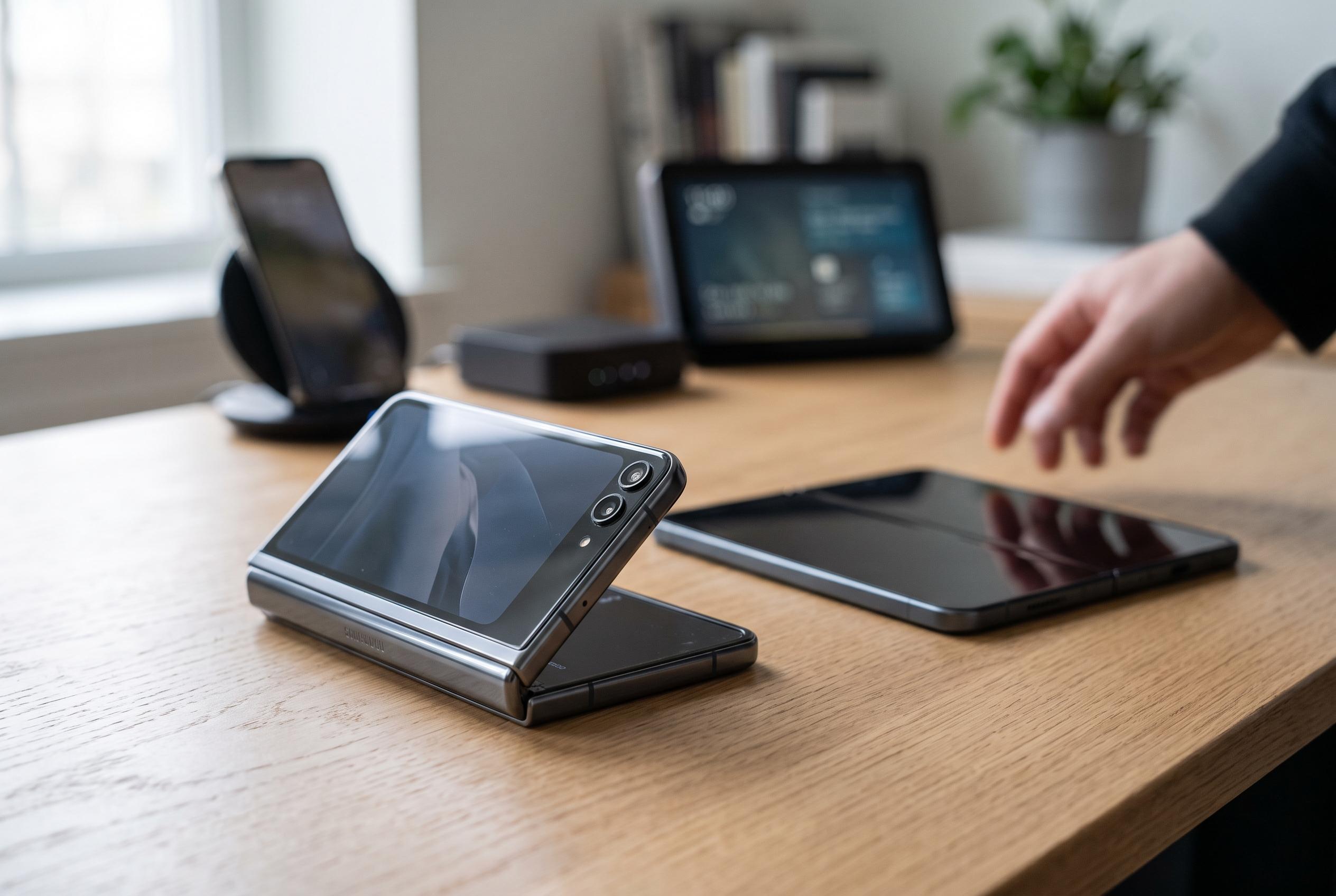

Apple’s first foldable, the iPhone Duo, introduces a bold departure with a larger outer screen and metal frame, contrasting Google’s more refined Pixel 11 Pro Fold, signalling divergent philosophies in the evolving foldable smartphone market.
Apple’s first foldable arrives as a deliberately different product, not a cautious clone. According to Apple’s announcement, the iPhone Duo uses a 7.6-inch inner display and a 5.4-inch outer display, with a titanium frame, Apple Pencil support and iOS 27 tuned for foldable use. Google’s Pixel 11 Pro Fold, meanwhile, remains the more familiar closed-phone shape, with Google describing it as thinner, lighter and refined around a gearless hinge and upgraded multitasking. The contrast is clear: Apple is framing the Duo as a new kind of iPhone, while Google is treating the foldable as a mature version of a conventional handset.
That distinction carries through to the hardware. Apple says the Duo uses an under-display front camera on the inner screen and ships in Star White and Night Sky, with pre-orders starting on October 16 and availability from October 23. MacRumors reports that the device is powered by the A20 Pro chip and 12GB of RAM, while the company’s foldable page pegs the starting price at $1,999. Google, by comparison, has positioned the Pixel 11 Pro Fold around the Tensor G6, improved durability and a new HiLight camera notification system. In practical terms, Apple is selling novelty and raw silicon, while Google is selling polish and incremental refinement.
The display strategy is where the philosophies diverge most sharply. Apple’s wider outer screen is designed to feel closer to a tablet-friendly workspace when unfolded, which should suit video, document editing and split-screen use. Google keeps a more orthodox cover screen, then opens into a square-like internal panel that is better aligned with multitasking than with cinema-style media playback. Apple also claims a nearly invisible crease, whereas Google’s latest foldable still accepts a visible bend in the middle, even if it is reduced from earlier generations. For buyers who care about the feel of the main panel, that may prove more important than the headline dimensions.
The camera systems reinforce the same split. Apple has opted for a 48-megapixel dual-camera arrangement, with a main sensor and an ultra-wide lens, while Google includes a three-camera layout with a telephoto module. That gives the Pixel the more flexible zoom set-up on paper. Apple, however, appears to be leaning on computational photography and the wider form factor to make the Duo more compelling for staged, landscape-first use. The real verdict will depend on testing, but at launch the Pixel still looks like the safer choice for people who want range rather than simplicity.
Battery and charging also point in different directions. Apple says the Duo delivers all-day battery life and supports 60W wired charging, which would be a notable step up for the company if it translates into real-world performance. Google’s foldable is slower to recharge, but its larger battery and established software features should make it easier to live with day to day. For many buyers, the decision will come down to ecosystem rather than specifications: Apple’s advantage lies in its hardware integration and first-party app support, while Google continues to lean on Gemini, messaging tools and cross-device services. In a first-generation foldable from Apple, caution is still sensible. Google has already had several iterations to work out the rough edges, and that maturity may matter more than novelty for most users.
Disclaimer: This content is intended for informational purposes only. Readers are advised to exercise their own judgement, conduct due diligence, or consult a qualified expert before acting on any information provided.