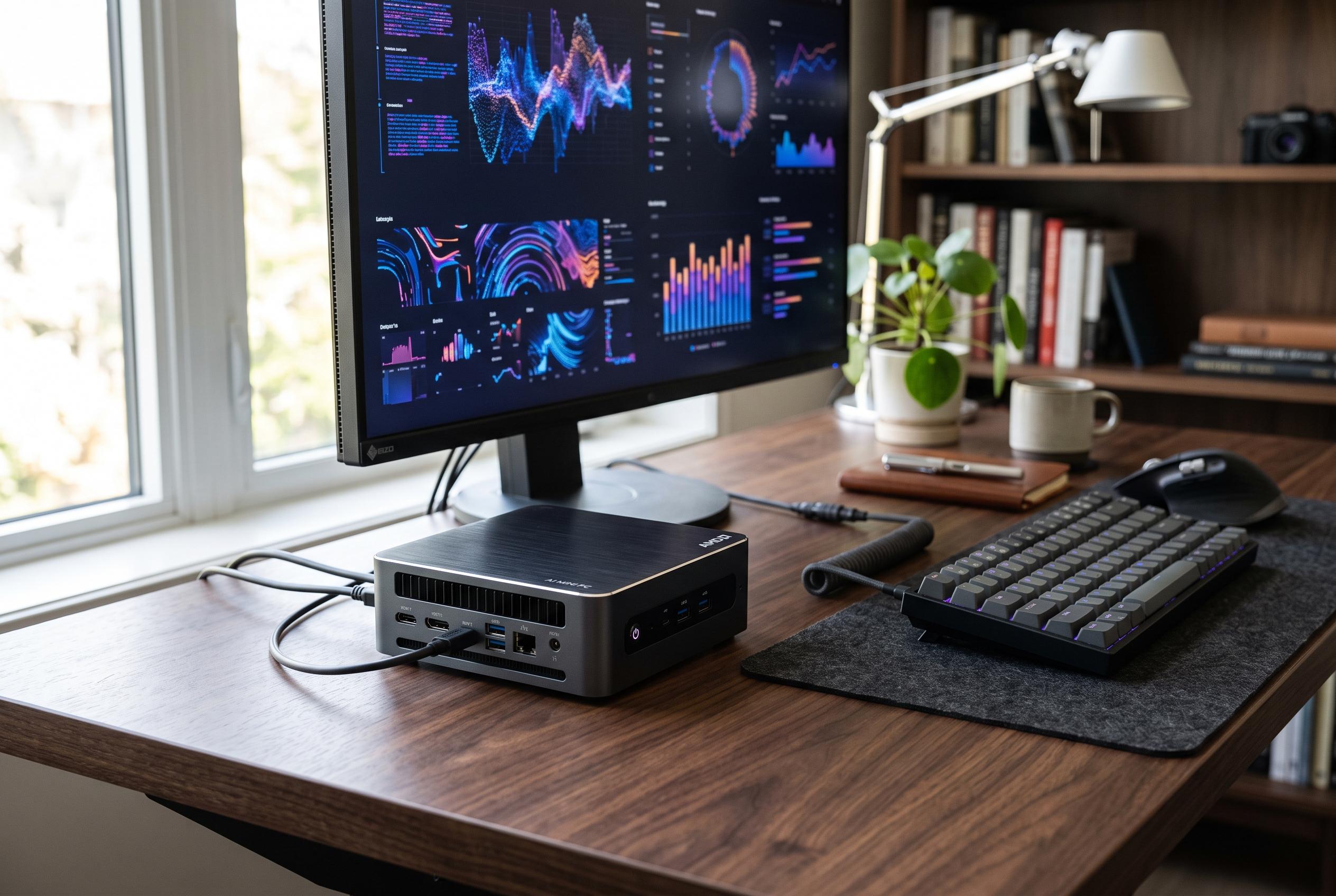

The latest wave of AMD-based AI mini PCs emphasises increased memory capacity and hardware customisation over raw compute, signalling a transition towards more specialised AI deployment in compact systems.
The real story in the current crop of local AI mini PCs is not that they differ wildly in raw compute. It is that most of them do not. The Framework Desktop, GMKtec EVO-X2, Beelink GTR9 Pro and Minisforum’s MS-S1 line all sit on the same AMD Ryzen AI Max+ 395 platform, so the meaningful differences are not in the silicon itself but in the chassis choices wrapped around it. That is why reviewers keep returning to ports, cooling, noise, firmware defaults and price rather than any obvious gap in processor capability.
That point has become sharper with Minisforum’s new IFA 2026 announcements. According to Tom’s Hardware, the company has now shown upgraded AI-focused systems built around AMD’s Ryzen AI Max+ Pro 495, with support for up to 192GB of unified memory and an integrated Radeon 8065S GPU rated at up to 131 TOPS. The new machines are aimed at local inference, privacy-sensitive deployments and longer-running AI workloads, which underlines how quickly this category is moving towards higher memory ceilings rather than merely faster clocks.
For buyers considering today’s 128GB machines, the first practical issue is memory allocation, not benchmark charts. On these systems, the split between system memory and graphics memory is set in firmware, not dynamically at runtime. That means a poor default BIOS setting can make a capable machine appear strangely weak, because model layers may be pushed back onto the CPU. It is a simple detail, but it changes the result far more than many comparison tables admit.
The second issue is that bandwidth, not compute, is often the limiting factor. That is why dense 70B models can run on 128GB Strix Halo boxes yet still feel slow, while mixture-of-experts models of similar or larger size can perform much better. In other words, these mini PCs are often suitable for local AI work, but the user experience depends heavily on the model type, quantisation and memory access pattern.
Among the current AMD options, the choice is mostly about use case. The Framework Desktop remains the strongest option for repairability and Linux-friendly tinkering, while the GMKtec EVO-X2 is widely treated as the availability play when stock is tight. Minisforum’s MS-S1 Max stands out for networking and expansion, and Beelink’s GTR9 Pro is pitched as a quieter, better-connected alternative. A comparison by Computing for Geeks reached the same broad conclusion: these systems share the same core platform, so purchasing decisions turn on the surrounding hardware, not the processor alone.
There is also a broader shift underway. AMD’s newer Ryzen AI Max PRO 400 family pushes the category towards 192GB unified memory, with a corresponding jump in the amount available to graphics workloads. That matters because it opens the door to larger models than the 128GB generation can comfortably hold. For buyers, the implication is clear: the current systems are still relevant, but they are arriving at the end of a transition, not the beginning.
Apple has now moved the same conversation into macOS. Its refreshed Mac mini line, as described in the source material, adds a lower-memory M6 model and an M5 Pro version that reaches 64GB. The bandwidth is attractive and the machines are quiet, but they still sit in a different part of the market, with the memory ceiling and pricing structure making them more suitable for smaller local models than for the larger workloads the 128GB AMD boxes are designed to absorb.
The conclusion is straightforward. If the workload is CUDA-heavy or requires clustering, NVIDIA’s GB10-based systems remain the distinct option. If the goal is local inference on mixture-of-experts models, the current AMD mini PCs are credible, but the purchase should be driven by ports, thermals, noise and BIOS behaviour rather than by superficial benchmark comparisons. The newest Minisforum systems, together with the emerging 192GB class, suggest that this market is moving towards bigger memory pools and more specialised deployment choices, not towards a single universal best buy.
Disclaimer: This content is intended for informational purposes only. Readers are advised to exercise their own judgement, conduct due diligence, or consult a qualified expert before acting on any information provided.