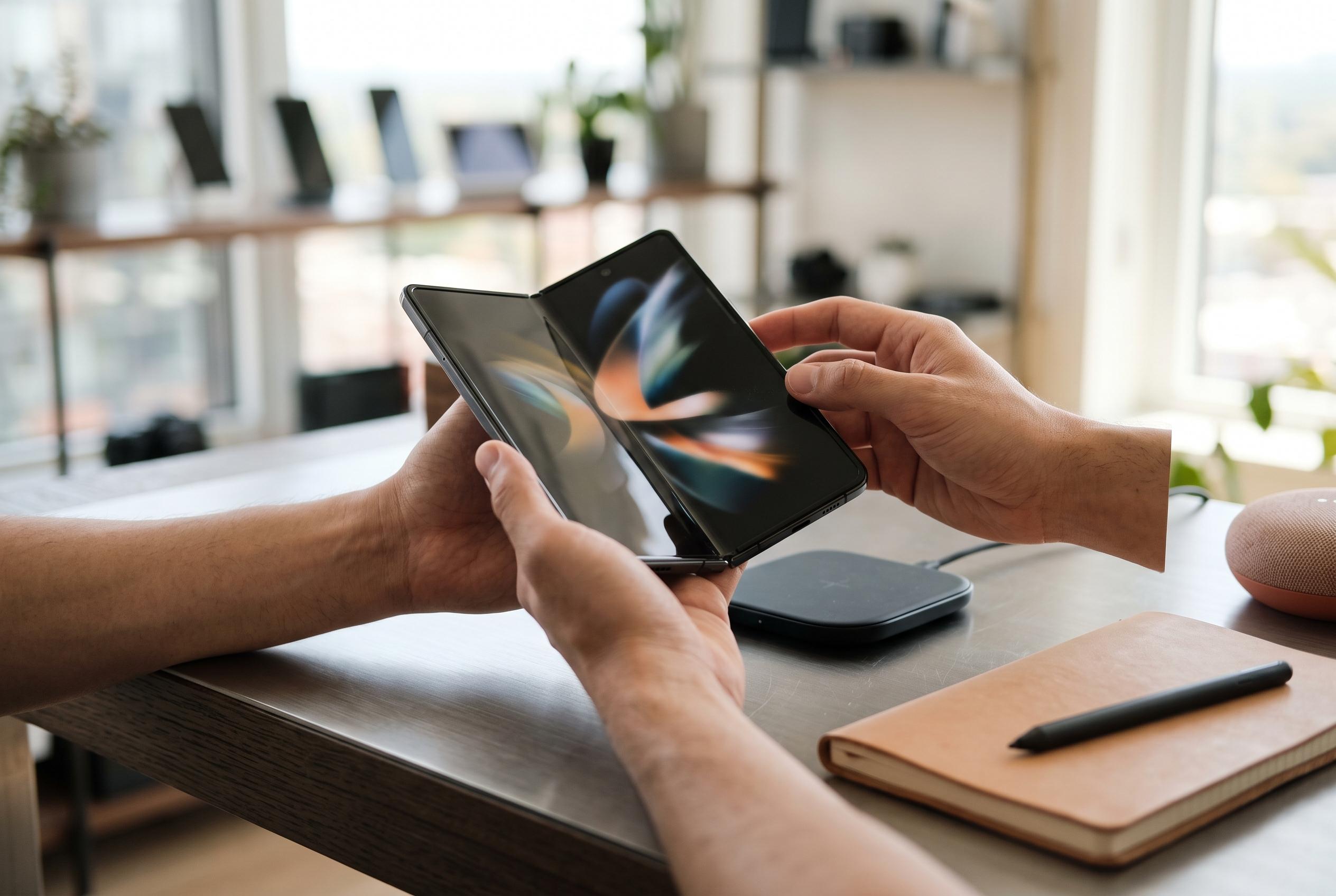

Huawei’s Pura X Max leads a growing class of wide foldable smartphones, attracting attention from Apple, Samsung, and Xiaomi, and signalling a shift from experimental formats to high-end design direction.
Huawei’s Pura X Max sits at the centre of a new class of wide foldable phones that is drawing interest from Apple, Samsung and Xiaomi. Huawei was first to push the format with the original Pura X, and the Max version extends that idea with a larger body, a broader inner panel and a specification sheet aimed squarely at premium buyers. The result is a category that now looks less experimental and more like a genuine design direction for high-end smartphones.
On size and weight, Xiaomi’s 18 Fold appears to be the most compact option, while Samsung’s Galaxy Z Fold 8 is the lightest of the group. Huawei’s Pura X Max is larger and heavier than Xiaomi’s device, but still lighter than Apple’s iPhone Duo, according to the published measurements. PhoneArena’s comparison suggests Apple has used a titanium frame and ceramic shield materials on the iPhone Duo, while Huawei pairs glass with an aluminium frame and gives the Pura X Max a more colourful finish palette.
Display hardware is one of the clearest points of difference. Huawei’s main panel measures 7.7 inches, with a 5.4-inch cover screen, both running at 120Hz and rated at 2,500 nits and 3,000 nits respectively. The iPhone Duo, as described by Android Central, uses a 7.6-inch folding display and a 5.4-inch outer screen, with a creaseless panel, IP68 protection and iOS 27 multitasking support. Xiaomi goes furthest on brightness, with 4,000 nits claimed for both screens, while Samsung keeps a familiar 7.6-inch inner display and 5.5-inch cover panel with a 3,000-nit rating.
The chipsets underline how differently each maker is approaching performance. Huawei’s Kirin 9030 Pro is said to deliver a 25% to 30% gain over the previous generation in the Pura X line. Apple’s iPhone Duo is powered by the A20 Pro, while Xiaomi has moved to its own XRING O3 processor. Samsung’s Galaxy Z Fold 8 continues with Qualcomm’s Snapdragon 8 Elite family. In each case, memory tops out at 16GB and storage reaches 1TB, although Apple also offers a 2TB configuration.
Camera systems remain broadly aligned with the foldable premium tier, but Xiaomi is the most aggressive on headline resolution. Its 200MP main sensor leads the group, while Huawei counters with a 50MP main camera, ultrawide lens, 3.5x periscope telephoto and a multispectral unit. Apple’s dual 48MP rear cameras are more conservative on paper, and Samsung keeps to a 50MP main and 50MP ultrawide pairing. Battery strategy also differs: Xiaomi claims a 6,000mAh cell, Huawei lists 5,300mAh, and Samsung uses 4,800mAh with slower charging than the Chinese rivals.
Pricing reflects the same split. Huawei’s Pura X Max starts at 10,999 yuan, Samsung’s Galaxy Z Fold 8 begins at $1,900, and Apple’s iPhone Duo starts at $1,999 for the base version. Xiaomi matches Huawei’s opening price in yuan, but its global availability remains limited, with TechRadar noting that the 18 Fold is currently a China-only product. Taken together, the comparison shows a market moving quickly from novelty to competition, with design, software and regional availability now likely to matter as much as raw specifications.
Disclaimer: This content is intended for informational purposes only. Readers are advised to exercise their own judgement, conduct due diligence, or consult a qualified expert before acting on any information provided.