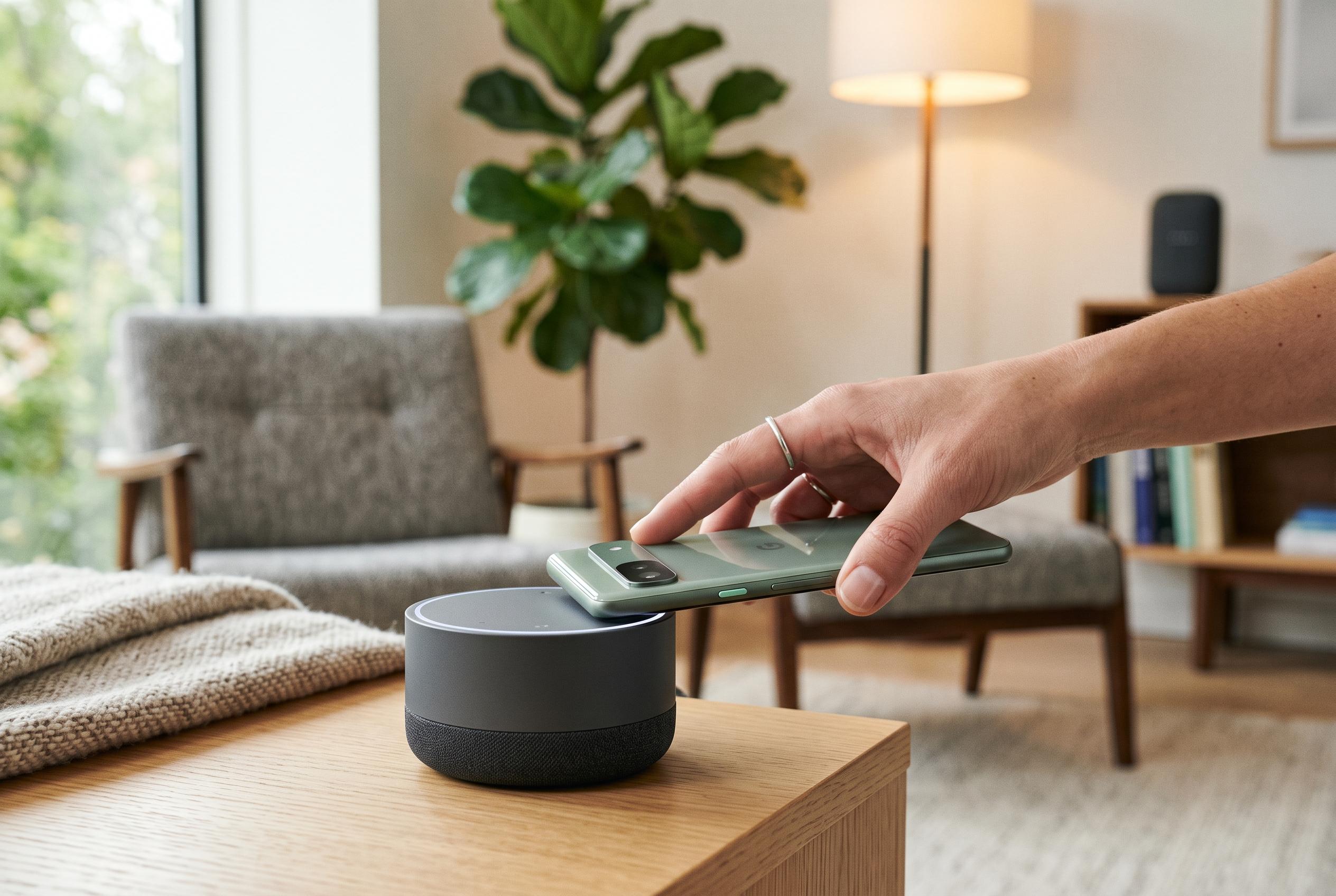

While commonly used for contactless payments, Android’s near-field communication capability is increasingly transforming into a versatile tool for home automation, effortless Wi-Fi sharing, contact sharing, and faster Bluetooth pairing through simple tap actions.
Android’s near-field communication reader is often treated as a payment tool, but that is only one of its uses. The same chip can read inexpensive programmable tags and accessories, allowing a phone to carry out actions with a single tap. For many users, that turns a built-in feature into a practical shortcut for automation, sharing and device pairing.
One of the most useful applications is home and travel automation. Apps such as Tasker, Automate and NFC Tools can write a command, or a chain of commands, to a blank NFC sticker. That tag can then trigger routines such as switching on Do Not Disturb, lowering screen brightness or launching a navigation app. In a car, a tag can be used to connect to Bluetooth, open maps and set media volume before a journey begins. Home automation systems can use the same approach to arm security, switch off lights or reverse those actions when the tag is scanned again.
NFC can also remove friction from Wi-Fi sharing. Instead of reading out a long password or scanning a QR code, a host can write the network name, password and security type to a tag in the standard Wi-Fi format. A guest can then tap an NFC-enabled Android phone against the tag and receive a prompt to join the network. The method is especially useful in homes, small offices and rentals, though it should be used carefully because anyone who has access to the tag can also read the stored credentials.
The technology is also a replacement for some of the old phone-to-phone tap features that disappeared with Android Beam. Current Android devices no longer use that direct exchange method, but NFC tags can still store contact cards in vCard format. That makes them useful for digital business cards, conference badges and self-made contact tags that let another person save a name, number and email address with very little effort.
A further advantage is faster Bluetooth pairing. Many headphones, speakers and car systems include NFC specifically for this purpose, usually marked with a small NFC symbol. Instead of digging through Bluetooth menus, the user taps the phone against the accessory and the pairing details are exchanged immediately. Where the feature is supported, it saves time and avoids the repetitive setup that is common with shared speakers, car systems and other frequently connected devices.
Disclaimer: This content is intended for informational purposes only. Readers are advised to exercise their own judgement, conduct due diligence, or consult a qualified expert before acting on any information provided.