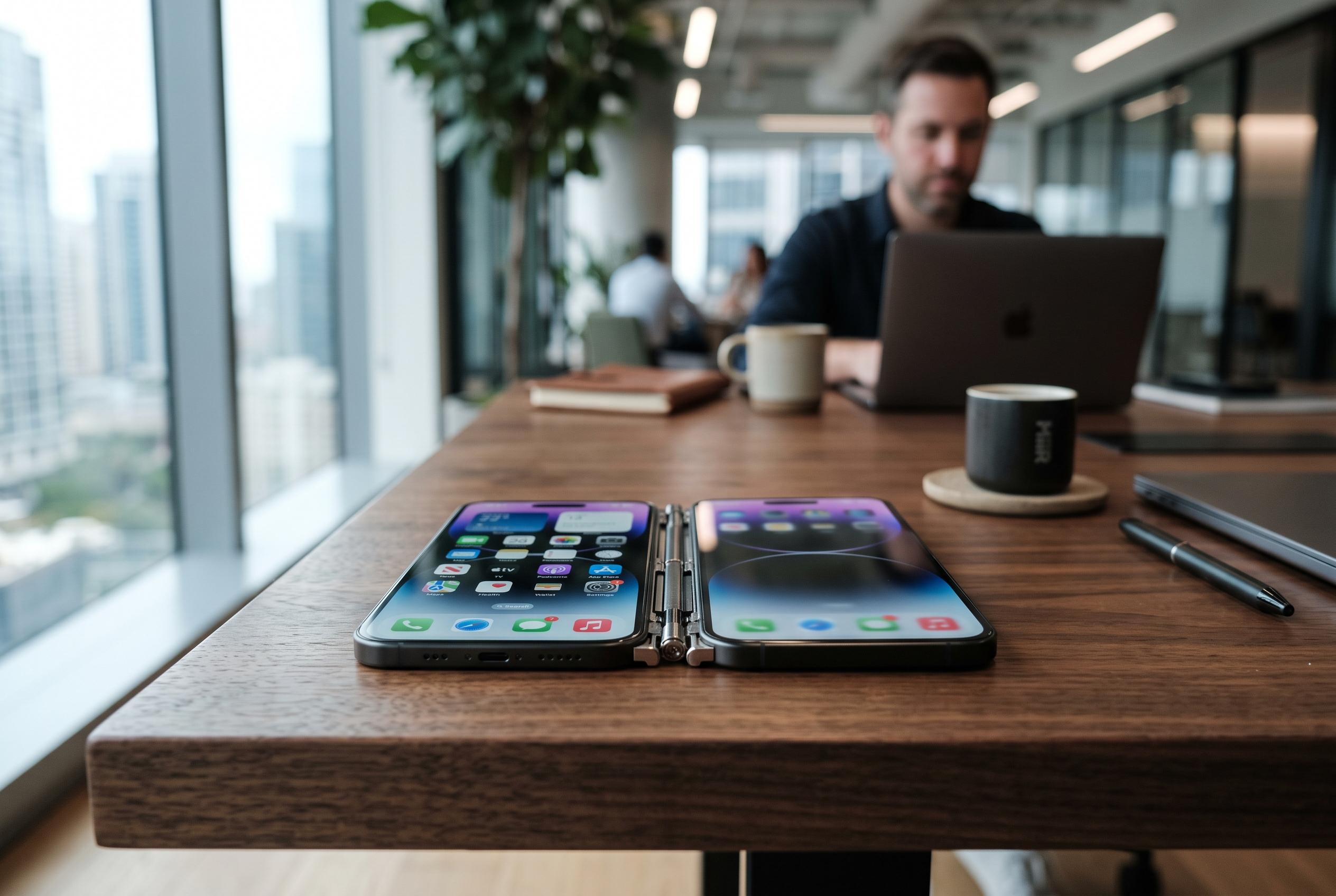

Apple unveils its latest flagship models, the iPhone 18 Pro and Pro Max, featuring the company’s first foldable handset, signalling a bold step into new form factors and high-end smartphone innovation.
Apple has opened the next phase of its iPhone cycle with the iPhone 18 Pro and iPhone 18 Pro Max, while also unveiling its first foldable handset, the iPhone Duo. According to Apple’s newsroom and coverage from Tom’s Hardware and Tom’s Guide, the company split its 2026 line-up into two waves, with the premium models arriving first and the standard iPhone 18, the cheaper 18e and the thinner second-generation Air expected later, in early 2027. Apple says pre-orders for the Pro models begin on 12 September, with availability from 18 September in more than 65 countries, including the UK.
The new Pro models arrive with Apple’s A20 Pro chip, which Tom’s Hardware says is the company’s first 2-nanometre smartphone processor. Apple has also kept the storage ceiling high, offering 256GB, 512GB, 1TB and, for the first time, 2TB variants. The iPhone 18 Pro starts at £1,199 in the UK, while the Pro Max begins at £1,299, according to Apple. MacRumors reported that the new pricing represents a $100 increase over the equivalent iPhone 17 Pro models in the US.
That launch has immediate relevance in Russia, where M.Video has already begun taking pre-orders. The retailer lists the iPhone 18 Pro from 174,999 rubles and the Pro Max from 189,999 rubles, while iXBT said the 512GB Pro Max rises to 220,000 rubles. Russian pre-orders also include the iPhone Duo, which underscores how Apple is using the Pro tier to anchor the first phase of its rollout.
For buyers considering alternatives this autumn, the iPhone 17 Pro and iPhone 17 Pro Max remain the clearest internal benchmark. They still offer premium materials, a complete camera set, 120Hz displays and enough processing headroom to remain current for years. The smaller Pro uses a 6.3-inch screen, while the Max has a 6.9-inch panel, longer battery life and, in some markets, a 2TB configuration. In Russian retail, the iPhone 17 Pro is still being sold from about 119,000 rubles, well below the new Pro’s starting level.
Outside Apple’s own range, flagship Android phones continue to challenge it most strongly on photography, battery life and charging speed. Xiaomi’s 17 Ultra, vivo’s X300 Ultra, Oppo’s Find X9 Ultra, Honor’s Magic 8 Pro, vivo’s smaller X300 and OnePlus 15 all combine high-end chips with large batteries and, in several cases, advanced telephoto systems and 4K or 8K video capture. The common pattern is clear: Apple is setting the pace on software support and ecosystem integration, but several rival models now compete aggressively on imaging hardware and endurance.
Disclaimer: This content is intended for informational purposes only. Readers are advised to exercise their own judgement, conduct due diligence, or consult a qualified expert before acting on any information provided.