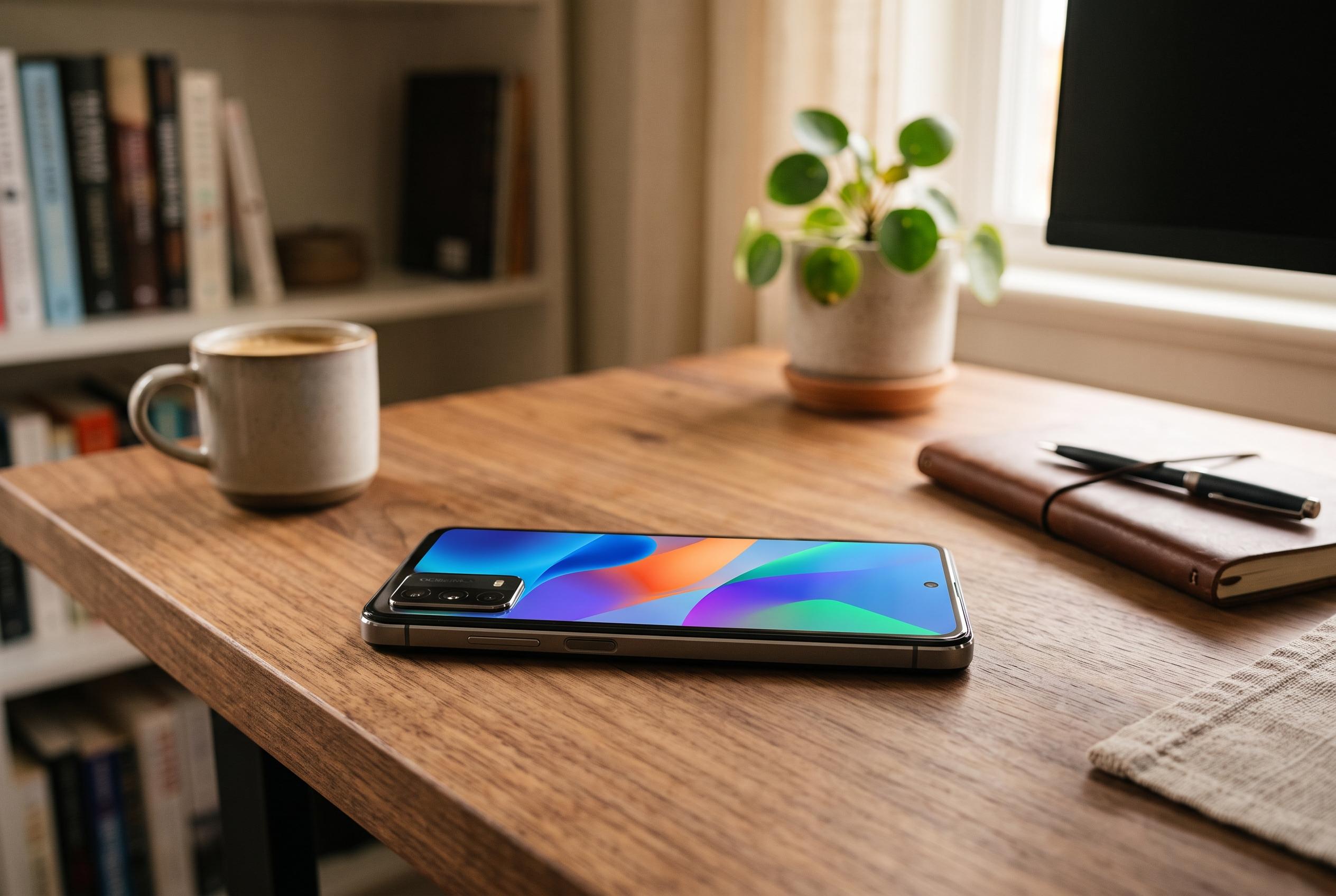

Cubot’s A50 offers a compelling mix of features for budget-conscious users, including a large full HD+ screen, a 5,000mAh battery, and expandable storage, challenging the expectations for entry-level devices.
Cubot’s A50 sits in a crowded corner of the market, but it makes a clear case for itself: a low-cost handset with a large FHD+ IPS panel, a 5,000mAh battery, NFC, expandable storage and Android 16. In a segment where 4GB of memory and weak entry-level chips are still common, that combination gives it a practical appeal that goes beyond the asking price. According to Cubot’s own material, the phone is aimed at everyday media, communication and photography, while third-party listings place it in the budget class with a Unisoc T620 platform and 128GB of storage.
The hardware package is sensible rather than ambitious. The A50 uses a 6.58-inch IPS display with a 1080×2408 resolution, which should be the main selling point for buyers who value sharpness and wide viewing angles over refresh-rate claims. The phone is built around the Unisoc T620, paired here with 6GB of LPDDR4X memory and 128GB of storage, plus microSD support. The review also notes Bluetooth 5.2, Wi‑Fi, GPS, GLONASS, BeiDou and a USB Type-C port with OTG, alongside a 5V/2A charger in the box and no fast-charging support.
That balance appears to carry through into everyday use. The device runs a fairly clean build of Android 16 with little apparent bloat, and in routine tasks such as messaging, web browsing, video playback and document work it behaves smoothly. The 5,000mAh battery is described as sufficient for around two days of moderate use, which is in line with the phone’s modest power demands. For gaming, the A50 is better suited to lighter titles and older releases than to demanding current ones, although the review says it can handle casual games and some emulation up to the PSP era with acceptable results.
Synthetic testing places the T620 in the upper part of the ultra-budget class, though still well behind more capable mid-range chips. The review records an AnTuTu 11 score of 422,523 and Geekbench 7 results of 485 in single-core and 1,605 in multi-core tests. That keeps it competitive with some older or weaker budget processors, but not with Helio G99-class hardware. The author’s broader point is that low-end smartphone chip design has barely shifted in years: vendors continue to rely on near-identical CPU layouts, so gains often come from clock speed rather than architectural progress.
The camera system is another mixed but not disappointing element. The A50 uses a 48-megapixel main camera, a 2-megapixel macro sensor and a depth sensor, with a 16-megapixel front camera. In the review, the main sensor performs best in normal light and on nearby subjects, with good detail and steady autofocus, but distant scenes are said to suffer from aggressive sharpening in processing. The selfie camera is described more favourably, with natural colour and little heavy-handed smoothing. Overall, the phone comes across as a well-rounded budget device: not exceptional, but unusually coherent for the money.
Disclaimer: This content is intended for informational purposes only. Readers are advised to exercise their own judgement, conduct due diligence, or consult a qualified expert before acting on any information provided.