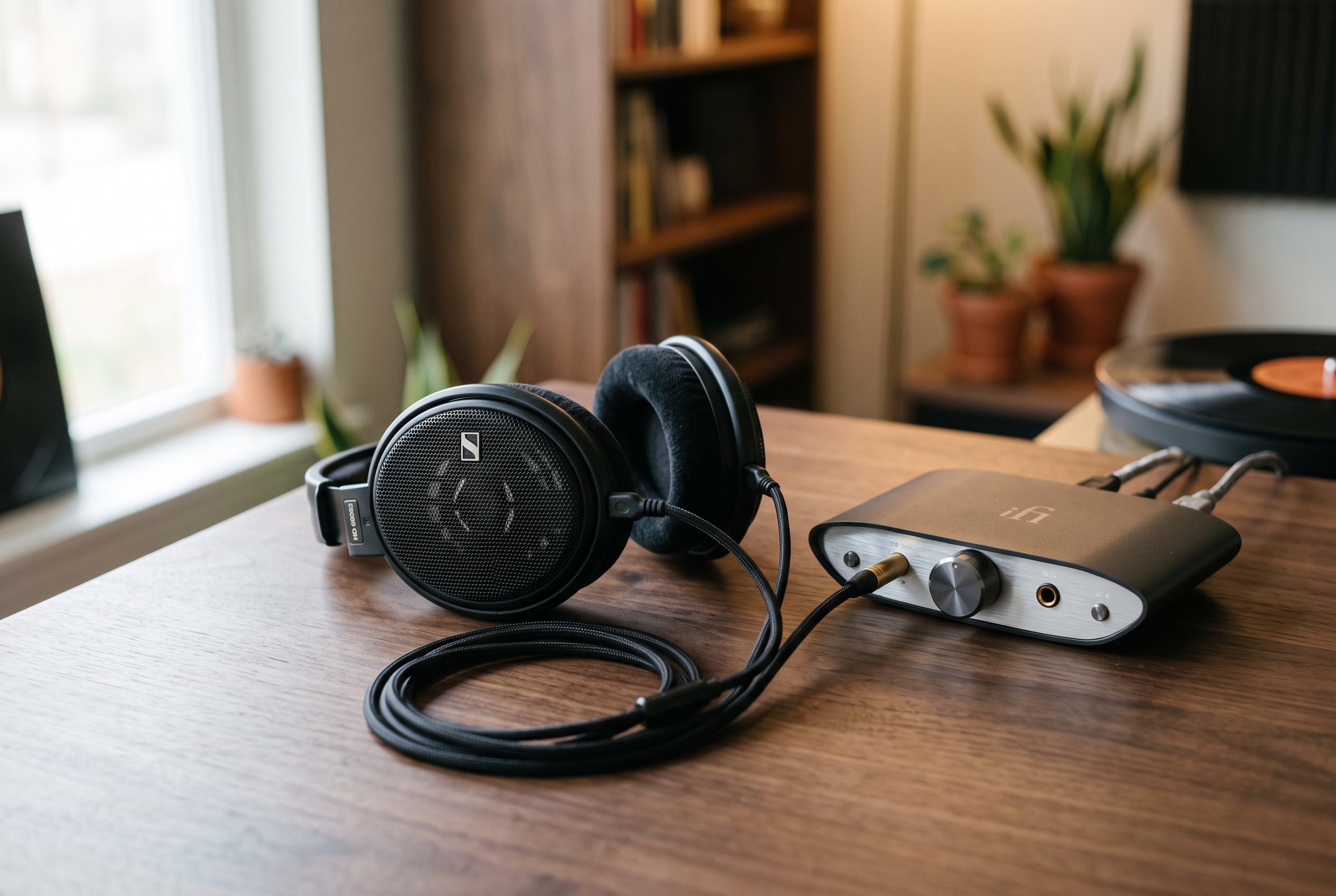

The Sennheiser HD 660S2 headphones’ performance hinges more on the quality of the source than on the headphones themselves, with significant improvements seen when paired with a powerful DAC like the iFi Zen DAC 3.
For the Sennheiser HD 660S2, the question is not whether they are good headphones, but how much better they can become with the right source. TechRadar’s hands-on account suggests the answer is: sometimes only a little, sometimes a lot. The difference depends less on the headphones themselves than on what is feeding them.
That fits the broader consensus around the HD 660S2. SoundGuys describes them as a slightly bassier take on the original model, while RTINGS notes their 300-ohm impedance and the need for proper amplification. TechRadar’s own review has also praised their open-back layout, comfortable fit and balanced tuning, while warning that they do not offer the sort of built-in features found in wireless rivals.
The iFi Zen DAC 3 is a sensible match on paper. Audio Review says it is a USB-C DAC, headphone amplifier and preamp with support for high-resolution PCM and DSD formats, while TechRadar has highlighted its clean output, strong specification and useful feature set. In practical terms, it is designed to provide more drive than a typical laptop or phone output.
In TechRadar’s tests, though, the gains were more nuanced than dramatic when the HD 660S2 were used with a MacBook Air M5 and MacBook Pro M4. The headphones already sounded composed and detailed from those built-in outputs, especially in the mid-range and treble, with the DAC mainly adding a touch more scale, bass weight and separation rather than transforming the overall character.
The bigger change came when the same headphones were paired with a phone and a USB-C to 3.5mm adaptor. TechRadar found the sound became quieter, flatter and less controlled, with less mid-range body, reduced treble confidence and a narrower sense of space. In that setting, the Zen DAC 3 restored much of the drive and layering that the HD 660S2 can deliver, reinforcing the wider point that high-impedance wired headphones do not always need a discrete DAC, but can benefit greatly from one when the source is underpowered.
Disclaimer: This content is intended for informational purposes only. Readers are advised to exercise their own judgement, conduct due diligence, or consult a qualified expert before acting on any information provided.