
Apple launches its first foldable, the iPhone Duo, featuring a design reminiscent of Samsung’s Galaxy Z Fold but boasting enhancements like an under-display camera and thermal management, as industry rivals scramble for differentiation in the rapidly evolving foldable market.
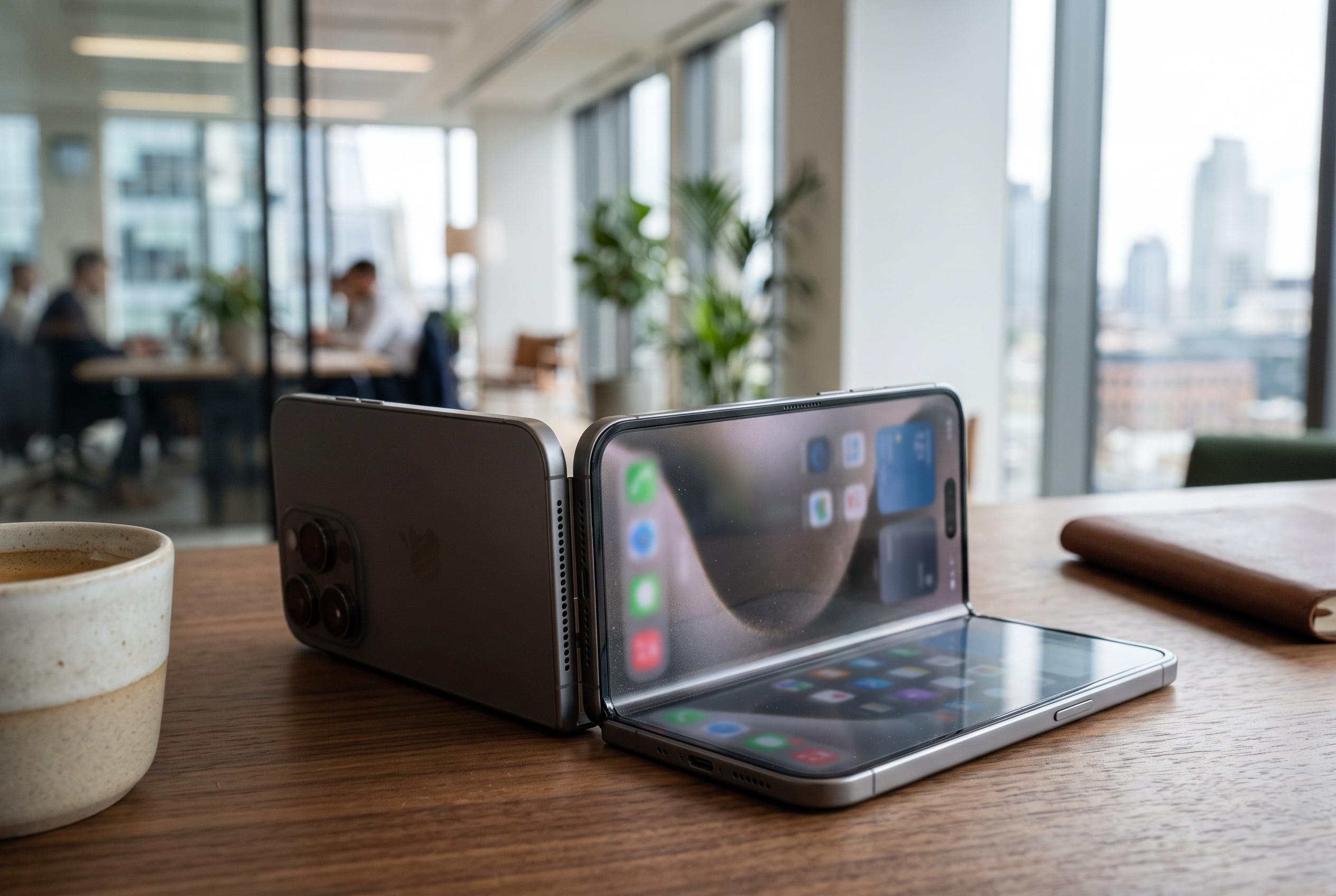
Apple’s first foldable, the iPhone Duo, has arrived with a design that will feel very familiar to anyone who has followed Samsung’s Galaxy Z Fold line. In his review of the Galaxy Z Fold8, Oficina da Net argues that the new Apple device does not just take cues from Samsung’s format; it exposes how little room there is left for genuine differentiation in this category. The comparison is particularly pointed because both phones open like a compact booklet to reveal a large inner display, with the same basic promise: a phone when closed, a tablet-like screen when opened. According to reports from Tom’s Guide, What Hi-Fi? and Android Central, Apple has launched the Duo as a direct rival, with a 7.6-inch inner screen, a smaller outer display and pricing that starts at around $2,000 in the United States.
The Z Fold8’s strengths begin with its physical refinement. Oficina da Net says the device is slimmer and lighter than earlier generations, while still feeling solid thanks to its aluminium frame, glass rear panel and improved hinge. It also ships with a 45W charger in the box, which is welcome on a premium device, even if the case and screen protector are still sold separately. Samsung’s durability story remains more complicated. The phone carries an IP48 rating, which helps with water resistance but offers limited protection against dust and sand, a long-standing weak point for foldables. Android Central reported that Samsung has also said a slight bend or indentation in the display is intentional, designed to reduce the risk of damage from fine particles when the phone closes.
Samsung’s dual-screen approach is the heart of the device. The outer 5.5-inch display is described as practical for typing and quick tasks, but less convincing for social feeds and short-form video. The larger 7.6-inch inner panel is where the format makes sense, especially for split-screen work and app shortcuts. That is also where the foldable category still shows its compromises. Oficina da Net criticises the visible camera cut-out on the inner screen and argues that Samsung should have relied more on the main rear camera for selfies, or moved to an under-display solution. That criticism becomes sharper when set against Apple’s new foldable, which What Hi-Fi? says uses an under-display front camera and a near-invisible crease, both of which are presented as key advantages over Samsung’s approach.
Performance is strong on paper, but heat still limits sustained use. The Z Fold8 uses Qualcomm’s Snapdragon 8 Elite Gen 5, and Oficina da Net says benchmark numbers are lower than those of Samsung’s own Galaxy S26 Ultra despite the shared chip, largely because the foldable chassis has less room for cooling. Android Central likewise notes that the iPhone Duo uses Apple’s A20 Pro chip with improved thermal handling, including vapour chamber cooling, which gives Apple an early performance narrative in the foldable segment. Battery life, however, appears to be one of Samsung’s better achievements here. Oficina da Net says the Fold8’s 4,800mAh silicon-carbon battery comfortably lasts a full day, and charging to full with the included 45W adapter takes just over an hour. That compares favourably with the iPhone Duo’s 4,700mAh battery, although Apple is also said to support faster charging than Samsung.
Cameras are where the Z Fold8 looks least convincing for its price. Oficina da Net says Samsung has reused an ageing 50MP main sensor and removed the telephoto lens, leaving the phone with a main and ultrawide camera but no optical zoom. The result, the review argues, is a system that is acceptable in isolation but disappointing on one of the most expensive phones Samsung has ever sold. The iPhone Duo, according to Android Central and PhoneArena, also launches without a telephoto lens, so Apple has not solved that gap either. On balance, Oficina da Net concludes that the Fold8 is one of Samsung’s best foldables in terms of shape, feel and battery life, but one of its weakest in camera hardware and pricing. The verdict is clear: for readers who want the book-style foldable form factor and can afford it, the phone is compelling; for everyone else, waiting for prices to fall remains the sensible choice.
Disclaimer: This content is intended for informational purposes only. Readers are advised to exercise their own judgement, conduct due diligence, or consult a qualified expert before acting on any information provided.