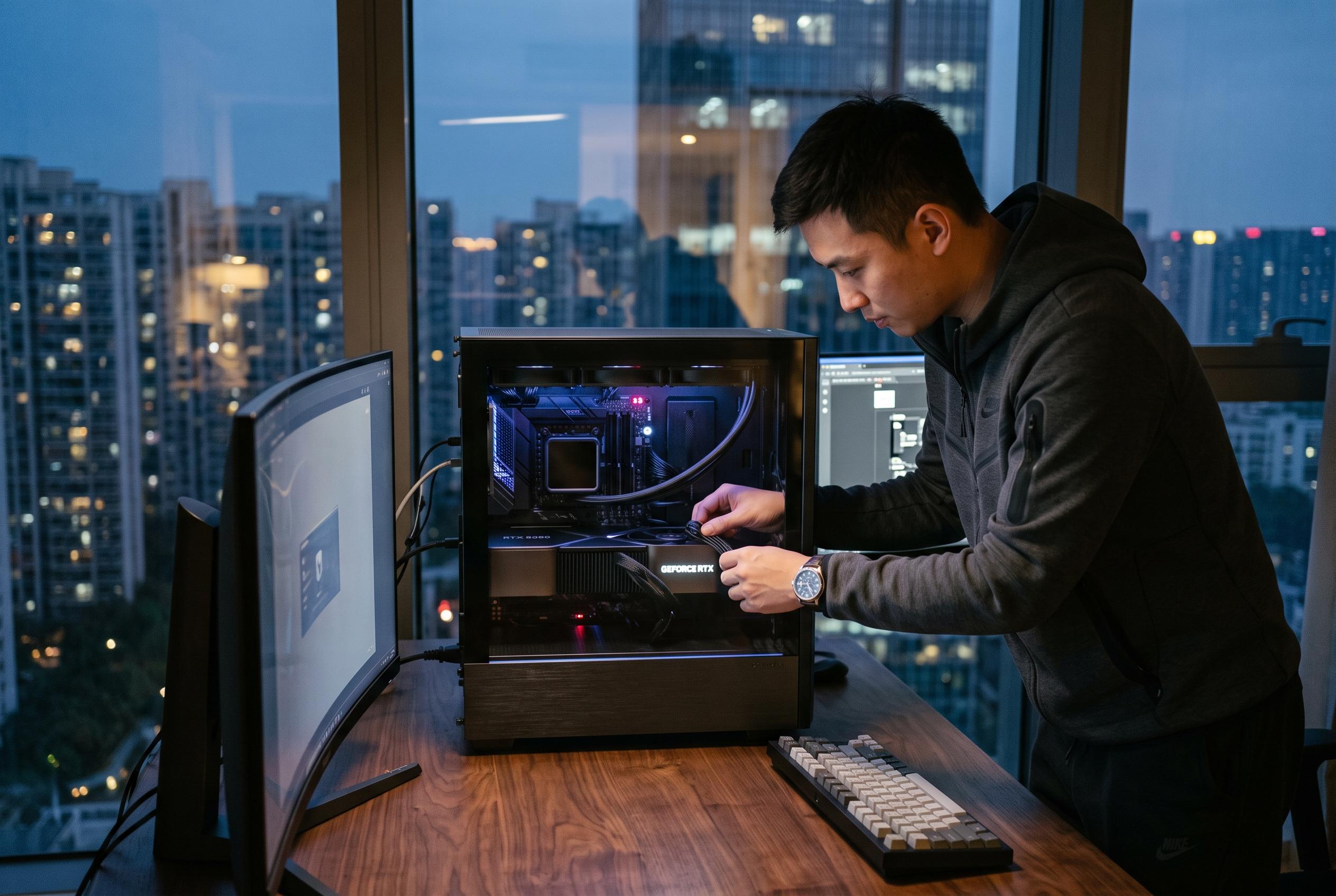

Despite US export restrictions, significant volumes of Nvidia’s GeForce RTX 5090 are reportedly circulating in China, driven by high demand for AI workloads and grey-market activity, leading to increased prices and supply pressures.
Reports from hardware forums and social media suggest that Nvidia’s GeForce RTX 5090 is still circulating in China in significant volumes, despite US export restrictions that were meant to keep the flagship gaming card out of the market. According to imagery shared by HKEPC and echoed by Italian technology site HWUpgrade, whole pallets of cards have reportedly been bought by Chinese system builders and redirected into AI workstation and datacentre builds.
That matters because the RTX 5090 has become unusually expensive and scarce. In Europe, retail pricing has climbed far above launch levels, while availability has tightened sharply. The pattern is familiar: when a high-end GPU combines strong compute performance with limited supply, it becomes attractive beyond gaming, especially for buyers seeking cheaper hardware for inference and smaller AI workloads.
Nvidia has already tried to blunt that demand with region-specific variants. MSI said in a statement that it has never officially sold the RTX 5090 in China, and that any units appearing there are parallel imports rather than authorised supply. The company said only the RTX 5090 D and RTX 5090 D V2 are intended for the Chinese market, both of them reduced to meet local regulatory requirements. Even so, the images circulating online suggest that unofficial channels may still be moving standard cards into the country.
The attraction is easy to understand. The RTX 5090 offers 32GB of memory, which is high for a consumer GPU and useful for certain AI tasks. That still leaves it far behind Nvidia’s dedicated professional hardware, however. Tom’s Hardware noted that Nvidia’s RTX Pro 6000 Blackwell carries 96GB of memory and starts at a price well above $18,000, which makes consumer cards a tempting substitute for firms trying to reduce upfront costs.
There are also broader signs that US export controls are reshaping the Chinese accelerator market rather than eliminating demand. Tom’s Hardware reported that Biren Technology, one of China’s domestic AI chipmakers, posted revenue growth of nearly 2,000% in the first half of 2026 after Nvidia and AMD were pushed out of the market for advanced AI GPUs. At the same time, the grey market remains active enough for scams and tampering to flourish: Tom’s Hardware has also documented both hollowed-out RTX 5090 frauds in Germany and, separately, a modified RTX 5090 with 96GB of memory listed in China for less than $4,000.
That combination points to a market under strain. High prices, restricted supply and the appetite for AI compute have created conditions in which gaming GPUs are treated less as consumer graphics cards and more as raw accelerator silicon. Whether the Chinese shipments seen online are fully genuine or partly staged, the underlying pressure on Nvidia’s consumer supply chain is real.
Disclaimer: This content is intended for informational purposes only. Readers are advised to exercise their own judgement, conduct due diligence, or consult a qualified expert before acting on any information provided.