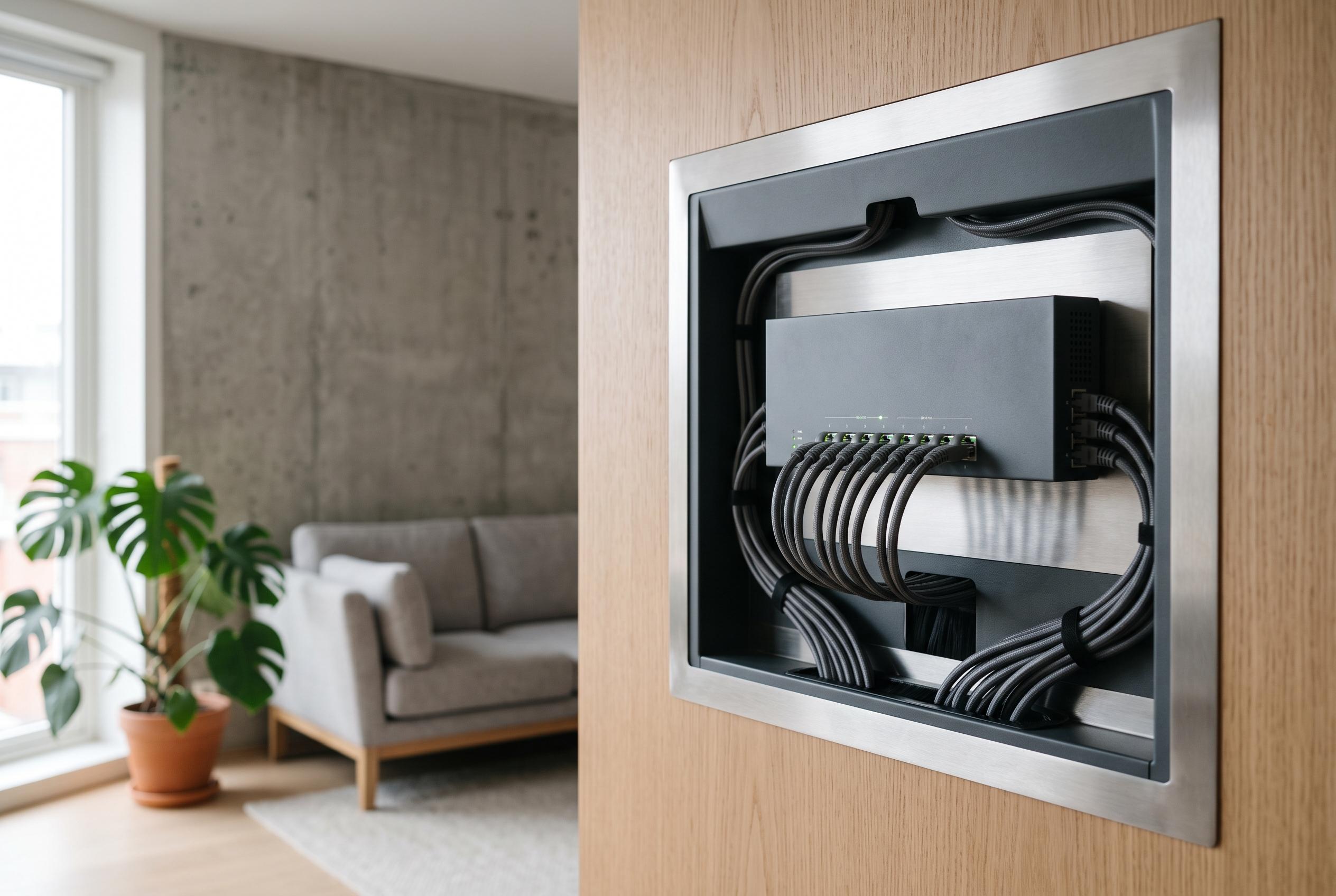

The latest industry research from CEDIA reveals that the US professional residential technology market is now centred on networking and infrastructure, marking a shift from high-end spectacle towards reliable, everyday systems amid increasing AI adoption and workforce challenges.
CEDIA Expo 2026 in Denver was dominated by eye-catching hardware: vast displays, high-end theatres, premium loudspeakers and automation systems pitched at affluent homeowners. Yet the more revealing story came from CEDIA’s new Professional US Smart Home Market Analysis, which places the US professional residential technology integration market at $33.8 billion across about 23,000 businesses.
That figure matters because it shifts attention away from the most photogenic products and towards the categories that actually sustain the sector. According to the analysis, home networking is now the largest segment, worth about $5.2 billion, followed by distributed audio at $3.8 billion and lighting and shading at roughly $3.7 billion. The findings suggest that the core of the business is less about spectacle than infrastructure, control and systems that must work reliably every day.
The study, produced with The Farnsworth Group, was based on 287 interviews conducted between late May and late June 2026 with integrators, security installers, networking specialists, electrical contractors, remodelers and general contractors involved in residential technology. CEDIA says respondents had to meet strict qualification criteria, including influence over buying or installation decisions and a meaningful share of business tied to residential projects. That makes the latest estimate a fresh benchmark rather than a straight continuation of the organisation’s 2023 research, which used a different methodology and produced a lower market estimate.
The dominance of networking is especially striking. CEDIA says 88% of firms installed home networking during the previous year, ahead of integrated control systems and media rooms at 77%, distributed audio at 76%, security at 72%, and outdoor audio and lighting and shading at 70% each. CE Pro’s reporting from the show floor reinforced that picture, with manufacturers increasingly presenting networking as the foundation for audio, video, security, HVAC and automation rather than as a background utility.
Distributed audio remains one of the industry’s biggest revenue pools, but it is increasingly being folded into broader system design. Coverage from CEDIA Expo 2026 noted products and demos from brands such as KEF, James by Sonance, Coastal Source and Theory Audio Design, all pointing towards a market in which audio appears across more room types and installation formats. Lighting is moving in a similar direction. CEDIA’s research puts lighting and shading almost level with distributed audio, and integrators identified it as one of their biggest growth opportunities for the year ahead.
Artificial intelligence was another major theme, but the research suggests the industry is still separating practical use from marketing noise. CEDIA says 79% of firms reported greater use of AI in their own operations over the past year, while 58% saw more customer demand for AI-related products or features. Even so, the most pressing constraint remains human capacity. Skilled labour was cited by 27% of respondents as the biggest business challenge, far ahead of finding new clients or keeping pace with technology. CEDIA has been building workforce programmes in response, including efforts to connect the sector with technical schools and younger workers.
Despite softer housing activity and higher costs in parts of the construction chain, the outlook inside the industry remains broadly upbeat. Nearly 78% of firms expect revenue growth over the next 12 months, and direct referrals continue to drive most new business. The message from Denver was therefore less about the scale of the latest six-figure theatre systems than about the quieter layers underneath them: networking, audio, lighting and the technicians who can make the whole stack function.
Disclaimer: This content is intended for informational purposes only. Readers are advised to exercise their own judgement, conduct due diligence, or consult a qualified expert before acting on any information provided.