
Recent advancements in mini PC technology now enable compact systems to serve as powerful AI workstations and creative machines, featuring support for up to 96GB of RAM and modern connectivity, blurring the line between small desktops and full-sized workstations.
Mini PCs with 96GB of RAM are no longer a niche category for enthusiasts alone. They now sit at the point where compact systems can credibly serve as AI workstations, creator machines, homelab nodes and serious office desktops without taking up tower-sized space. For buyers weighing portability against headroom, the attraction is clear: more memory for large projects, more room for virtual machines and fewer slowdowns when many applications are open at once.
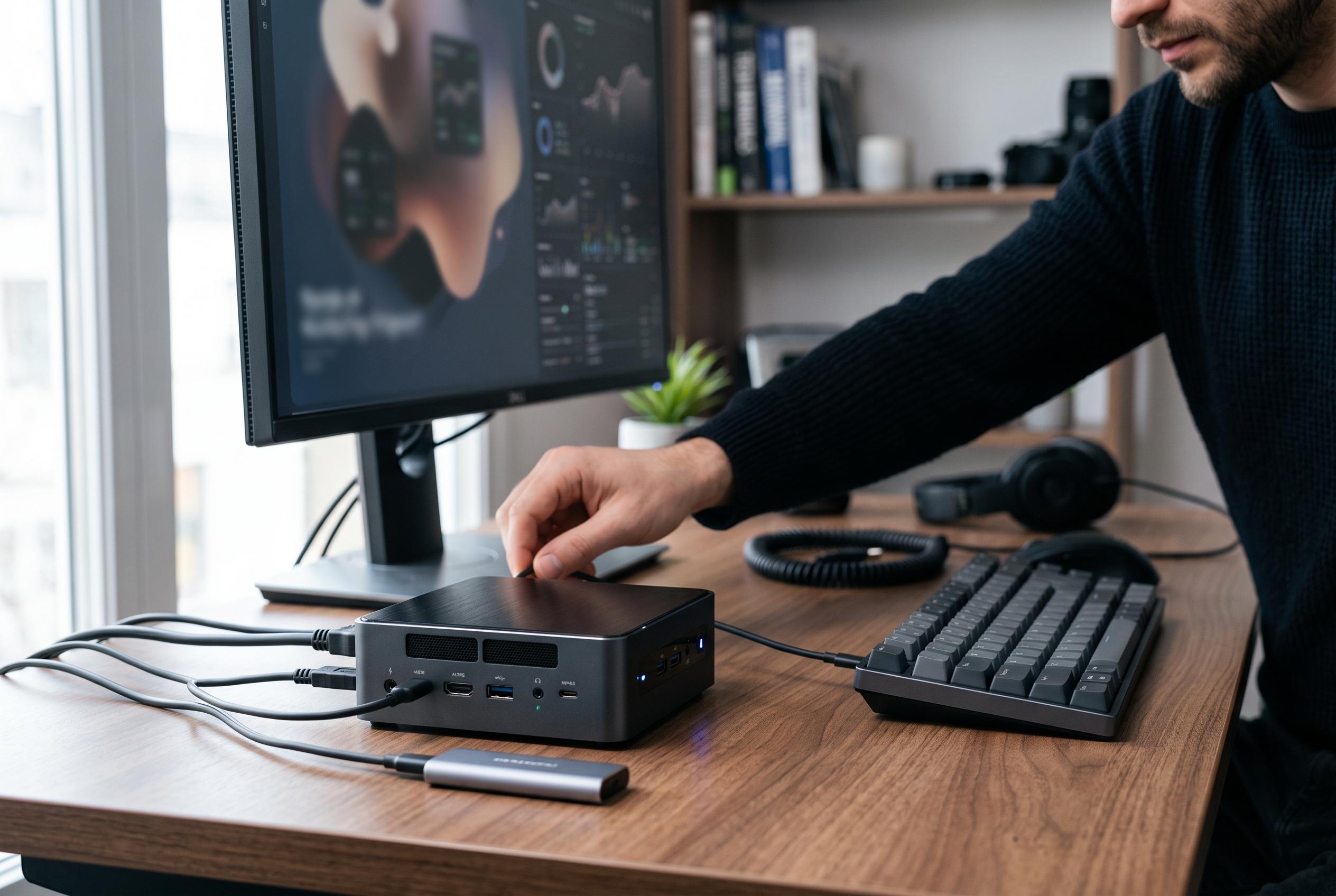
The strongest examples in this class are defined less by RAM alone than by the wider platform around it. That means recent Ryzen AI and Intel Core Ultra processors, fast DDR5 or LPDDR5X memory, USB4, 2.5GbE or 10GbE networking, and enough display outputs to support demanding desk setups. TechRadar’s 2026 mini PC guide also reflects this shift, highlighting how performance, upgrade potential and connectivity now matter as much as raw speed when users choose compact systems.
For users who want a balanced everyday machine, the most practical options are the ones that combine 96GB support with sensible expansion. Minisforum’s X1 Pro family, Beelink’s SER9 MAX and GMKtec’s K8 Plus all follow that pattern in different ways, offering strong integrated graphics, modern wireless standards and flexible storage. Systems such as the Reatan X8 and Minisforum MS-A2 go further by emphasising future growth, with the ability to move up to 96GB of memory and add more storage or higher-end networking later.
The market is also moving well beyond the old assumption that mini PCs are only for office work. TechRadar has recently pointed to more capable machines, including GMKtec’s higher-end AI models and Bosgame’s M5 AI system, as evidence that compact desktops are becoming legitimate tools for local AI tasks and creator workloads. At the top end, CHUWI’s UniBox AI495 Pro, shown at IFA Berlin 2026, illustrates how far the category has advanced, with support for as much as 192GB of LPDDR5X memory, dual 10Gbps Ethernet and two USB4 ports in a 2.9-litre chassis.
Networking is another dividing line in this segment. Buyers building a home lab, file server replacement or multi-machine workspace will get more value from models with dual 10GbE or at least dual 2.5GbE ports than from systems focused purely on graphics. That is why machines such as the Beelink GTi15 285H and Minisforum MS-A2 stand out: they are built not just for speed, but for moving data quickly and reliably between drives, NAS units and other devices.
The key point for shoppers is that 96GB is now a sensible target rather than an extreme one. It gives enough overhead for heavy multitasking, local model work and creative software without forcing a move to a full desktop tower. According to current mini PC line-ups, the best choices are those that treat memory as part of a wider system design: adequate cooling, modern I/O, flexible storage and a processor matched to the workload. That is what separates a compact computer that merely fits on a desk from one that can genuinely replace a larger workstation.
Disclaimer: This content is intended for informational purposes only. Readers are advised to exercise their own judgement, conduct due diligence, or consult a qualified expert before acting on any information provided.