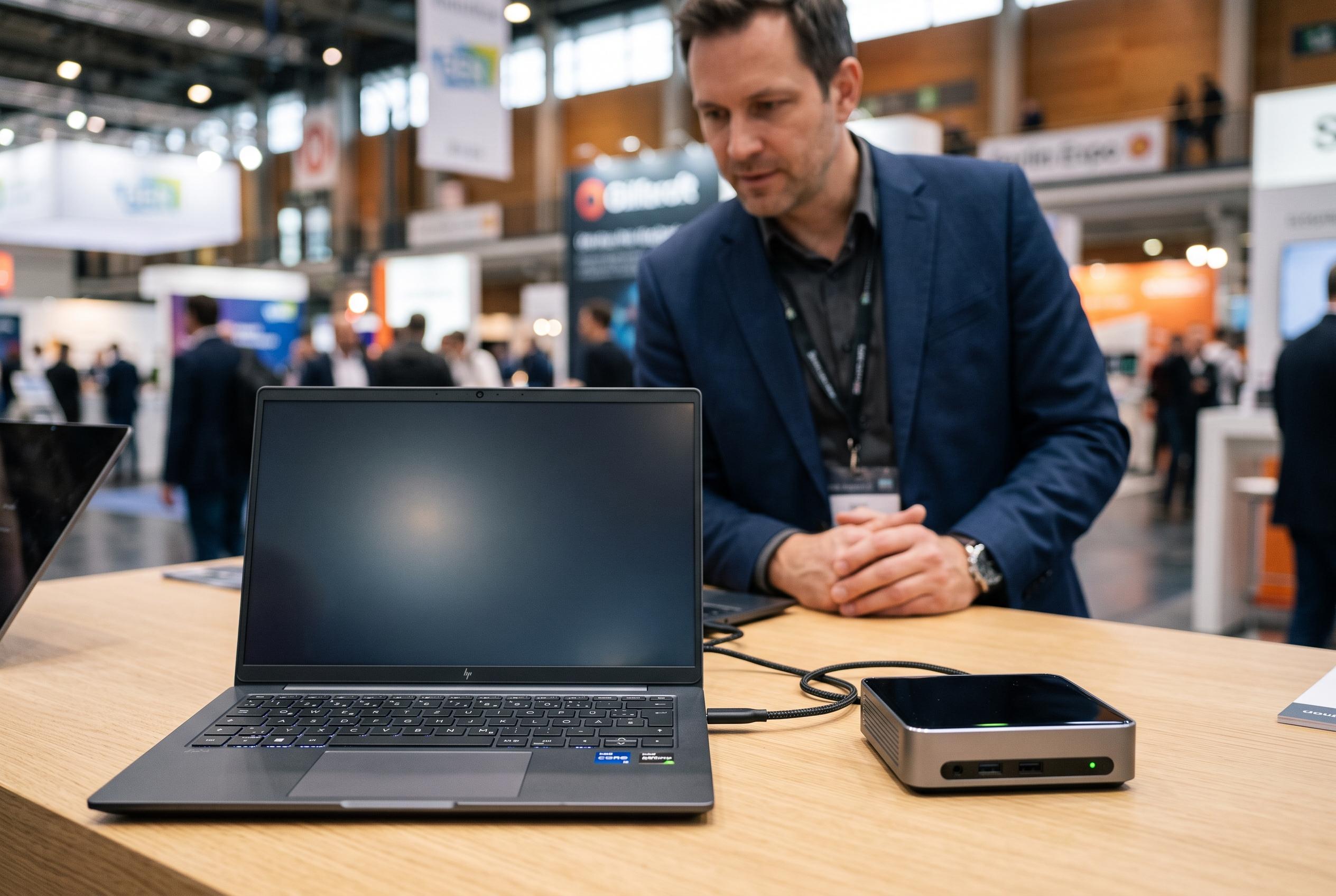

At IFA 2026 in Berlin, AMD unveiled new hardware and software strategies emphasising the shift towards personal AI, with devices capable of understanding context and performing complex tasks locally, signalling a disruptive change in computing paradigms.
AMD used its IFA 2026 keynote in Berlin to argue that the next phase of computing will be built around personal AI, not cloud-only services. Speaking at the show, senior vice-president and general manager Jack Huynh framed the shift as a move towards devices that can understand context, assist more intelligently and keep more of the work local to the user.
The company paired that vision with new hardware and software aimed at developers and enterprise buyers. AMD said Ryzen AI Halo systems will arrive with Microsoft’s Project Zenith developer environment preloaded, alongside Visual Studio Code, Windows Subsystem for Linux, GitHub Copilot CLI and PowerShell, in a bid to make local AI development faster and less dependent on remote infrastructure. The AMD website also said the company’s new Ryzen AI Halo developer platform and Ryzen AI Max PRO 400 Series processors are intended to help teams build and run agentic AI applications on-device, with support for models of up to 200 billion parameters.
At the more extreme end of the product stack, AMD unveiled the Threadripper Halo Station, a workstation prototype designed to bring datacentre-style AI performance to a desktop form factor. According to AMD and coverage from Tom’s Hardware, the system combines a Ryzen Threadripper PRO 9995WX processor with dual Instinct-class accelerators, and is pitched at users who need to train or fine-tune very large models locally. Tom’s Hardware reported that the machine is built around a 96-core Threadripper PRO chip and dual liquid-cooled Instinct MI350P accelerators, underlining AMD’s attempt to position the platform as a workstation for heavy AI research rather than conventional creative work.
AMD also linked the launch to enterprise deployment through a collaboration with SUSE, which it said is intended to help developers move AI workloads from local systems into supported production environments. Alongside that, the company highlighted a range of OEM products shown at the event, including Acer’s Aspire G AGB110 mini-PC and Aspire G 3D 16 notebook, plus Lenovo’s ThinkCentre X Ultra, M75s Gen 6, M75q Gen 6 and IdeaPad Slim 3. AMD said these systems reflect a broader industry change in which on-device AI is becoming a baseline expectation rather than an optional extra.
Disclaimer: This content is intended for informational purposes only. Readers are advised to exercise their own judgement, conduct due diligence, or consult a qualified expert before acting on any information provided.