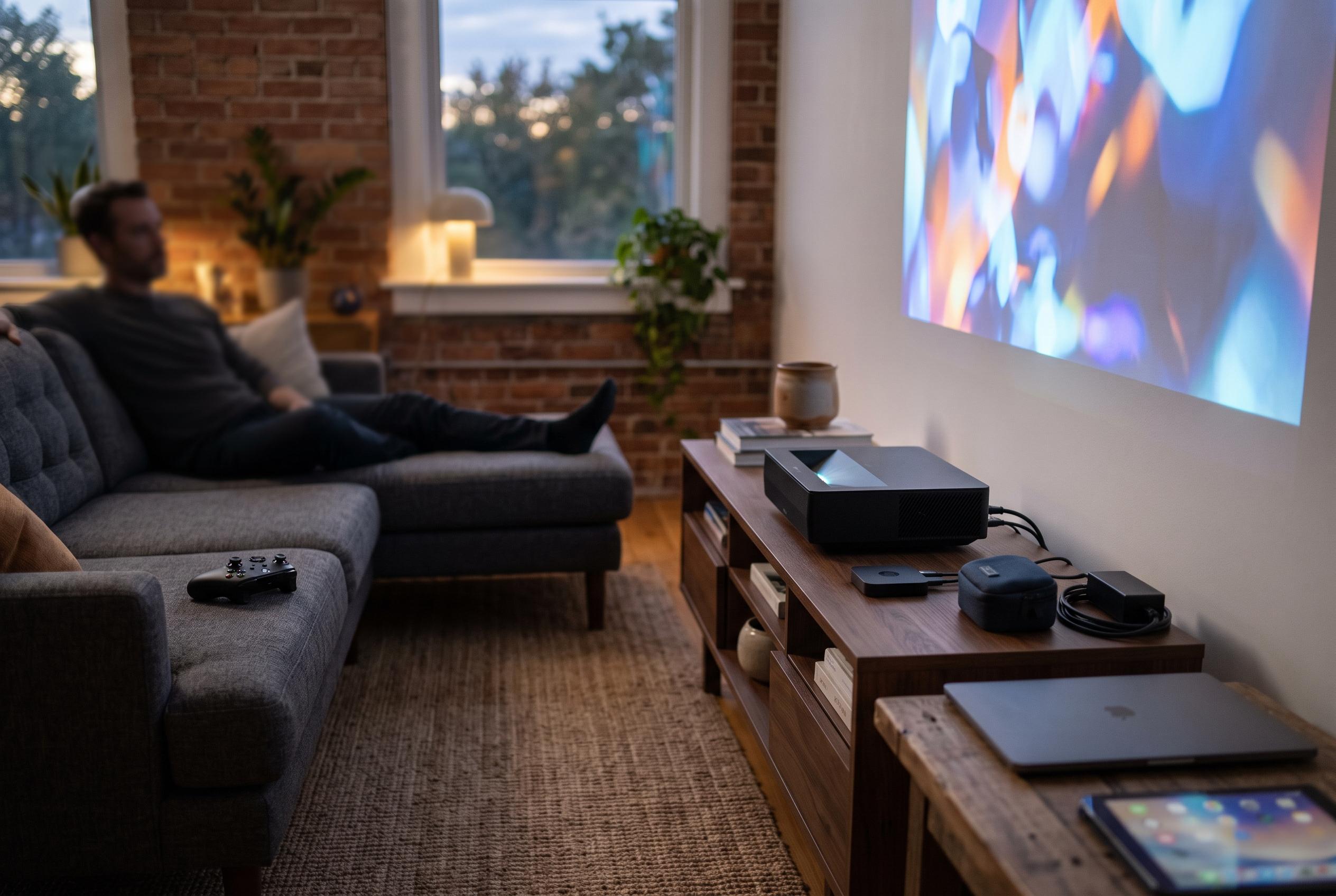

High-end laser projectors like XGIMI Titan, JMGO IRIS Ultra Max, and Nebula X1 Pro signal a shift towards multifunctional large-screen displays, blending brightness, colour accuracy, and portability for diverse settings beyond traditional home theatres.
Recent round-ups of premium laser projectors show how far the category has moved beyond simple home cinema. The latest models are pitched as large-screen displays for living rooms, outdoor events, studios and meeting spaces, with brightness, colour accuracy and installation flexibility now as important as resolution. According to the product material and specialist coverage, the current stand-out names are XGIMI Titan, JMGO IRIS Ultra Max and Nebula X1 Pro. These are not budget replacements for a television; they are high-spec systems built to handle difficult rooms and varied use cases.
XGIMI’s Titan is the most conventional of the three, but also one of the most balanced. The company says it uses a dual-laser light engine, a 0.78-inch DLP chip and 5,000 ISO lumens, a combination aimed at rooms with some ambient light. XGIMI also claims support for HDR10, HDR10+, Dolby Vision, HLG and IMAX Enhanced, while buyers get motorised lens adjustment, optical zoom and lens shift. That matters because optical alignment preserves image quality better than heavy digital correction. Independent coverage has noted that the Titan is impressive for brightness and sharpness, even if its black levels are less convincing in a dark room.
JMGO’s IRIS Ultra Max is the most technically aggressive option, especially for gaming. JMGO says it is a true 4K projector capable of 120Hz output without dropping to a lower resolution, backed by TI dual DLPC chips. The company also lists VRR, low latency and 4K 120Hz motion processing, which makes it more relevant to PlayStation 5, Xbox Series X and gaming PCs than many rivals. Brightness is quoted at 6,500 ISO lumens, with 10,000:1 native contrast and 110% coverage of BT.2020. It also has a motorised gimbal, four-way lens shift and a wide optical zoom range, giving it unusual placement freedom for a high-performance projector.
Nebula’s X1 Pro takes a different approach by treating audio as part of the product, not an afterthought. According to Nebula’s information, the system includes a wireless 7.1.4 speaker package with Dolby Atmos and 400W of output, plus two wireless microphones. That makes it better suited to outdoor screenings, parties and karaoke than most projectors, which usually rely on weak built-in speakers or an external sound system. The projection side is still serious, with a triple-laser light source, Dolby Vision support, 3D playback, a glass lens and flexible setup tools such as autofocus, obstacle avoidance and wall-colour adaptation. In practice, it is the most lifestyle-oriented of the three and the easiest to move between rooms.
Taken together, the three models show where the premium projector market is heading. XGIMI is targeting all-round home cinema use, JMGO is pushing harder into gaming and installation flexibility, and Nebula is trying to package image, sound and portability as one system. For buyers, the main trade-off is no longer simply brightness versus resolution. It is whether the projector is intended to replace a television, support a console, or act as a portable event system.
Disclaimer: This content is intended for informational purposes only. Readers are advised to exercise their own judgement, conduct due diligence, or consult a qualified expert before acting on any information provided.