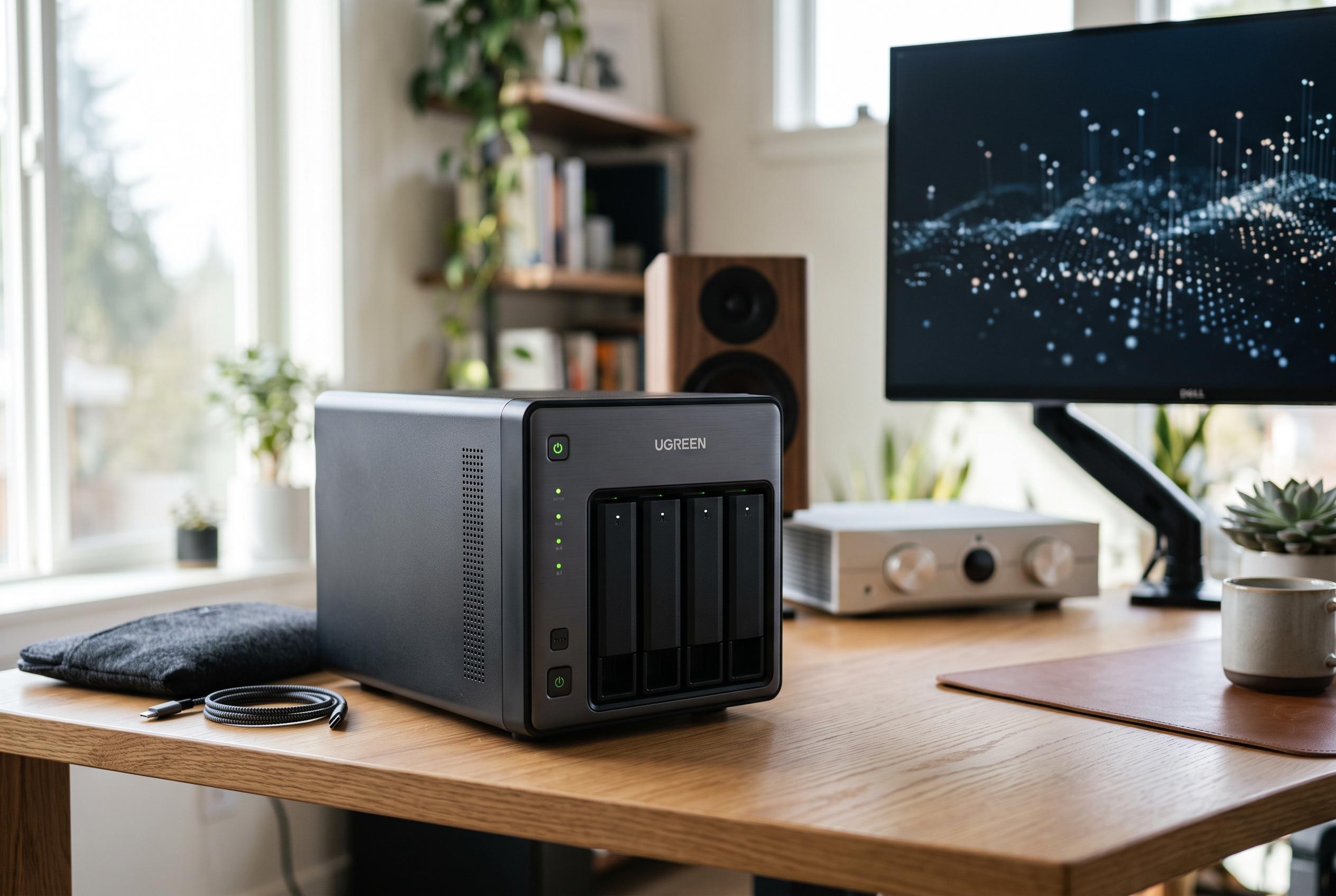

Ugreen’s DXP4800 Pro emerges as a versatile home server with enterprise-grade specs, offering enhanced media transcoding, virtualisation, and network speed, though software ecosystem still trails behind industry leaders.
UGREEN’s DXP4800 Pro is best understood as a response to a shift in how many people use a NAS. It is no longer just a quiet box for files. In the hands of reviewers at Android Central, IT Pro and TechRadar, the device is presented as a compact home server as much as a storage appliance, built around a 13th-generation Intel Core i3-1315U, DDR5 memory and dual-network connectivity including 10GbE. That combination gives it far more headroom than the typical consumer NAS, especially for Docker containers, media streaming and other parallel workloads.
That hardware advantage is the DXP4800 Pro’s main appeal. Reviewers have repeatedly highlighted its ability to handle transcoding, virtual machines and heavier container stacks without feeling undersized. Android Central noted support for up to 96GB of DDR5 RAM and pointed to the machine’s suitability for media-heavy use, while TechRadar described the newer model as a meaningful step up from earlier UGREEN units thanks to faster graphics, AV1 decoding and better concurrent performance. For users who want one device to run services, manage backups and stream media, that is a persuasive case.
The other major draw is speed over the network. IT Pro reported that the enclosure includes both 2.5GbE and 10GbE ports, plus two M.2 slots for NVMe storage, giving it a clear advantage when moving large files or building a cache for frequently accessed data. That matters less for opening documents, but more when consolidating libraries, editing large media files or copying data between machines. It also makes the system more future-proof, since network upgrades tend to outlast individual drive cycles.
The trade-off is software maturity. Reviewers have been far less enthusiastic about UGOS Pro than about the hardware. IT Pro said the platform still trails Synology and QNAP in app depth and advanced features, while TechRadar found the ecosystem improved but not yet class-leading. That gap matters most in storage management. Synology’s Hybrid RAID remains a clear advantage for users mixing drives of different sizes or expanding one disk at a time. UGREEN offers conventional RAID modes, but not the same flexibility. For buyers starting from scratch with a matched set of disks, that may be acceptable. For anyone building gradually, it is a real constraint.
Disclaimer: This content is intended for informational purposes only. Readers are advised to exercise their own judgement, conduct due diligence, or consult a qualified expert before acting on any information provided.