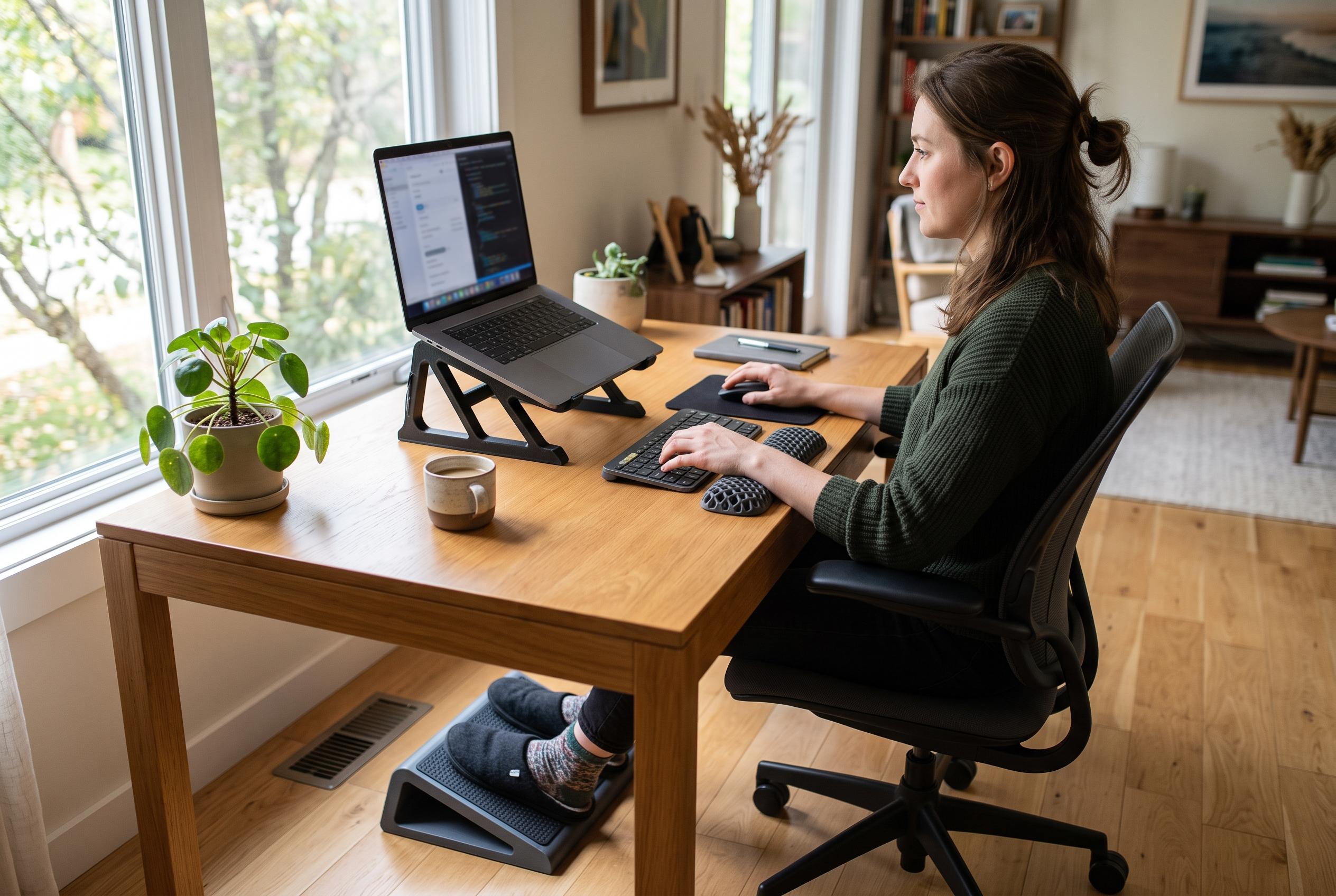

Advances in 3D printing are enabling customised ergonomic solutions, like wrist rests, laptop stands, and foot supports, to help improve posture and reduce strain during everyday tasks at home.
3D printing is increasingly useful for making small adjustments that improve everyday comfort, not just novelty objects. For home offices, reading and handheld gaming, the most practical designs tend to address posture, support and the way pressure is distributed across the body. That can mean a wrist rest, a raised screen, a foot support or a better grip on a portable console.
Wrist rests are a good example. Lenovo says these accessories are intended to support the wrists during long sessions at a keyboard or mouse, with the aim of reducing fatigue and lowering the risk of repetitive strain injuries. Bublepik’s 3D-printed mouse rests take that idea further with an open-lattice structure, a wipe-clean surface and a stable base, while higher-end products such as Autonomous’ ErgoRest 3D use a polymer lattice and claim to reduce load rates substantially. But ergonomics specialists at ErgoCanada caution that wrist rests are not always beneficial and may increase risk if they press on soft tissue; they argue that palm supports used mainly during pauses are often preferable.
Screen height is another area where 3D printing can make a measurable difference. A laptop placed flat on a desk encourages the user to hunch forward, which can strain the neck and shoulders over time. Guides from cani3dprintit.com stress that a printed laptop stand needs a braced structure and a suitable material such as PETG if it is to remain rigid and durable. Similar commercial tablet-and-laptop stands from Print-Gift.ro are designed to lift the display closer to eye level, reducing the need to crane the neck and helping the user maintain a more neutral posture.
A footrest is less visible but can be just as useful. Raising the feet can improve seating position and circulation, particularly for shorter users who cannot place their feet flat on the floor. The most practical printed versions often combine plastic supports with wood or other materials to save filament and improve strength. That same approach applies to other ergonomic prints, from a rotating ring that keeps a book open with less finger strain to custom grips for handheld consoles. In each case, the value of the print is not in the object itself, but in the small reduction it brings to tension, awkward angles and repeated effort.
Disclaimer: This content is intended for informational purposes only. Readers are advised to exercise their own judgement, conduct due diligence, or consult a qualified expert before acting on any information provided.