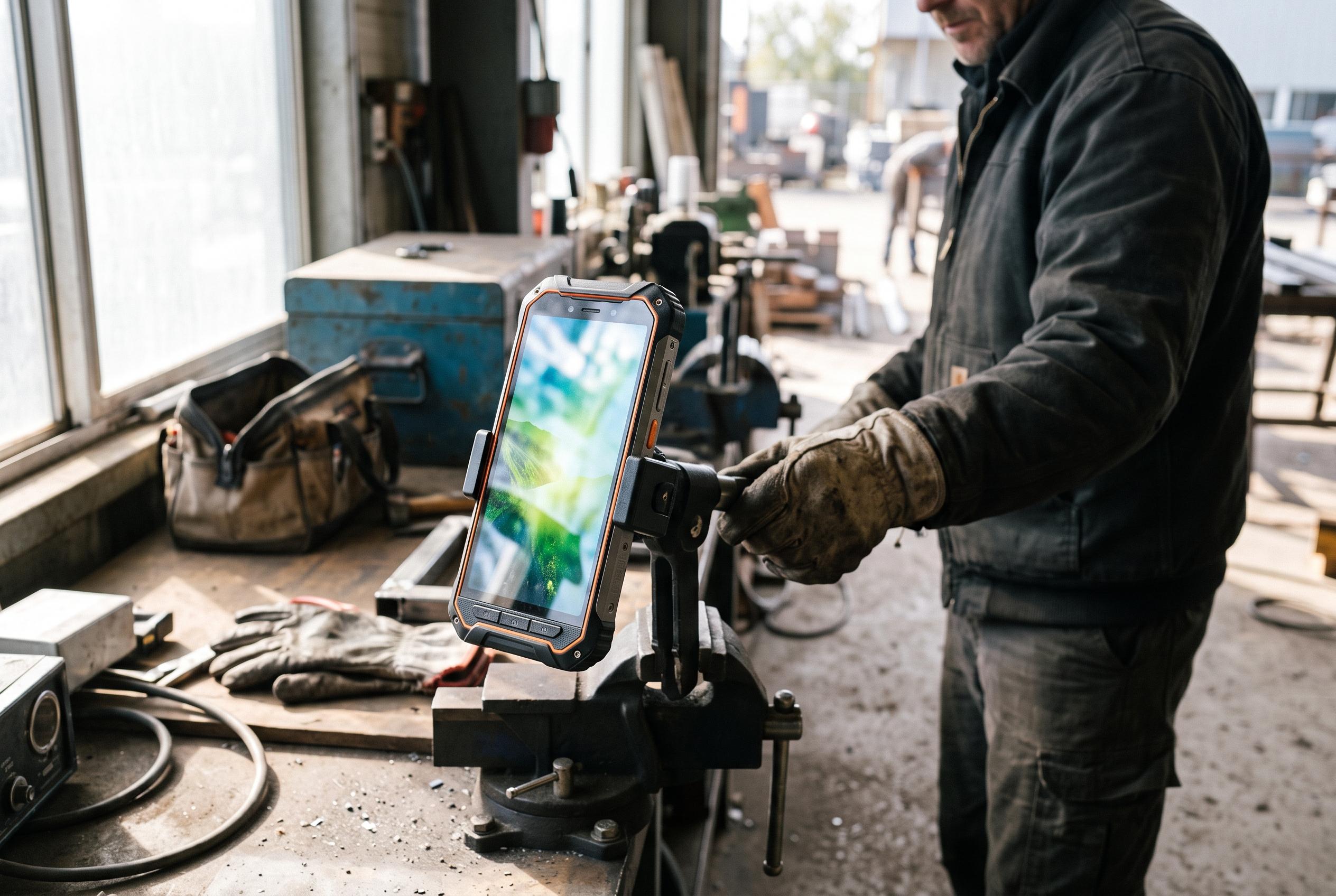

Choosing the right screen for rugged phones hinges on specific working conditions, with recent advancements tightening the gap between AMOLED and LCD in brightness, durability, and power efficiency in demanding environments.
For buyers of rugged phones, the screen choice is not a cosmetic detail but a practical one. In devices built for sites, farms, warehouses and outdoor work, the panel has to stay readable in harsh light, preserve battery life and survive repeated knocks. The central trade-off is between AMOLED and LCD, two display types that behave very differently once a handset leaves an office desk.
The distinction begins with how each panel produces an image. AMOLED uses self-emissive pixels, so each dot can switch on and off individually. LCD depends on a constant backlight behind the panel. That basic design difference explains why AMOLED usually delivers deeper blacks and stronger contrast, while LCD tends to look flatter but more uniform. Several display guides also note that AMOLED can appear more vivid, although the actual result depends on the quality of the panel rather than the label alone.
Outdoors, brightness matters more than contrast. A screen that looks excellent indoors can become difficult to read in direct sun, and rugged-phone buyers often prioritise this more than any other specification. LCD panels have traditionally had an advantage in peak brightness, but recent AMOLED panels have narrowed the gap, with some now exceeding 2,000 nits and reaching levels that rival or surpass comparable LCDs. That means the sensible comparison is not between technologies in the abstract, but between the specific phones and their rated peak brightness.
Battery performance also differs in a way that matters to field users. Because AMOLED only powers lit pixels, dark interfaces and dark mode can reduce consumption, especially when a device is showing maps, menus or other dark content. LCD backlights remain active at a steady level, so drain is less dependent on what is on screen. However, that does not make AMOLED universally more efficient: a bright white page or an all-day document workflow can erode the advantage, and the real-world outcome still depends on battery size, software tuning and the display’s brightness setting.
Durability is the other major consideration. LCD generally carries a lower risk of burn-in and tends to age more predictably over long periods of static use. AMOLED has improved substantially, but image retention remains a known issue if fixed icons or navigation elements stay on screen for extended periods. Repair economics matter too. Replacement AMOLED panels often cost more than LCD equivalents, which can affect the total cost of ownership for buyers who expect frequent drops, impacts or screen damage in rough environments.
The best choice therefore depends on working conditions rather than brand preference. Buyers who spend long hours in bright sun should examine peak nits, not marketing claims. Those who use dark interfaces heavily may benefit from AMOLED’s lower power draw on dark content. Anyone trying to minimise repair costs or avoid burn-in risk may prefer LCD. In practice, the strongest rugged-phone designs increasingly pair AMOLED with very large batteries to offset its power demands, showing that manufacturers see the display decision as part of a broader system rather than a simple contest between two panel types.
Disclaimer: This content is intended for informational purposes only. Readers are advised to exercise their own judgement, conduct due diligence, or consult a qualified expert before acting on any information provided.