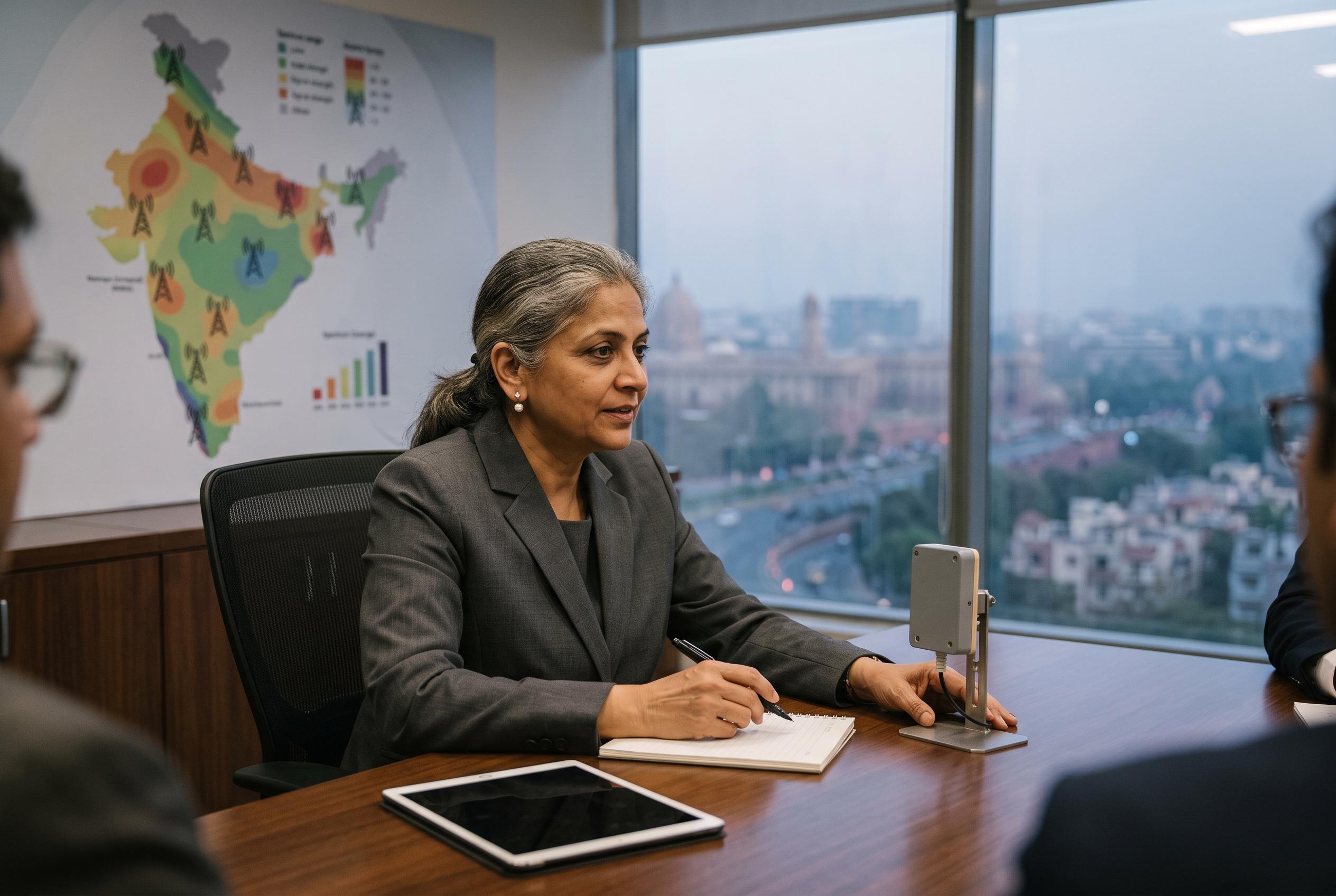

A high-level consultation in New Delhi underscores India’s ambitions to shape the future of 6G spectrum policy, with a focus on the contested upper mid-band segment and regional leadership ahead of WRC-27.
According to Communication Today, a consultation in New Delhi has brought fresh attention to India’s bid to shape the spectrum agenda for 6G, with policymakers, regulators, operators and standards bodies coalescing around a contested but increasingly prominent upper mid-band segment between 6.425 GHz and 8.4 GHz. The session, titled “6G Golden Band: Can India Lead the Global Spectrum Agenda?”, was jointly organised by NITI Aayog and the ITU-APT Foundation of India at the Civil Services Officers’ Institute on 23 September.
The technical case for the band is straightforward. Supporters argue that it offers the mix of coverage, capacity and contiguous bandwidth that future 6G systems will need, particularly if networks are to support channels of 200 MHz to 400 MHz. Prof Abhay Karandikar, a member of NITI Aayog, said India has an opportunity to help define the global framework for 6G spectrum by building an early domestic consensus around the so-called Golden Band and presenting a coordinated position before the World Radiocommunication Conference in October 2027 in Shanghai. He also stressed that coexistence studies will be essential if existing fixed, satellite and other services are to be protected while new uses are introduced.
Bharat Bhatia, president of IAFI, said India had already played a central role in putting 6G spectrum on the WRC-27 agenda and should now press that advantage. He argued for a study-led approach in which parts of the 6.425-8.4 GHz range could develop into a regional or global tuning range for 6G, while administrations retain flexibility to protect incumbent users. The wider industry case was reinforced by Dr Ravi Gandhi of Reliance Jio, who said India’s heavy reliance on wireless networks makes additional mid-band capacity unavoidable. He said India now has more than 400 million 5G users and over one billion broadband connections across wireless and wireline services, with about 95 per cent of data traffic carried over wireless networks.
Others at the consultation tied the spectrum debate to international process and domestic planning. Jitendra Singh of Qualcomm India said India is chairing the relevant WP5D studies on the 7.125-8.4 GHz range and must resolve refarming and incumbent issues at home while building support abroad. Ashish Garg of GSMA said technical advances such as advanced MIMO and AI-enabled radio networks would improve efficiency but could not replace the need for additional mid-band spectrum, particularly if 6G is to support immersive communications, extended reality and integrated AI services. Dr Manish Saxena of ISRO underlined the need to safeguard existing and planned satellite operations, while TRAI’s Arun Agarwal pointed to earlier recommendations on the upper 6 GHz band and the importance of aligning Indian policy with outcomes at WRC-27.
Amit Gulati of the Wireless Planning and Coordination wing of the Department of Telecommunications called for sustained engagement with Asia-Pacific administrations and more active participation in APT working groups. Pradeep Singh, who moderated the discussion for NITI Aayog, invited stakeholders to submit their views within two weeks so that policy work on the Golden Band could continue. The broader message from the meeting was that India’s 6G strategy will depend not only on domestic coordination across government, industry and academia, but also on technical evidence, coexistence planning and regional diplomacy if it is to influence the spectrum decisions that will shape the next generation of mobile networks.
Disclaimer: This content is intended for informational purposes only. Readers are advised to exercise their own judgement, conduct due diligence, or consult a qualified expert before acting on any information provided.