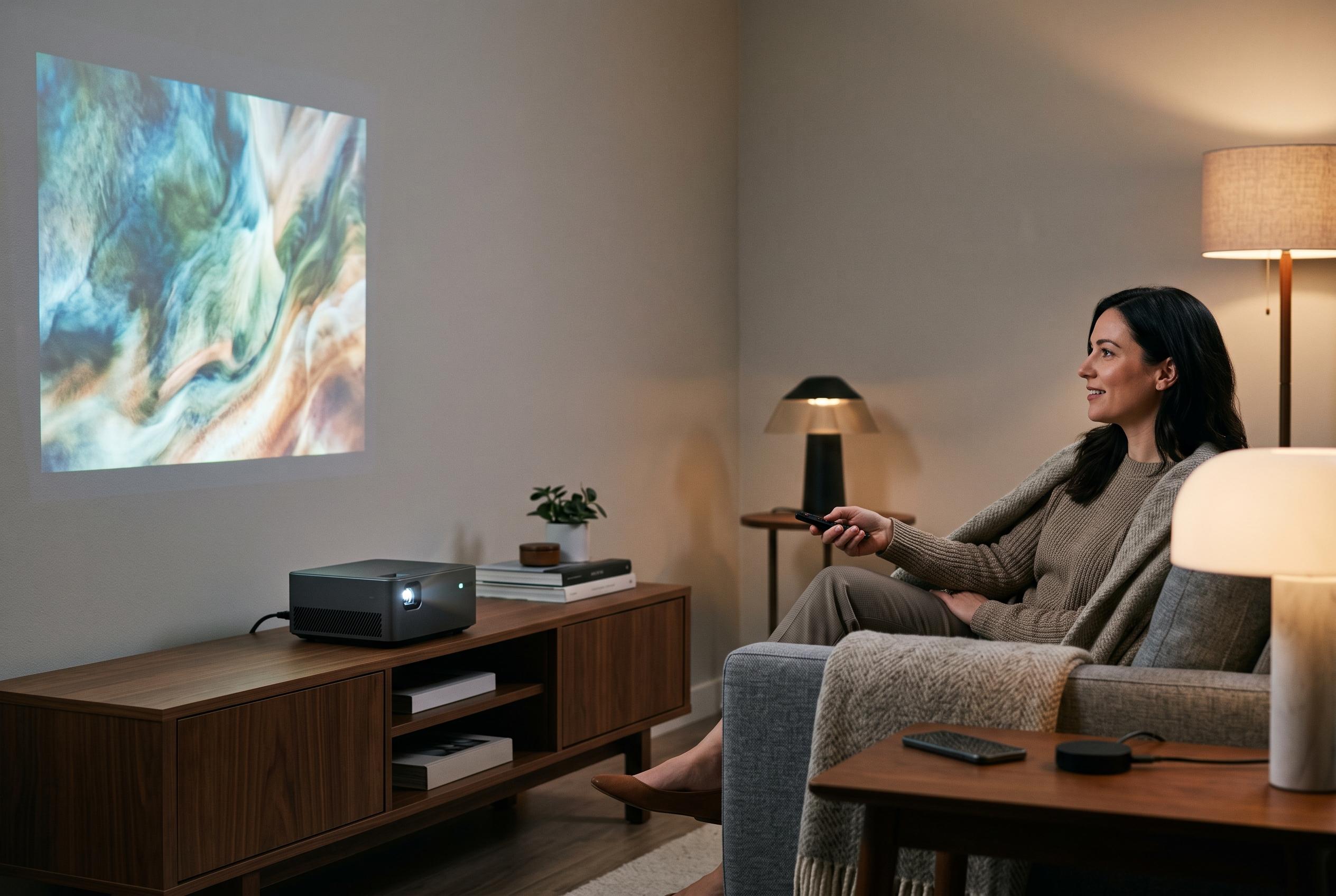

Leica has launched the Cine Compact 1, a compact, portable projector featuring 4K output, laser light source, and streaming capabilities, signalling a shift in its home cinema offerings and challenging established rivals with premium build quality and flexible placement options.
Leica’s Cine Compact 1 is a reminder that the brand’s expertise has never been limited to still photography. The company has been making projectors for decades, and this latest model extends its recent push into home entertainment with a compact design, a laser light source and a price that places it firmly in the premium portable class. At $1,995 in the United States, it is still far from cheap, but it is notably less expensive than Leica’s earlier, larger home cinema projectors, while remaining a serious alternative to higher-brightness rivals such as Hisense’s C2 Ultra.
The projector’s physical design follows the now-familiar cube-and-gimbal formula seen in this category, but Leica gives it a distinctive finish and a more limited mechanical movement than some competitors. The body is built around a DLP imaging system using pixel shifting to produce 4K output, paired with a triple RGB laser light source rated for 25,000 hours. Leica says brightness reaches 1,700 lumens, while the company also cites projection sizes up to 220 inches and a 360-degree rotation system that lets the unit aim upwards, downwards or across a room. In practice, that flexibility makes the projector easy to place, though its movement is confined to one axis rather than full two-axis freedom.
Portability is one of its stronger selling points. At under 10 pounds, it is light enough to carry between rooms or outdoors, and it ships in a foam case with a handle. Leica also includes an optional stand and an integrated tripod thread for ceiling mounting. Setup is designed to be straightforward, with autofocus, automatic screen fitting, keystone correction and intelligent framing. For the best picture quality, though, those digital corrections are best used sparingly. The projector also includes optical zoom, which is a valuable advantage over many compact models because it allows users to preserve brightness more effectively than with digital zoom adjustments.
Leica has also paid close attention to audio and streaming. The Cine Compact 1 runs Hisense’s Vidaa operating system, which gives access to major services including Netflix and other common streaming platforms, and the remote includes dedicated app buttons. The interface is functional, although some menu behaviour can feel overbearing during setup. On the audio side, the built-in 2 x 10-watt speakers are strong enough for a large living room, and the projector supports Dolby Digital, Dolby Digital Plus and DTS Virtual:X. External sound systems can be connected by Bluetooth or through HDMI eARC, which makes the device more flexible than many self-contained portable projectors.
Image performance is mixed at factory settings, but improves meaningfully with adjustment. The projector supports SDR, HDR10, HLG, HDR10+ and Dolby Vision, and it also includes 3D playback. In testing, SDR content responded well to modest changes in colour saturation, colour temperature and brightness, producing solid contrast, good shadow detail and generally accurate colour. HDR required more intervention, because the default picture modes were judged too dark, but switching to brighter HDR settings and enabling tone mapping improved visibility and balance. Streaming material, however, appears to suit the projector particularly well, with one reviewer noting that default settings on online content delivered convincing colour and contrast across SDR, HDR10 and Dolby Vision.
Leica’s Cine Compact 1 is also clearly aimed at gamers as well as film fans. The projector supports auto low latency mode, and measured input lag came in below Leica’s own specification in testing, with especially low figures at 1080p and 240Hz. Brightness remains the main compromise. The rated output is enough for a cinematic image in a dark room and adequate for moderate ambient light at more modest screen sizes, but it is not in the same class as the brightest room-to-room projectors. That means buyers are paying not for maximum punch, but for compactness, build quality, versatile placement and Leica’s emphasis on lens quality and image refinement. For viewers who value those qualities, the Cine Compact 1 makes a strong case, even if its price still keeps it in niche territory.
Disclaimer: This content is intended for informational purposes only. Readers are advised to exercise their own judgement, conduct due diligence, or consult a qualified expert before acting on any information provided.