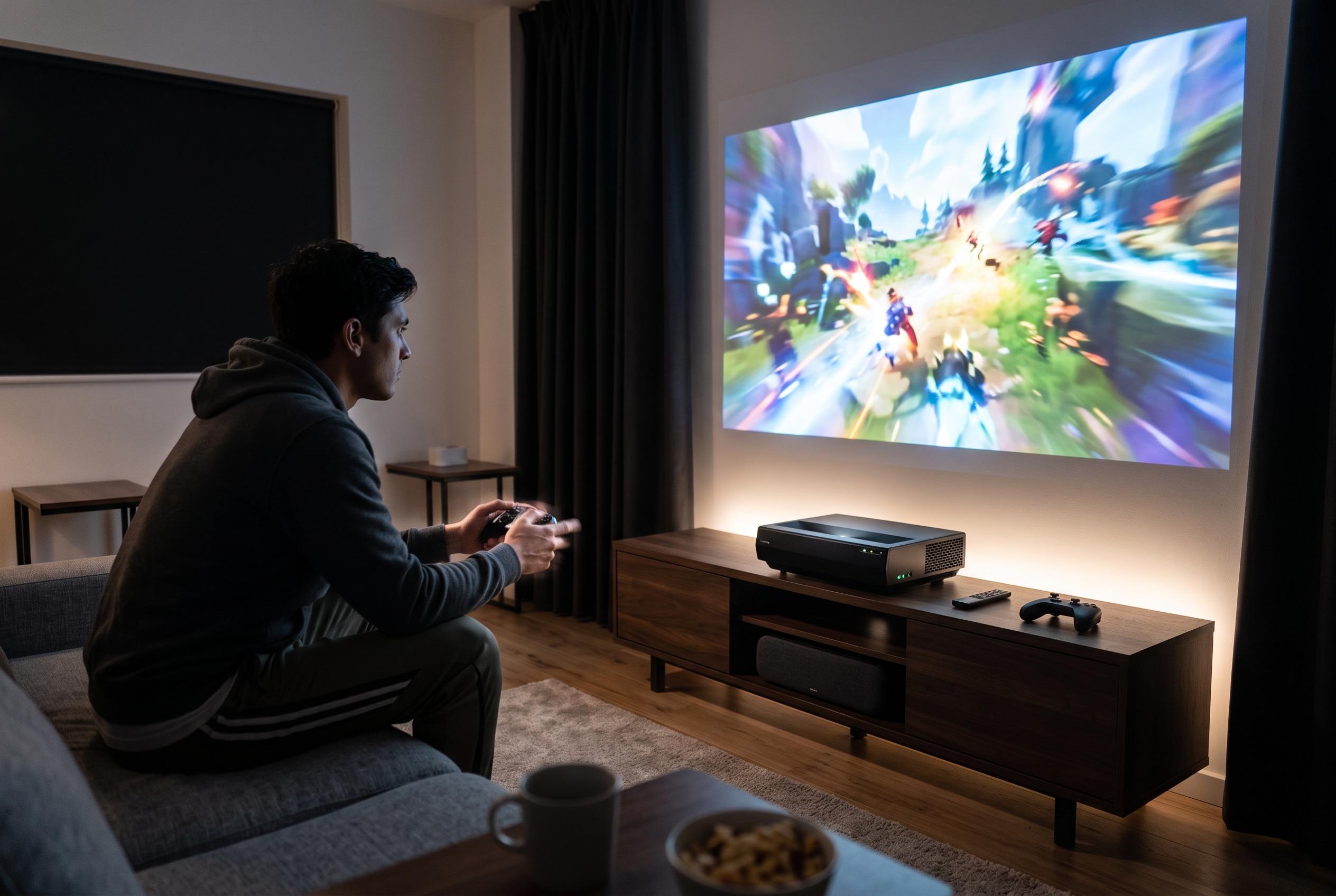

The ViewSonic LX700-4K emerges as a leading choice for gamers seeking a laser projector prioritising fast response and high brightness, though with modest black levels and built-in speakers, highlighting its gaming-first design in the competitive projector market.
The ViewSonic LX700-4K remains the strongest all-round choice in this group for players who want a projector built around gaming rather than general home cinema. It pairs 4K UHD resolution with a laser light source and the sort of specification set that matters in practice: fast response, high brightness and enough placement flexibility to work in a typical living room. Independent reviews have described it as a bright DLP laser projector with low input lag and solid motion handling, while also noting that its black levels and built-in speaker are not its strongest points.
That trade-off is important because the LX700-4K is best understood as a gaming projector first and a film projector second. Projector Reviews says ViewSonic positions it within its “Designed for Xbox” line, with support for 1440p at 120Hz and a laser source rated for up to 30,000 hours. B&H Photo Video lists 3,500 lumens, HDMI 2.0 inputs and vertical lens shift, all of which reinforce the case for a setup that is easier to live with over time, even if the speaker and contrast performance are modest. For buyers in rooms with some ambient light, that combination is more practical than a spec sheet that only looks impressive on paper.
The BenQ TK710 is the clearest premium alternative for players who want a laser model with strong gaming credentials. Projector Central describes it as a 4K DLP laser projector with 3,200 ANSI lumens, low latency and support for 1440p at 120Hz, while also highlighting vertical lens shift and eARC for easier installation and audio integration. Video reviews cited in the source material point to 4.2ms input lag at 1080p/240Hz and 16.7ms at 4K/60Hz, which underlines the central compromise: it can be very fast, but not at every resolution and refresh-rate combination.
For buyers who want the simplest route to a conventional gaming installation, the ViewSonic PX701-4K still makes sense. The product summary emphasises its 4K resolution, 3,200 ANSI lumens, 240Hz support and 4.2ms input lag, which keeps it focused on console play without adding streaming software or onboard audio into the decision. The drawback is that the projector market rewards clear specification data, and the available product information is less consistent than it should be on screen size limits and some feature details. That makes it attractive on value, but less tidy as a recommendation than the LX700-4K.
The TK700 occupies a different niche. It is the more traditional lamp-based BenQ option, suited to tabletop placement and straightforward home entertainment use. The supplied material says a 100-inch image can be produced from roughly 8.2 feet away, with 3,200 lumens and HDR10 support, but it also notes inconsistent latency figures in the product data. In other words, it is a reasonable pick for a simple living-room projector, but not the cleanest choice for buyers whose main concern is clearly documented competitive gaming performance.
The other models in the roundup broaden the market beyond the core gaming trio. The VOPLLS G7 stands out for Google TV, automatic focus and keystone correction, which may matter more to casual users than raw gaming metrics. The XGIMI HORIZON 20 and Valerion StreamMaster Plus2 push into RGB triple-laser territory, combining stronger streaming and cinema features with gaming-friendly refresh rates and response times. For most buyers, though, the central decision still comes down to the same practical questions: how bright the room is, how far the projector must sit from the screen, and whether low lag or built-in convenience matters more.
Disclaimer: This content is intended for informational purposes only. Readers are advised to exercise their own judgement, conduct due diligence, or consult a qualified expert before acting on any information provided.