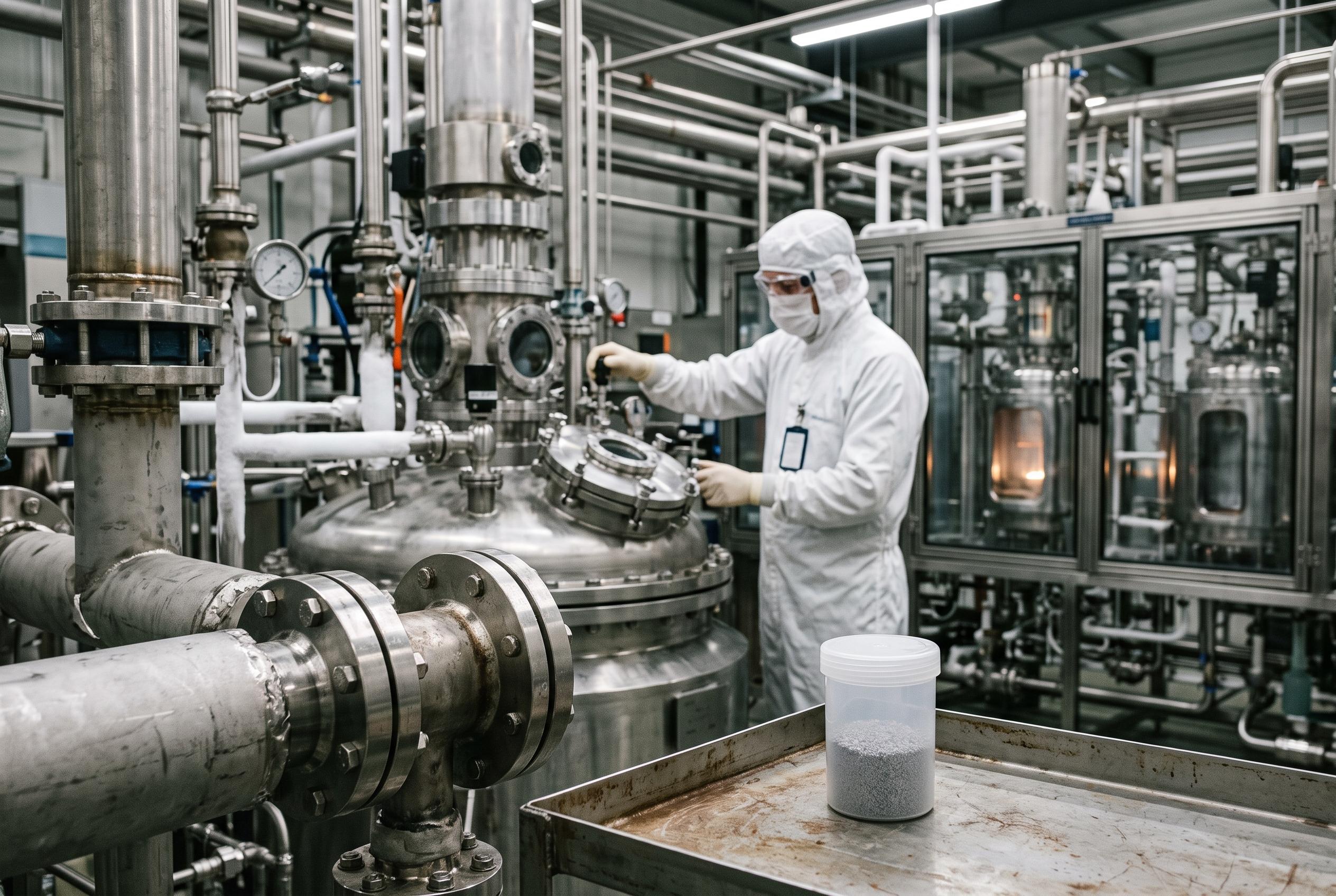

India is set to boost its solar manufacturing capabilities by incentivising domestic polysilicon production, aiming to reduce reliance on imports and strengthen its position in the global solar supply chain ahead of its 2030 clean energy targets.
India is preparing to move one step further up the solar manufacturing chain, with a proposed incentive programme for polysilicon production aimed at cutting dependence on imports, especially from China. According to the Ministry of New and Renewable Energy, the country has already built a substantial base in modules and is expanding cell output quickly, but it still lacks domestic supply of polysilicon, the purified silicon that sits at the start of the solar value chain. Reuters-style reporting from local outlets indicates the government is now considering whether to support more than 10 GW of capacity, with some discussions pointing to a larger target of at least 30 GW by 2030.
The shift matters because polysilicon is not a finished product; it is the raw material converted into ingots and wafers, which are then turned into cells and modules. India has made strong progress in the downstream parts of the chain, with the renewable energy ministry saying the country now has more than 213 GW of module manufacturing capacity and around 32 GW of cell capacity. But that progress leaves a clear gap upstream, where India remains heavily reliant on imported material.
Officials are discussing a production-linked incentive structure, although the final design, subsidy levels and eligibility rules have not been announced. Santosh Kumar Sarangi, the ministry’s secretary, has said setting up polysilicon and metallurgical-grade silicon plants could require investment of around Rs 850 crore per GW. The government is also looking beyond polysilicon alone, with a target of at least 80 GW of domestic ingot and wafer manufacturing capacity by June 2028 as part of a broader effort to build a more integrated solar industry.
Industry leaders say the proposal could strengthen supply security, but they also warn that self-sufficiency alone will not be enough. Vinay Thadani, director and chief executive of GREW Solar, told NDTV that India has advanced in modules and cells but still faces a major weakness in upstream materials. He said domestic production of polysilicon and wafers would make the sector more resilient, but added that long-term competitiveness will depend on scale, technology, efficient operations and access to low-cost power.
The policy push comes against the backdrop of India’s wider clean-energy ambitions and its desire to reduce concentration risk in strategic manufacturing. Business Standard reported that the Ministry of New and Renewable Energy is already in talks with the finance ministry over a PLI-style scheme for polysilicon, while Hindustan Times said the plan is linked to India’s 2030 non-fossil power goals. IEEFA has noted that earlier solar PLI efforts have helped revive investor confidence, but actual capacity additions have lagged ambitious targets, underscoring the challenge of translating incentives into large-scale industrial output.
For now, the proposed polysilicon scheme signals a change in emphasis. India is no longer focused only on assembling finished panels at home. It is trying to build a solar supply chain that starts with raw materials and extends through ingots, wafers, cells and modules, in the hope that deeper domestic integration will reduce import risk and create a more durable manufacturing base.
Disclaimer: This content is intended for informational purposes only. Readers are advised to exercise their own judgement, conduct due diligence, or consult a qualified expert before acting on any information provided.