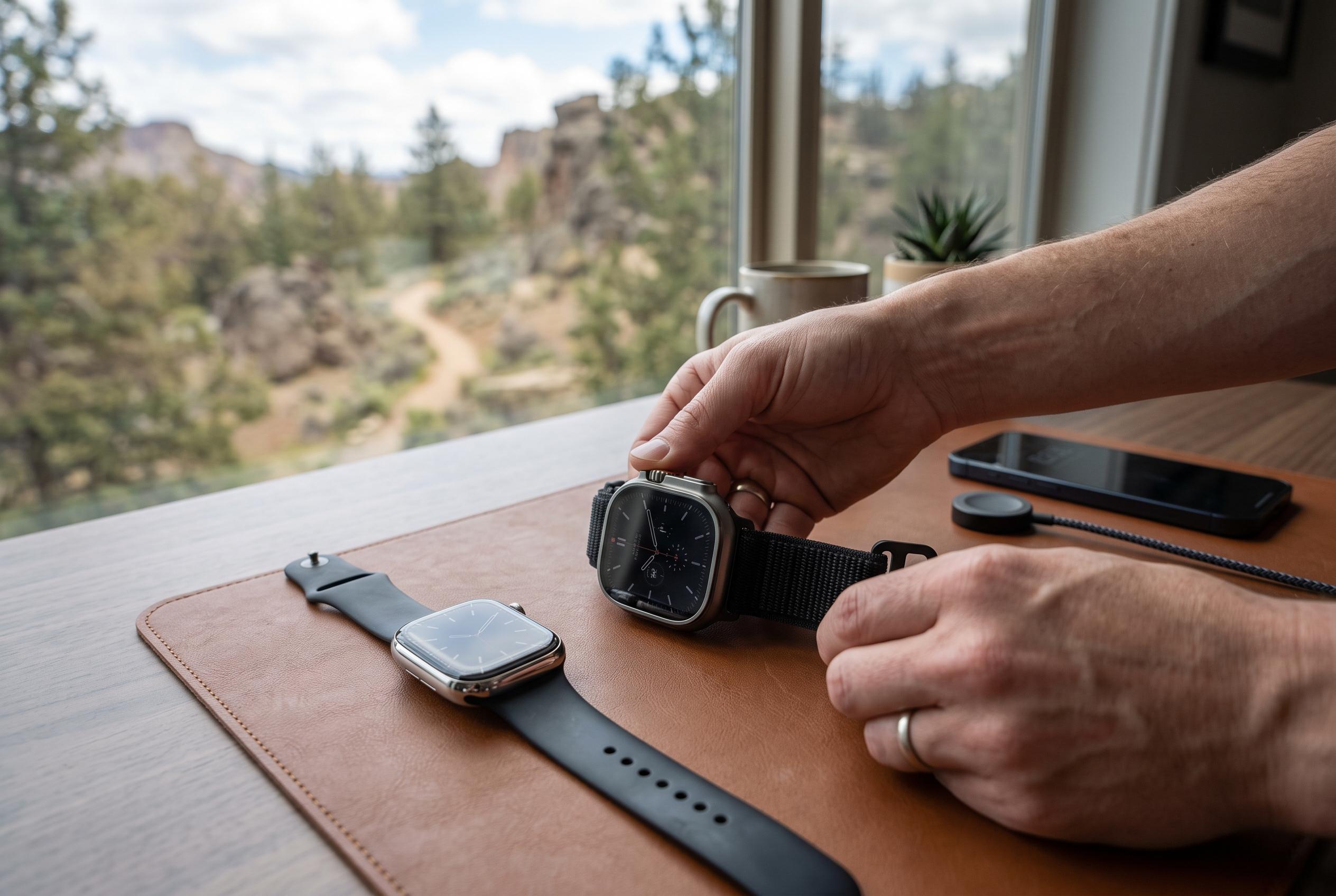

Apple’s latest smartwatch duo shares many core features, but their design, durability, and battery life distinctions now define their appeal, prompting consumers to weigh everyday use against rugged outdoor needs.
Apple’s latest smartwatch pair is more alike than ever, which is precisely why the choice is harder this year. The Apple Watch Series 12 and Apple Watch Ultra 4 now share the same S11 chip, the new Health Sensing System, Readiness scoring, and Apple’s updated Siri and Audio Intelligence features, according to Stuff’s review and corroborating buying guides from MacRumors and TechRepublic. That leaves buyers weighing a familiar question: do you want the lighter, cheaper model that covers most needs, or the larger, tougher watch that is built for harsher conditions and much longer use between charges? According to the pricing details in those reports, the answer depends less on features than on how you actually plan to wear it.
On price, Apple has kept the starting figures where they were last year. Stuff says the Series 12 begins at $399 or £369 for the 42mm aluminium GPS model, while the Ultra 4 starts at $799 or £749. MacRumors notes that the gap narrows if you move to higher-end Series 12 materials: titanium starts at $699 and the new ceramic version rises to $899, which can push the smaller watch above the Ultra. That matters because the Ultra’s headline premium is not buying extra health tracking. In everyday use, the two watches are much closer than the price tags suggest.
The split is clearer in the design. The Series 12 remains the slimmer, easier-to-ignore Apple Watch, with 42mm and 46mm cases and a profile that suits more wrists and more formal clothing. Stuff reports that the aluminium model weighs just 32.2g in the smaller size, while even the larger versions stay relatively light. The Ultra 4, by contrast, is a 49mm titanium watch that weighs 63g and is visibly bulkier. That extra mass is part of the point: it is built to tolerate knocks, rough weather and harder use, while the Series 12 is the more discreet option for people who want an Apple Watch that disappears into daily life.
Durability and display brightness are where the Ultra 4 begins to justify its cost. Stuff says the Series 12’s aluminium models now use Ceramic Shield 2, which Apple says is far tougher than the glass used before, while titanium and ceramic versions use sapphire crystal. The Ultra 4 uses sapphire crystal as standard, offers 100-metre water resistance, and is certified for recreational scuba diving to 40 metres. It is also tested against the MIL-STD 810H standard for heat, shock and vibration. Both watches are dust resistant, but the Ultra’s screen is brighter at up to 3,000 nits, compared with 2,000 nits on the Series 12, which should make a real difference in strong sunlight, on the water or on a mountain.
Health and fitness monitoring, however, is where the case for the Series 12 becomes strongest. MacRumors and Stuff both say the two watches share the same core health stack: heart-rate sampling throughout the day, Readiness, Recovery HRV, improved step tracking, ECG, hypertension notifications, irregular rhythm alerts, blood oxygen measurement, sleep apnoea alerts, sleep score, wrist temperature sensing and the Vitals app. Women’s health features are also identical across the pair. In practical terms, if the main reason to buy is health tracking, the Series 12 gives you essentially the same toolkit as the Ultra 4 for far less money.
The Ultra 4’s extra functions are aimed at people who spend time outdoors or away from reliable mobile coverage. Stuff says it adds precision dual-frequency GPS, satellite connectivity for Emergency SOS and Find My, dual speakers, a three-microphone array with wind-noise reduction and a more capable altimeter. Tom’s Guide also highlights satellite safety tools and the stronger location performance. The Series 12 sticks with standard L1 GPS, which will be adequate for most users, but not as accurate in dense city streets, woodland or other difficult environments. For runners, hikers, climbers and divers, those differences are meaningful rather than cosmetic.
Battery life remains the Ultra’s clearest advantage. Stuff reports up to 24 hours on the Series 12, or 38 hours in Low Power Mode, versus up to 50 hours on the Ultra 4 and as much as 84 hours in Low Power Mode. MacObserver’s runner-focused guide says the Ultra also stretches outdoor workout endurance well beyond the Series 12. In day-to-day terms, that means the Series 12 is still very much a daily charger, while the Ultra can realistically last into a second or even third day. Both charge quickly, but the Ultra’s larger battery still leaves it as the better choice for travel, sleep tracking and long weekends away from a plug.
That is why the buying advice remains fairly simple. The Series 12 is the better option for most people because it is lighter, cheaper and now nearly as capable in health tracking as Apple’s top model. The Ultra 4 only makes sense if you will use what it adds: longer battery life, tougher construction, brighter display, more accurate GPS and satellite safety features. For buyers who want the best Apple Watch for everyday wear, the Series 12 is the sensible pick. For those who want a watch that can cope with far more demanding conditions, the Ultra 4 is the one that earns its premium.
Disclaimer: This content is intended for informational purposes only. Readers are advised to exercise their own judgement, conduct due diligence, or consult a qualified expert before acting on any information provided.