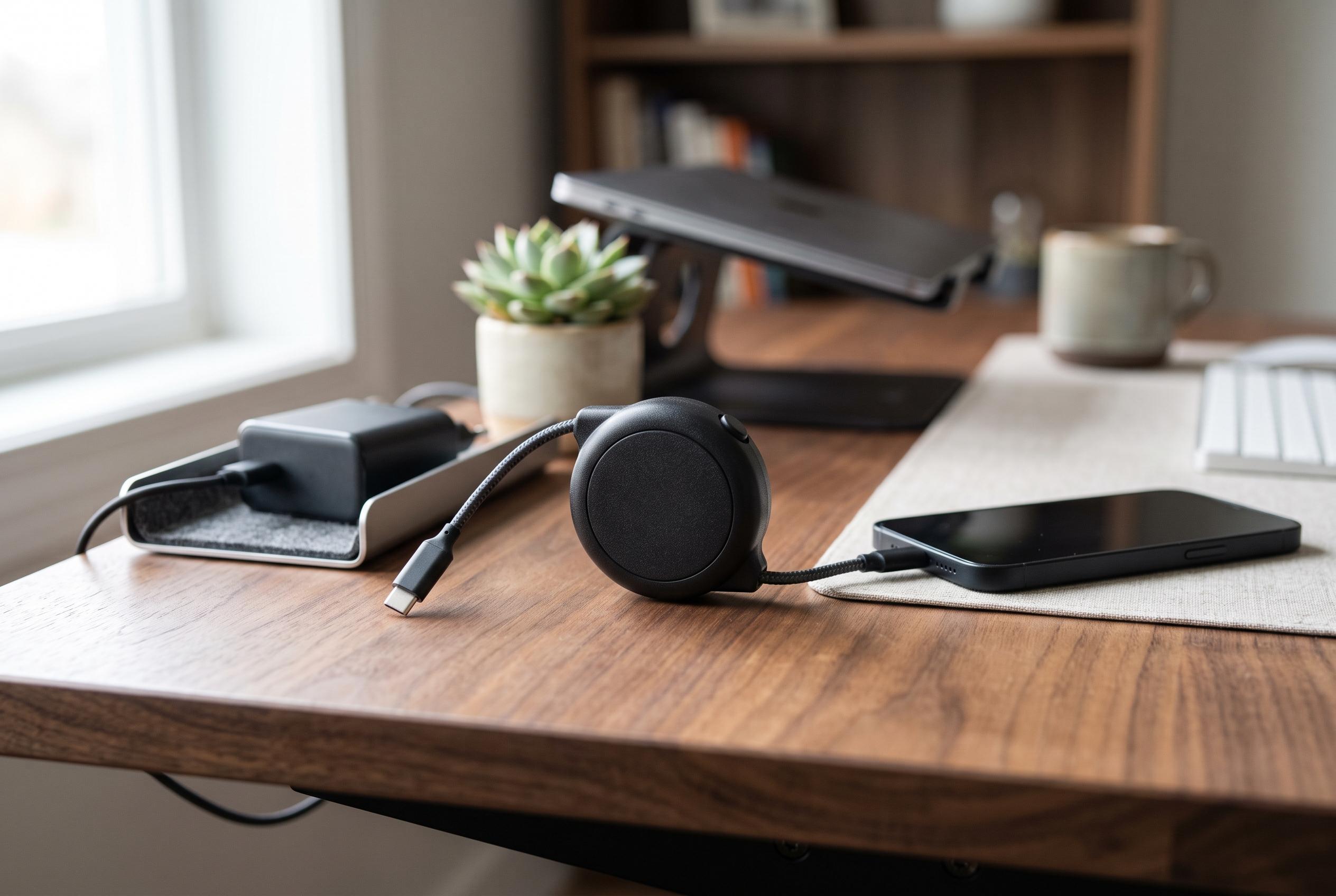

The UGREEN L531 redefines cable management with a compact retractable design supporting up to 100W charging, though its USB 2.0 speed limits its data transfer capabilities. Ideal for portability, it offers a neat solution for everyday charging needs but falls short for high-speed data tasks.
UGREEN’s L531 is a USB-C charging cable that treats cable management as the main product feature rather than an afterthought. Instead of a loose metre of wire, most of the lead sits inside a compact round casing, leaving only the two connectors exposed. Pull it out when needed, and the spring-loaded reel draws it back in once charging is finished. According to UGREEN’s product page, the idea is to combine a tidy desk setup with a travel-friendly form factor.
The physical design is deliberately small. UGREEN describes the body as a circular unit roughly 60mm across and about 18mm thick, with a mass of around 50g. The cable offers four fixed lengths, with preset stops at 36cm, 60cm, 82cm and 100cm, so users cannot choose an arbitrary length. In practice, that still covers most everyday uses, from a short desktop connection to a longer reach in a car or between a charger and a laptop.
Charging capability is the cable’s other main selling point. UGREEN rates the L531 for up to 5A and 100W, and says it includes an E-Marker chip to communicate the cable’s capabilities to the charger and the device. The company also lists support for Power Delivery 3.0 and PPS, which means the cable is aimed at more than just phones: it should suit many USB-C laptops, tablets and high-power handheld devices, provided the charger and the device can also negotiate that output. Independent write-ups of the cable have highlighted the same 100W charging specification and the presence of the E-Marker as the basis for safe high-wattage use.
What the L531 does not offer is fast data transfer. UGREEN says the cable is limited to 480Mbit/s, which is USB 2.0 territory. That makes it fine for phone synchronisation, simple file transfers and ordinary charging, but a poor choice for external SSDs, docks or displays, where USB 3.x, USB4 or Thunderbolt would be more appropriate. This distinction matters because a 100W label can easily suggest more capability than the cable actually provides.
That trade-off explains the cable’s best use cases. It is most convincing in a laptop bag, where it avoids the usual tangle of a loose lead, and in a car, where only the required length is pulled out and the rest stays contained. It also makes sense on a desk, where the reel keeps surfaces neater. The downside is that a retractable mechanism adds bulk, so a conventional cable remains the better choice if it lives permanently behind a monitor or rarely moves. Reviews of the L531 have tended to stress the same balance: practical convenience, solid build and genuine usefulness for people who value portability, but no special advantage for fixed installations.
Disclaimer: This content is intended for informational purposes only. Readers are advised to exercise their own judgement, conduct due diligence, or consult a qualified expert before acting on any information provided.