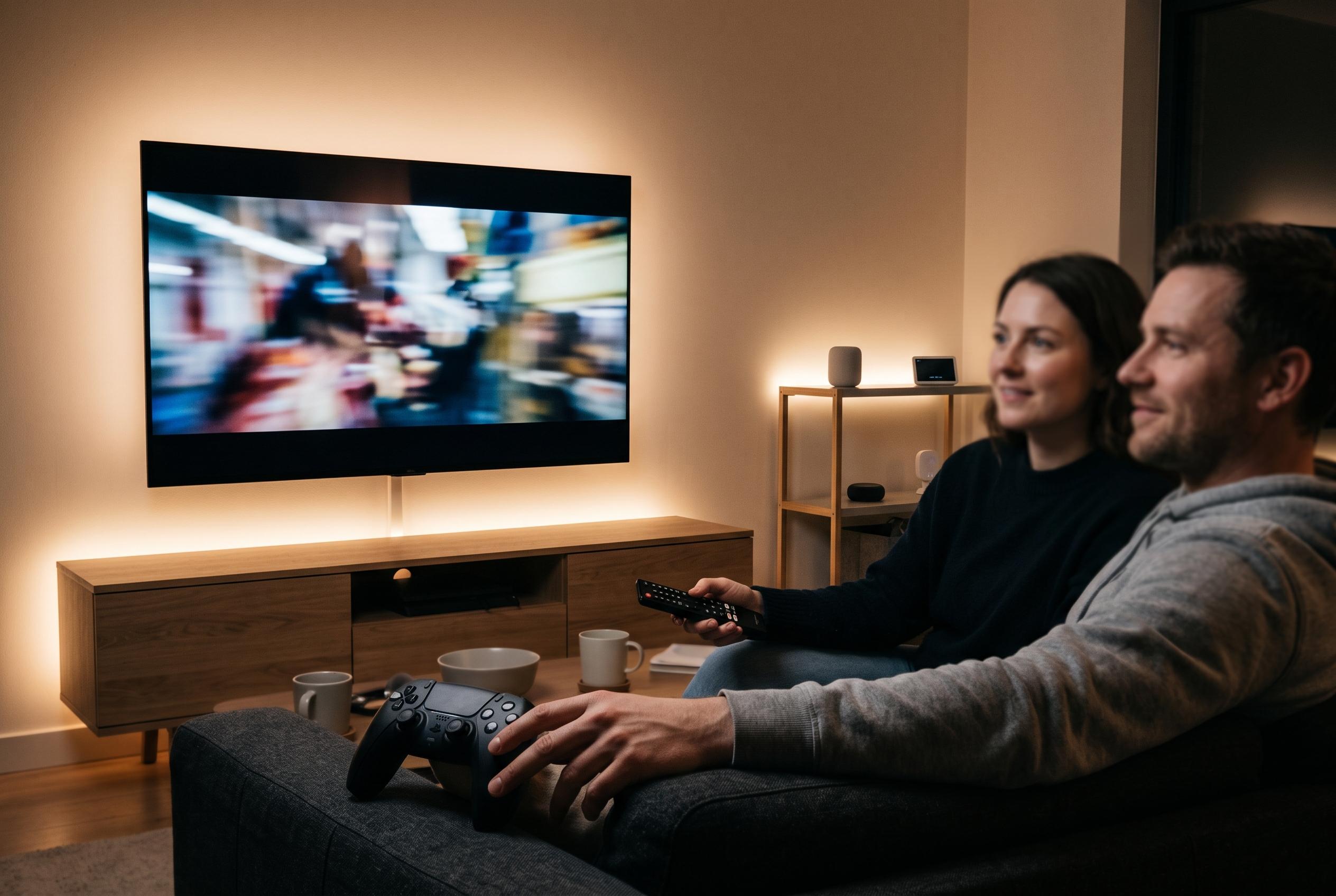

Philips has unveiled AmbiScape, a revolutionary feature expanding its Ambilight technology from the TV screen to a room-wide visual experience, enhancing immersion in gaming and film with smart-home integration.
Philips is extending one of its best-known television features beyond the set itself, turning the room into part of the picture. The company’s new AmbiScape system builds on Ambilight, the rear lighting effect that has become closely associated with Philips TVs since 2004, and aims to spread game and film visuals across a wider living space. According to Philips, the idea is to deepen immersion rather than simply decorate the screen. The new feature is being presented alongside a tie-in with Assassin’s Creed Black Flag Resynced and promotional discounts on selected compatible models.
Ambilight has long been designed to reduce the hard contrast between a bright panel and a dark room, but its appeal has broadened over time into a more explicit gaming and cinema tool. Philips says more than 35 million Ambilight televisions have been sold worldwide and that most customers who already own one want the technology again in their next set. Technically, the system uses LED zones on the rear of the chassis and real-time processing to match the colours shown at the edge of the image, with versions available in three-sided and four-sided layouts depending on whether the television stands on a cabinet or is fixed to a wall.
AmbiScape is Philips’ next step in that direction. The company says the feature, introduced in March 2026 and now being rolled out on recent televisions and monitors, can synchronise the lighting of up to four external sources, such as connected lamps or luminaires. It is built around the Matter smart-home standard, and Philips says it already works with E27 smart bulbs from WiZ, Nanoleaf, Philips Hue and IKEA, with more compatibility expected later. Setup is intended to be simple, using a QR code on the screen and step-by-step pairing through the television interface or remote control.
Philips also says the lighting response is quick enough to preserve the sense of immediacy expected by players. The company puts the latency at under half a second between the on-screen action and the connected lights, which should make the effect feel continuous rather than delayed. In practice, the pitch is that the glow no longer stops at the edges of the panel: it becomes a room-wide visual layer that follows the game or film more closely.
The hardware behind the feature is aimed squarely at gaming. Philips points to HDMI 2.1 connectivity, 4K at 120 Hz support, variable refresh rate, auto low-latency mode, FreeSync Premium and G-Sync compatibility as standard ingredients across the relevant range. The company also highlights its P5 picture engine, which uses artificial intelligence to improve motion handling, detail and visual clarity, while a built-in Game Bar gives quicker access to gaming settings.
The lineup spans several levels of ambition. OLED 800 and OLED+ 900 models are pitched at more demanding players, while the RGB Mini-LED 981 is positioned as the brighter option for well-lit rooms and HDR-heavy use. The Series 8000 is described as the entry point for AmbiScape, using LED and QLED panels to keep the experience accessible, and the Evnia monitor family extends the same idea to PC gaming with OLED or Fast IPS panels running from 175 Hz to 360 Hz and response times of 1 ms or less. To support the launch, Philips is offering rebates of up to €300 on selected TVs between 28 September and 29 October, with the first 1,000 eligible buyers also receiving a code for the game.
Disclaimer: This content is intended for informational purposes only. Readers are advised to exercise their own judgement, conduct due diligence, or consult a qualified expert before acting on any information provided.