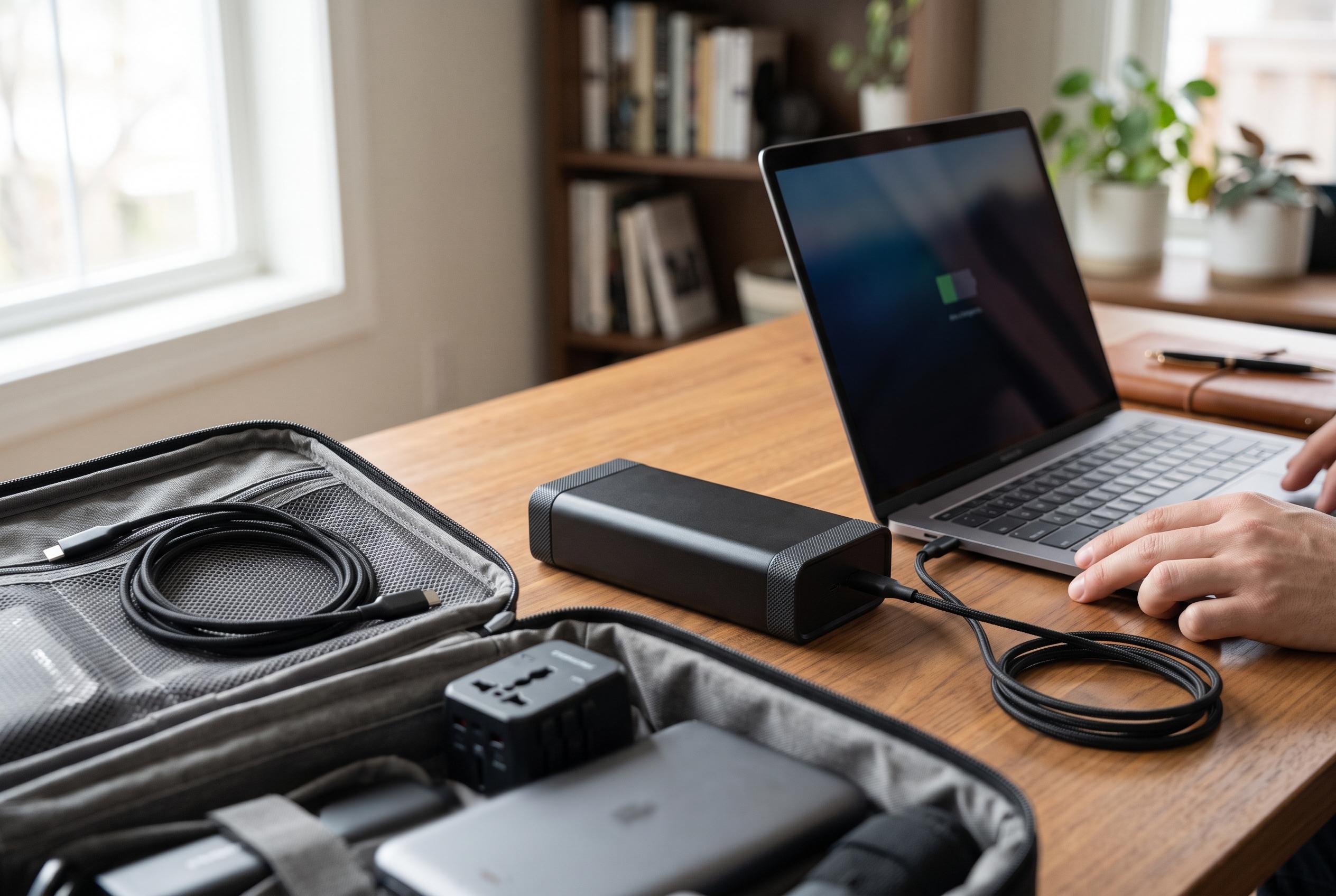

The Anker Prime Power Bank (26K, 300W) offers a new level of capacity and speed while remaining TSA-approved for air travel, challenging traditional portable charger limits for modern devices.
A good power bank in 2026 is no longer just a small backup battery for a phone. It needs enough capacity to matter, enough power to charge modern laptops, and enough compliance to travel without becoming a security problem. That is because the useful share of a battery’s rated mAh is lower than the headline figure suggests, while airline rules around portable batteries remain strict. In that context, the Anker Prime Power Bank (26K, 300W) is built around a simple idea: fit as much practical power as possible into a package that still passes air-travel limits.
The model’s main selling point is its 26,250mAh capacity, which Anker says translates into 99.75Wh. That matters because it sits just under the 100Wh threshold commonly used for carry-on battery approval. The distinction between watt-hours and watts is crucial here: the former measures stored energy, while the latter measures output. Anker’s device can deliver up to 300W in total, but that does not affect the Wh limit. The result is a battery that is large enough for serious use yet still described by the company as TSA-approved for flight.
Physically, the power bank is not small, but it is still unusually compact for its class. Anker lists dimensions of 159.9 × 38 × 62.7mm and a weight of 600g. That places it in the territory of a premium travel accessory rather than a pocketable charger. Still, compared with the capacity on offer, the size is restrained. For users who have previously carried 5,000mAh or 10,000mAh units, the jump in bulk will be obvious, but so will the gain in usefulness.
Charging hardware is where the Prime model most clearly separates itself from ordinary battery packs. It offers two USB-C ports and one USB-A port. The USB-C ports can each provide up to 140W, while the USB-A port can deliver up to 22.5W on its own, or 20W when both USB-C outputs are active. That is enough to charge demanding laptops and almost any current smartphone at full speed or close to it. Digital Camera World and Macworld both noted that the power bank is particularly well suited to laptop users, with Macworld highlighting its ability to keep multiple Apple devices running on the move.
Anker also claims very fast recharging for the unit itself. Using both USB-C ports together, it can take in 250W and reach 50% in about 13 minutes, according to the company. The device has a display for battery status and temperature, and app support for monitoring and adjusting charging behaviour. That software layer is more than cosmetic. It allows users to set charging preferences and manage ports in a more controlled way, which is helpful when carrying several devices at once.
Safety and thermal management are central to the design. Anker says its ActiveShield 4.0 system checks temperature millions of times a day and cuts power if overheating is detected. The company also uses PowerIQ 4.0 to direct charging towards the device that needs it most. Those features matter because high-output battery packs generate more heat and place more stress on the cells. In practice, they are part of what makes a high-capacity pack viable for both phones and laptops.
The downside is price. In Hungary, the Anker Prime Power Bank (26K, 300W) is sold for roughly 65,000 to 75,000 forints, although Anker’s own site has at times listed lower promotional prices. That puts it well beyond what most people need for a day trip or even a light weekend away. But for frequent travellers who want one battery pack that can serve a phone, a tablet and a laptop, it is among the most capable options currently available. The reviews from Digital Camera World, Macworld and other outlets broadly agree on that point, even if some question whether all buyers will find the performance worth the cost.
Disclaimer: This content is intended for informational purposes only. Readers are advised to exercise their own judgement, conduct due diligence, or consult a qualified expert before acting on any information provided.