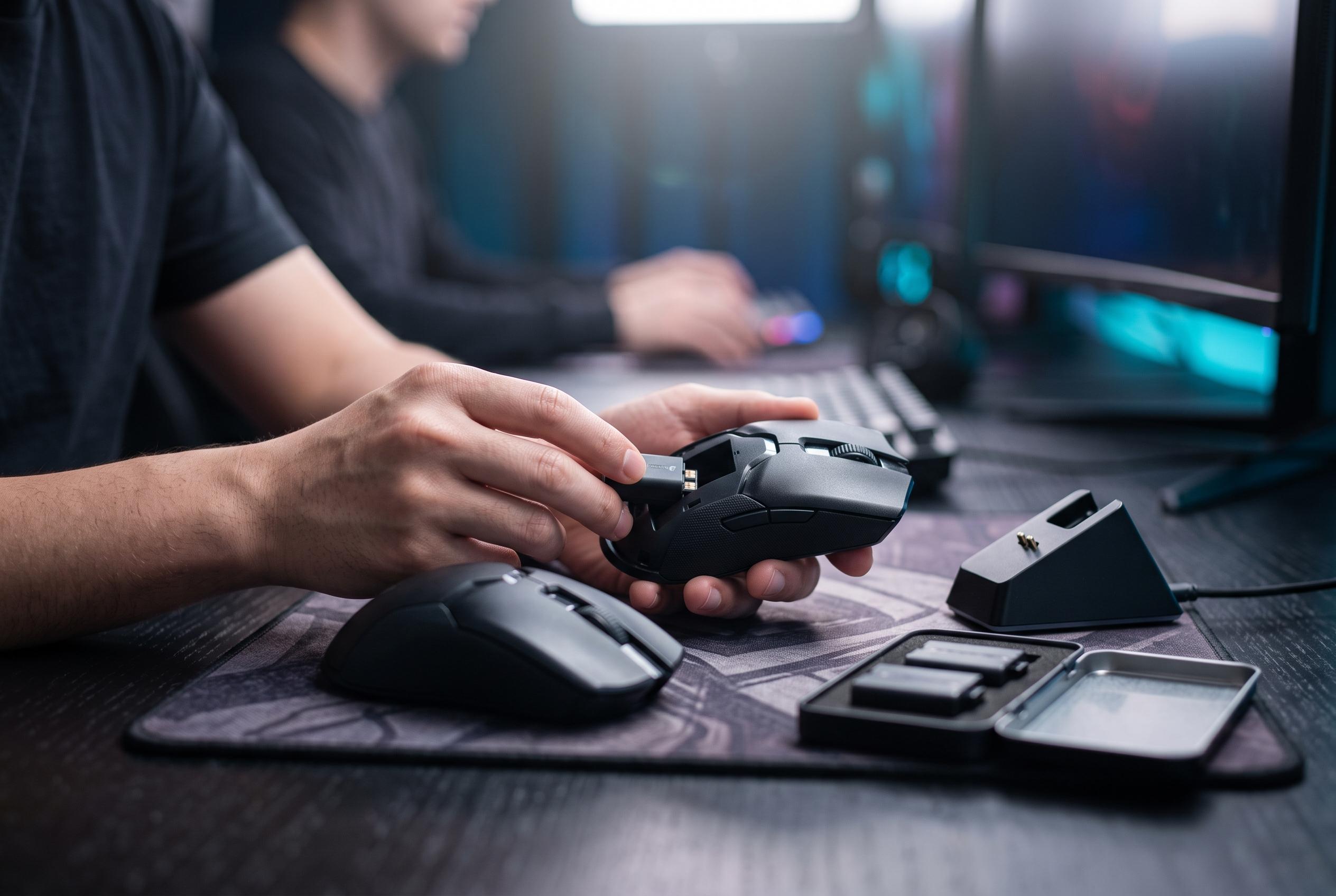

SteelSeries launches the Rival Pro and Sensei Pro, two high-end gaming mice featuring ultra-wideband connectivity, fast setup, and interchangeable batteries, aimed at serious gamers seeking seamless performance and flexibility.
SteelSeries has added two premium wireless mice to its line-up with the Rival Pro and Sensei Pro, both built around ultra-wideband connectivity rather than a conventional USB receiver approach. The design centres on a base station and a USB-C to USB-A cable, allowing the mouse to connect quickly after setup and to charge through the same system when not in use.
In practice, the process is straightforward. According to SlashGear’s review, both models were ready within minutes of being unboxed. The cable connects the base station to a PC, and SteelSeries says the same arrangement can also work with an Xbox Series X or S, or a PS5, although some console features may not be available. Once the base station is powered, the battery puck can be locked into place for charging, and the mouse becomes usable as soon as the Power/DPI button is held for a couple of seconds.
SteelSeries has also tried to make the system more flexible for people who move between desks or machines. The company sells a separate travel dongle, which removes the need to relocate the base station and cable each time the mouse is used elsewhere. If two devices are active at once, the mouse can be switched manually by holding the Power/DPI button and pressing the scroll wheel. That is a practical answer to one of the main objections to proprietary wireless systems: convenience drops quickly if the user has to rebuild the setup every time they change location.
The hardware itself is aimed firmly at serious gaming. PC Gamer reported that the Rival Pro uses SteelSeries’ TrueMove 42K Pro sensor, supports up to 42,000 DPI and offers an 8,000Hz polling rate. The same review highlighted optical switches, PTFE feet and a hot-swappable battery system, while noting that the shape is especially well suited to palm grip users. Tom’s Guide similarly described both mice as lightweight, fast and designed for zero-downtime use, with battery swaps intended to keep play uninterrupted.
Design is where the two models diverge most clearly. Notebookcheck said the Sensei Pro follows a symmetrical shape that should suit both left- and right-handed users, while the Rival Pro is an ergonomic right-handed design. That distinction matters because SteelSeries is pitching the pair to different kinds of players: the Sensei Pro for ambidextrous comfort and the Rival Pro for a more traditional contoured grip. The company has also pushed both models as part of its “Infinite Power System”, a branding that reflects the emphasis on continuous operation rather than charging breaks.
Taken together, the launch suggests SteelSeries is trying to compete on more than raw sensor numbers. The move to UWB removes the usual dependence on a small dongle, while the hot-swappable battery design aims to address one of the biggest frustrations in wireless peripherals. It is a premium approach, and one that may appeal most to users who value fast setup, low latency and a cleaner desk, even if it asks them to buy into a more specialised ecosystem.
Disclaimer: This content is intended for informational purposes only. Readers are advised to exercise their own judgement, conduct due diligence, or consult a qualified expert before acting on any information provided.