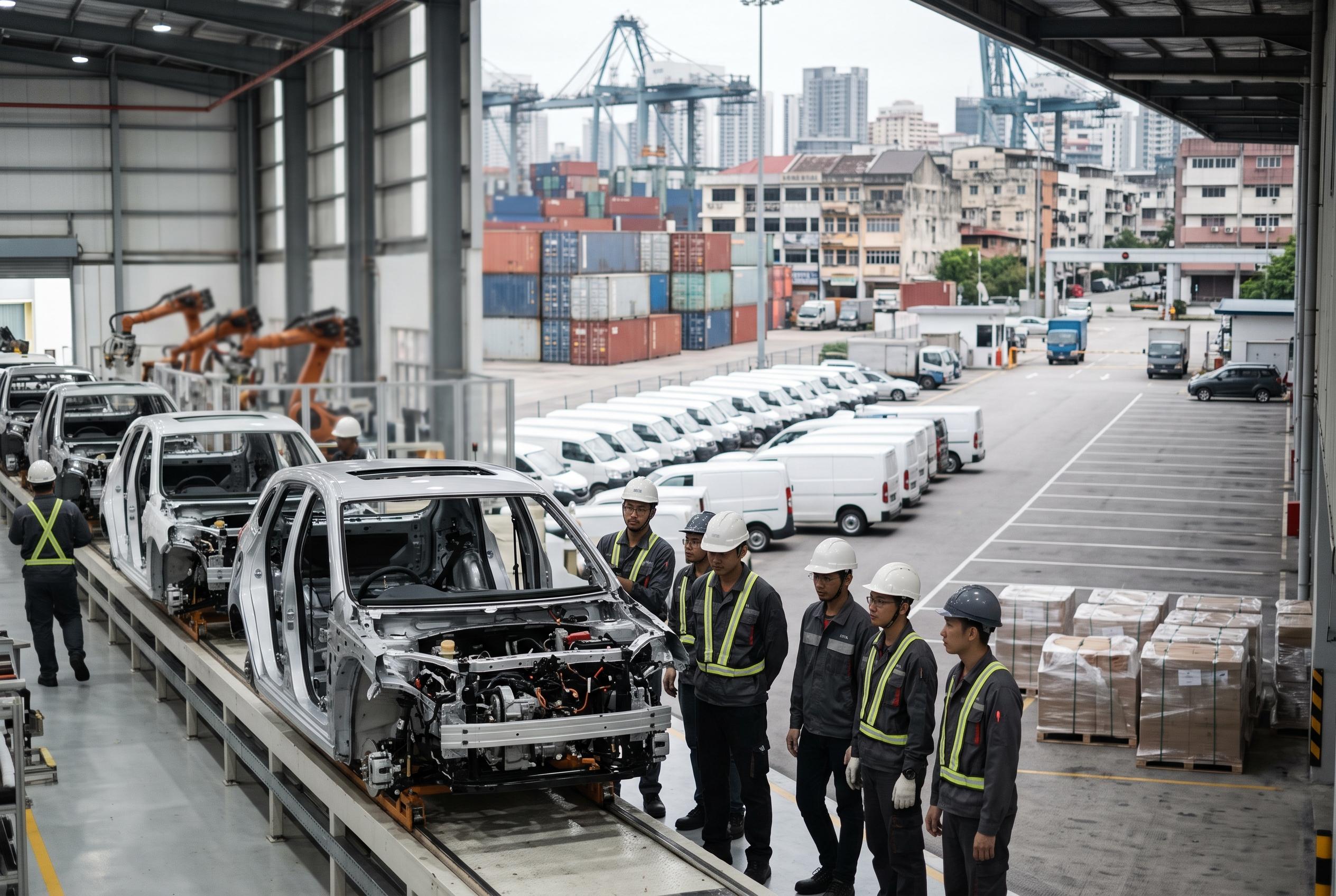

Chinese car manufacturers are rapidly building factories across South-East Asia, but sluggish local demand and overcapacity threaten to slow their regional ambitions, as new policies aim to balance investment with market absorption.
Chinese automakers are building factories across South-East Asia faster than the region’s buyers are absorbing the output, creating a widening gap between installed capacity and actual sales. According to the International Energy Agency’s Global EV Outlook 2026, Chinese battery-electric vehicle plants in Thailand were operating at about 20% of capacity, while facilities in Indonesia were running at less than 15%. The pattern reflects a broader shift in strategy: instead of exporting everything from China, manufacturers are increasingly trying to assemble vehicles locally, serve domestic demand and position themselves for regional exports.
The scale of the build-out is notable. The IEA said South-East Asia accounted for more than half of Chinese automakers’ overseas manufacturing footprint in 2025, with almost 1 million vehicles of annual capacity now in the region. That compares with a total overseas footprint of about 1.7 million units. The same report linked rising deliveries into the region to a 21% increase in China’s finished-vehicle exports, which reached 7.1 million units in 2025, up from 5.86 million a year earlier.
Indonesia and Thailand have seen the most visible concentration of Chinese automotive brands. GlobalData’s ASEAN automotive team said Indonesia had three Chinese brands in 2021, including MG, DongFeng and Wuling, but 22 by 2026. Thailand increased from three brands, MG, Haval and Ora, to 23 over the same period. Industry executives quoted by the report described China’s domestic market as intensely over-supplied and highly competitive, with overseas production increasingly serving as a way to secure market access and build local supply chains rather than simply move volume abroad.
That expansion has not yet been matched by demand. A market research executive said most Chinese automakers are missing sales targets and have already trimmed production plans as weak consumption and a growing number of competing brands weigh on the market. The overcapacity problem is not necessarily proof of poor investment decisions, the report noted, but it does mean some projects are likely to struggle until demand catches up. Analysts also pointed out that Chinese manufacturers have often built capacity ahead of sales, betting that localisation and regionalisation will pay off over time.
Governments in the region are trying to shape that process. In Thailand, officials are working with an import-to-local-production ratio of roughly 1:2 to 1:3, while Indonesia uses a 1:1 framework, according to the report. Thailand’s National Electric Vehicle Policy Committee is also weighing higher excise taxes on EVs that do not use domestic components, as the country attracts hundreds of new projects. Indonesia, by contrast, has offered tax discounts and waivers on new EV purchases. The measures are recent, however, and executives said they will take time to improve utilisation or shift demand materially.
For Chinese brands, the ASEAN strategy is about more than immediate local sales. If the region becomes a deeper production base, it could also support exports to other markets, depending on rules of origin and trade agreements. Thailand already has a mature automotive export ecosystem, while Indonesia offers access to battery-material supply chains. That combination helps explain why manufacturers such as BYD, Chery, Geely, Great Wall Motor, SAIC and Wuling are treating ASEAN as a long-term industrial base rather than just a sales destination.
Disclaimer: This content is intended for informational purposes only. Readers are advised to exercise their own judgement, conduct due diligence, or consult a qualified expert before acting on any information provided.