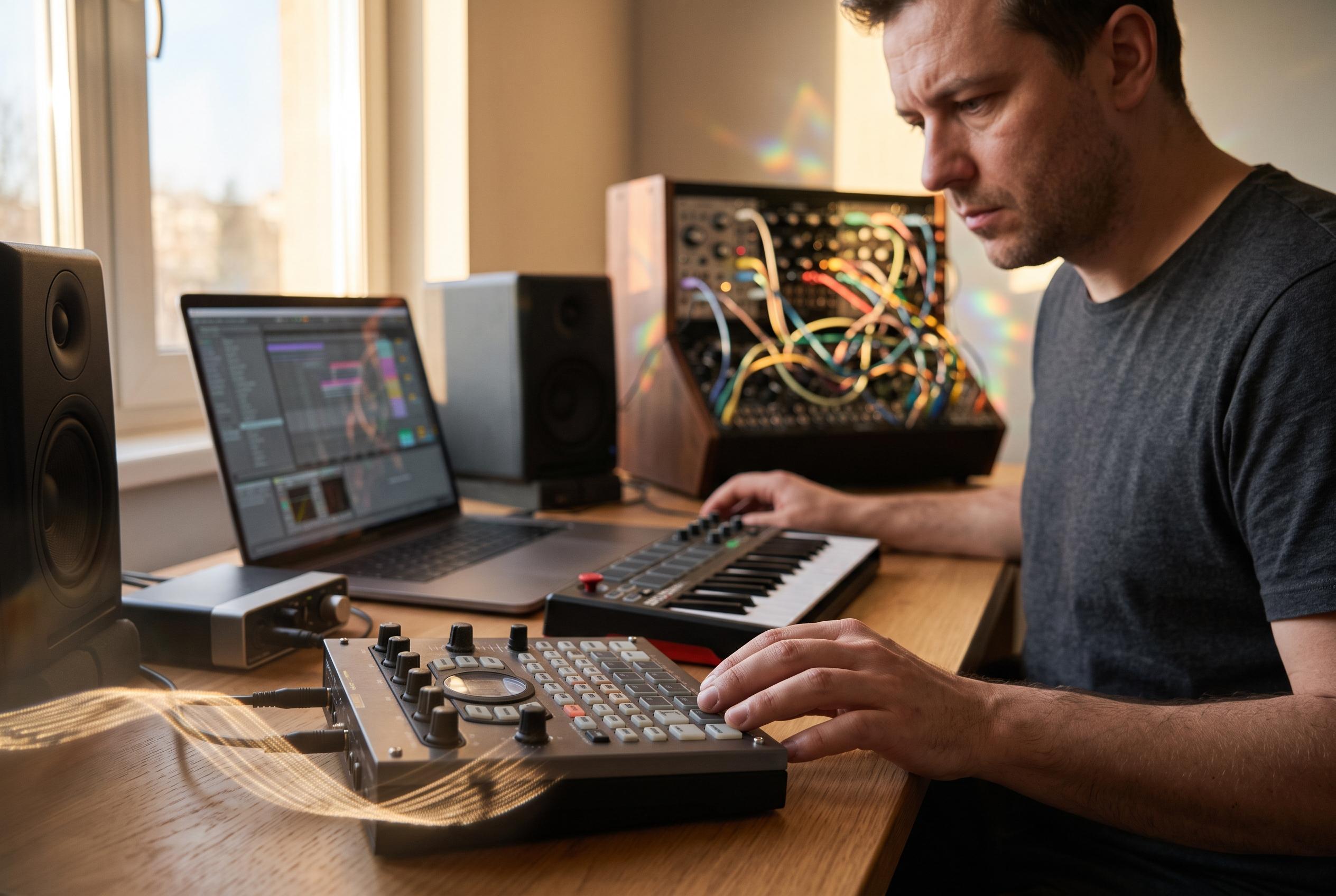

The latest update to Bitwig Studio enhances its modular environment with a major overhaul of the sampler, offering new slicing, time-stretching, and granular playback modes, further empowering electronic music producers and sound designers.
Bitwig Studio has established itself as one of the most distinctive digital audio workstations for electronic music production, and its appeal rests less on convention than on clarity. The software does not try to imitate the look and workflow of older studio applications. Instead, it presents signal flow, modulation and device relationships in a way that makes complex sound design easier to understand. That approach gives it a strong practical advantage for producers who want to see how a patch is behaving while they work.
According to the review published by The Audio Magazine, the programme feels especially effective once its layout and working methods become familiar. The writers said they had used it on both Mac Studio and Windows machines with excellent results, and described the latest 6.1 release as building on an already highly capable environment for composition and sound shaping. Bitwig is available for macOS, Windows and Linux, and it supports VST and CLAP plug-ins, which keeps it broadly usable in modern production set-ups.
One of Bitwig’s defining strengths is the way it makes sound architecture visible. Its device chains, nested devices and modulation system are designed to show how instruments and effects relate to one another rather than hiding those connections behind a flat rack. That matters in practical work, especially when a project involves elaborate processing or custom synthesis. The Grid, included in the full Studio edition, extends that philosophy into a modular environment for building instruments, effects and note-processing systems. Bitwig’s own release notes describe the Grid as part of a wider design language that keeps advanced processes inspectable rather than opaque.
The latest 6.1 update pushes that idea further through a major overhaul of the Sampler. Bitwig’s release notes say the new Sliced Sampler can divide a single audio file in several ways, including divisions, beats, onsets, pitch-based slicing and manual placement. Related coverage from MusicRadar and other specialist outlets notes that each slice can be triggered from MIDI or the Piano Roll, with its own loop and modulation settings. Automatic pitch analysis now identifies the analysed root key, which makes retuning and repurposing source material more flexible.
Two new playback modes broaden the creative range of the sampler considerably. The Spectral mode is aimed at time-stretching with minimal audible artefacts, while Fragments adds granular playback, allowing the sound to be broken into very small particles and reshaped in motion. The Audio magazine review said these features are exclusive to the full Studio edition, and other reviewers have noted that the new modes integrate directly with Bitwig’s modulation system, which makes them more than simple sample-editing tools. In effect, they become part of the wider sound-design workflow rather than a separate utility.
The update also introduces a Tuner device and module, alongside general improvements. That may be a smaller addition than the sampler redesign, but it fits the same pattern: practical tools are folded into the same environment as arranging, recording and performance. Bitwig’s Clip Launcher remains an important part of that workflow, providing an alternative to the standard timeline for testing ideas and building live-set material. Audio, instrument and hybrid tracks are all supported, which gives the software enough range for both composition and performance-oriented work.
The main caution remains the learning curve. Bitwig does not behave like a traditional linear workstation, and users coming from other DAWs will need time to adjust to its terminology and interface habits. But that unfamiliarity is also what allows it to stand apart. For producers who value visual feedback, deep modulation and a sampler that can be treated as a creative instrument rather than a static editor, Bitwig Studio continues to look like a serious and unusually well-considered choice.
Disclaimer: This content is intended for informational purposes only. Readers are advised to exercise their own judgement, conduct due diligence, or consult a qualified expert before acting on any information provided.