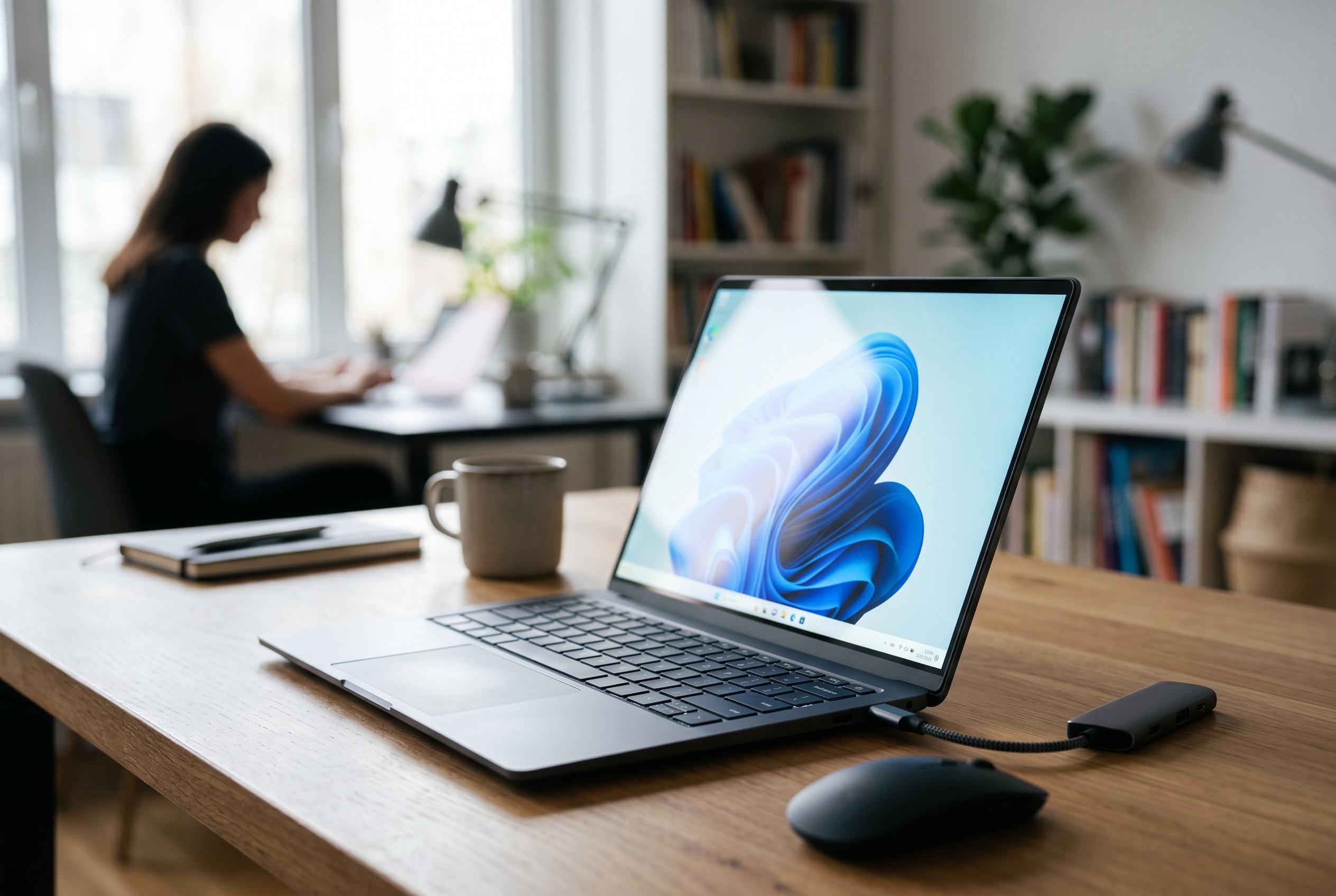

HP’s latest OmniBook Ultra 14 combines a sleek aluminium build, an impressive OLED screen, and powerful performance, positioning itself as a serious contender in the premium ultraportable market amid rising competition from Apple and other Windows laptop makers.
HP’s OmniBook Ultra 14 is part of a wider response from Windows laptop makers to Apple’s compact, premium portable machines. Reviews from TechRadar, Tom’s Hardware, PCWorld, Tom’s Guide and Notebookcheck all point to the same broad idea: this is a high-end 14-inch machine built for portability, battery life and a modern feature set, rather than a bargain model.
According to Presse Citron’s test, the specific configuration it examined sits well above the pricing of more mainstream ultrabooks, which makes value harder to judge in isolation. Yet the design language is clearly premium. The chassis is all aluminium, the machine is slim at 1.1cm, and the 14-inch form factor keeps it compact enough for regular travel. At 1.27kg, it is not the lightest in its class, but it remains firmly in ultrabook territory.
The build quality is also one of its main selling points. Presse Citron describes the finish as refined and discreet, with an anti-fingerprint surface that keeps marks under control. TechRadar and PCWorld likewise note that the OmniBook line feels well made, with a restrained design rather than an attention-seeking one. The keyboard is backlit and comfortable to type on, while the large touchpad and facial recognition camera help the machine feel fully modern, even though HP does not include a fingerprint reader on this model.
The screen is where HP clearly tries to distance the OmniBook Ultra 14 from cheaper rivals. Presse Citron’s measurements showed an OLED panel that exceeded the company’s own brightness claims, reaching 455 nits in SDR and 1,015 nits in HDR, with excellent colour accuracy and near-perfect contrast. Tom’s Hardware and Notebookcheck describe the same 14-inch 2,880 x 1,800 touchscreen as a 120Hz OLED panel with a premium feel, though, as with most glossy OLEDs, reflections remain the main drawback outdoors.
Performance depends heavily on configuration, but the model tested by Presse Citron uses Qualcomm’s Snapdragon X2 Elite, which places it at the sharper end of the current Arm-based Windows market. The review says the chip delivered some of the strongest CPU results the publication had seen, alongside graphics performance that was strong enough for demanding games at reduced settings. Tom’s Hardware and Notebookcheck also place the OmniBook Ultra 14 in the premium performance bracket, with configurations reaching 64GB of memory and 2TB of storage.
Battery life is another area where HP has clearly prioritised endurance. Presse Citron reports that its unit has a 70Wh battery, and its own tests suggested roughly 11 hours and 25 minutes of mixed use and nearly 15 hours of video playback. That is a strong result for a machine with this kind of display and chip class. TechRadar, by contrast, reported exceptional runtime from the OmniBook X 14 in a different configuration, reinforcing the broader point that HP’s latest compact Windows laptops are being tuned for all-day use.
Connectivity is modern, but not especially generous. The review notes three USB-C ports and a headphone jack, plus Wi-Fi 7 and Bluetooth 5.4. That is technically current, yet it still leaves many users needing an adapter or dock for USB-A accessories and external displays. PCWorld makes a similar point, arguing that the port selection is contemporary but less practical than a laptop with legacy connections built in. For buyers focused on performance, display quality and endurance, however, the compromise may be acceptable.
In the end, the HP OmniBook Ultra 14 looks like a deliberate attempt to justify a premium price with premium parts. On the evidence of these reviews, HP has succeeded on most counts: the machine is well built, fast, long-lasting and fitted with one of the better OLED panels now available in a 14-inch Windows laptop. Its cost remains high, and the glossy screen and limited port selection are real trade-offs, but for readers looking at the top end of the ultraportable market, it appears to be a credible alternative to the best-known rivals.
Disclaimer: This content is intended for informational purposes only. Readers are advised to exercise their own judgement, conduct due diligence, or consult a qualified expert before acting on any information provided.