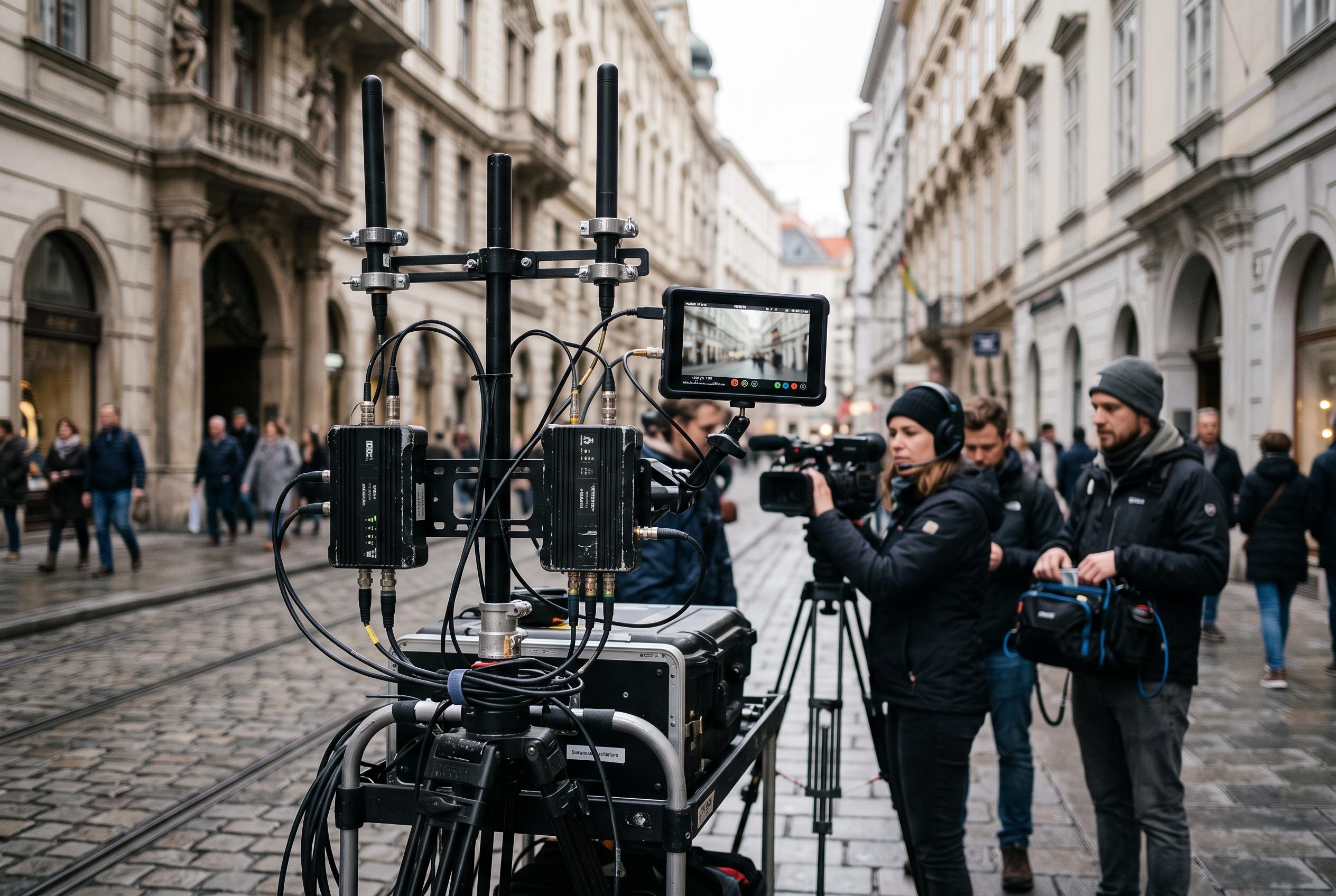

DJI’s second-generation SDR Transmission system passes rigorous field testing in Vienna, demonstrating enhanced reliability, hardware flexibility, and extended range in crowded and obstructed environments, promising a new level of dependability for small production crews.
DJI’s second-generation SDR Transmission has been put through a demanding field test in Vienna, where CineD used three cameras, a car, a boat and a spectrum analyser to assess whether the system can hold up in crowded radio-frequency conditions and over long distances. The publication said the tests were designed to probe more than laboratory-style specifications, with the goal of seeing how the link behaved in a real production environment that combined obstruction, movement and congestion. The result, according to CineD, was a system that remained usable in situations where many wireless feeds would begin to struggle.
That matters because the wireless video market has long been split between expensive professional systems and cheaper products that can fail as soon as the environment becomes difficult. CineD argues that DJI’s original Transmission line shifted that balance by bringing more dependable wireless monitoring to a wider group of filmmakers, drawing on the company’s experience with drone links and interference management. The new SDR Transmission 2 continues that approach with software-defined radio, a design that adapts to the spectrum in real time rather than relying on fixed behaviour. CineD also notes a significant change from the previous generation: every unit can now act as either a transmitter or receiver, and the system no longer relies on phone-based WiFi monitoring, which the company says is less dependable in congested environments.
Hardware flexibility is central to the new model. Each 136g transceiver carries DCI 4K60 10-bit HDR over HDMI or USB-C, and DJI rates the system at up to 4km in clear line of sight. CineD says the optional Expansion Accessory Kit adds SDI and extra ports for larger camera rigs, while the unit’s top-mounted switch allows it to change roles without menu diving or separate dedicated hardware. The publication also highlights the system’s scaling logic: one transmitter can feed up to eight monitoring or control points, and the full setup can reportedly support five transmitters and 40 receivers in a single location. Separately, a launch report cited by related coverage said the system starts at €349 or £309, while US availability remains absent because DJI radios have not secured FCC equipment authorisation.
In practical use, CineD’s three-camera video-village test suggested that the system is especially well suited to small crews working across multiple cameras. At Vienna’s Alte Donau, one camera rode on a DJI RS 5 with a Sony FX5, another used a long lens across the water, and a third was an Osmo Action camera placed at the shoreline. The receiver could switch between sources in a few taps, while pairing was reduced to setting the transmitter or receiver mode and identifying units on-screen. CineD says the system’s Auto Channel 2.0 feature scanned the spectrum and hopped to cleaner frequencies when needed, which helped in central Vienna’s crowded RF environment. Related summaries of the test describe the same setup as a strong demonstration of reliability and versatility for professional monitoring.
The more revealing trials came with obstruction and distance. In a moving car, CineD mounted three cameras and drove through urban streets while the receiver remained with the operator; the feed stayed clear at distances of a few hundred metres even with buildings and traffic in the way. On the water, the publication said the link remained clean at roughly 70 to 80 metres from shore, then stayed usable for around 1.5 to 2 kilometres over open water before weakening under a bridge at about 2 to 3 kilometres. CineD said the image reconnected without intervention on the return journey. The company also observed one operational limit for Osmo Pocket users: when connected via USB-C, the camera could not record internally at the same time. Even so, CineD’s overall conclusion was that the new system is a serious option for solo shooters, documentary teams and small production crews that need dependable wireless video in difficult conditions.
Disclaimer: This content is intended for informational purposes only. Readers are advised to exercise their own judgement, conduct due diligence, or consult a qualified expert before acting on any information provided.