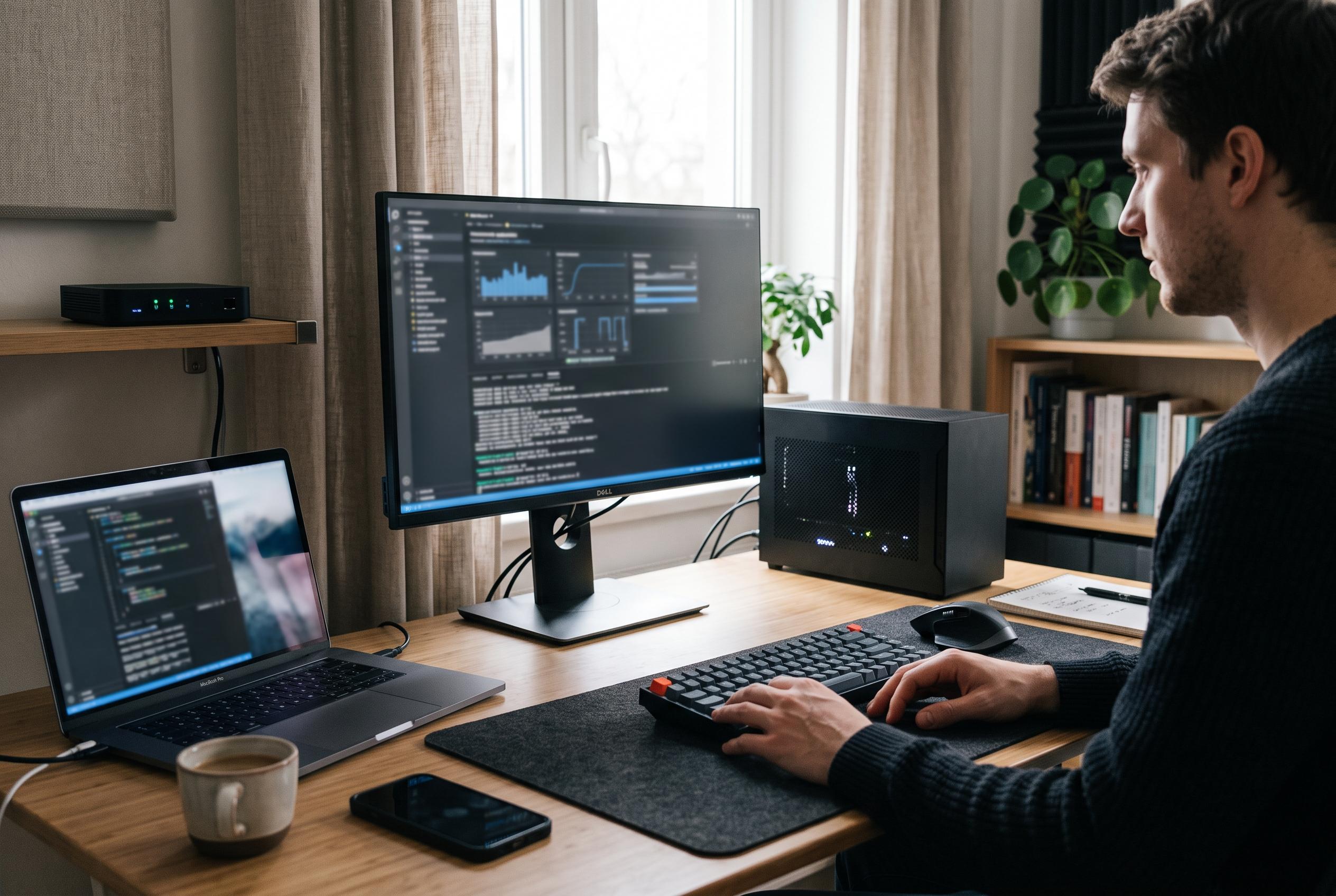

The rise of local machine-learning models such as LM Studio Bionic offers private, offline AI solutions for everyday tasks on consumer PCs, shifting the landscape of AI deployment and privacy considerations.
Local machine-learning models are increasingly being used for private, offline work on ordinary PCs, and LM Studio’s Bionic product is one of the clearer examples of that shift. The appeal is straightforward: the models can run without a permanent internet connection, avoid sending prompts to a cloud service, and are small enough to fit on consumer hardware if the model choice is made carefully. In practice, that makes them useful for document work, log analysis, transcription and scripting, rather than for the largest frontier systems, which still require far more memory than a desktop machine can provide.
The Habr article tested the setup on a PC with an Intel Core i5-14600, 32GB of DDR5 memory and an RTX 3070 Ti with 8GB of video memory, and it argues that LM Studio Bionic for Windows is a simple starting point for users who want to run open models locally. According to LM Studio’s own documentation, Bionic is designed around local execution but can also connect to larger models through its Secure Cloud, which the company says uses a zero data retention policy. The company’s pricing page says the free tier supports local models, the Bionic agent, offline voice transcription and limited web search, while paid plans expand access to cloud models and higher usage limits.
The local-first approach has clear privacy advantages. Data stays on the user’s machine unless they deliberately choose a cloud or remote mode, and that matters for commercial information as much as for personal material. It also avoids the unpredictable costs of token-based usage. But the article is careful to note that local systems do not magically remove all trade-offs. If a model is too large for the available video memory, it will spill into system RAM, and performance can collapse. For that reason, the practical advice is to choose lighter models that fit comfortably within VRAM rather than relying on nominal compatibility alone.
That point matters because LM Studio’s automatic recommendations are based on total memory, not just the amount of graphics memory available for fast inference. The article says this can tempt users into loading models that partly reside in shared RAM, which makes them much slower in day-to-day use. Smaller variants, including compact multimodal models, are often a better fit on an 8GB card. The article also highlights the importance of context window size: if too much of the GPU’s memory is consumed by the model weights, there is less room left for prompts and conversation history, which can reduce useful output even when the model technically loads.
Among the more practical examples is speech-to-text. LM Studio itself is not presented as a full transcription tool, but the article shows how to pair it with Whisper, the open transcription model from OpenAI, running through whisper.cpp on the local machine. The setup described uses a CUDA-enabled build, requires audio converted to 16kHz WAV, and can produce either text or subtitle output from the command line. In the test system, a little over an hour of interview audio was transcribed in under two minutes with the GPU, although the author notes that the result still needs manual checking for names, numbers, jargon and speaker attribution.
The article is also notably cautious about agent-style automation. LM Studio Bionic includes project-oriented features and web-connected modes, but the recommendation is to treat those as experimental rather than dependable replacements for scripted utilities. For file operations, the article argues that conventional tools remain more predictable, easier to audit and less likely to misinterpret instructions. That caution extends to Bionic’s remote access features as well: according to LM Studio, remote models run through LM Link on another device, while the conversation remains on the user’s machine, but that still broadens the security surface compared with an entirely offline setup.
The broader conclusion is not that local AI replaces large cloud systems, but that it has become genuinely useful for a class of everyday tasks on consumer hardware. The article’s most persuasive example is not theoretical performance, but a practical troubleshooting case in which local log analysis helped identify a router problem that manual searching and vendor support had not resolved. For organisations and individuals concerned about privacy, cost control and offline operation, the direction of travel is clear: the key question is no longer whether local models are viable, but which models fit the hardware and the job without forcing unnecessary compromise.
Disclaimer: This content is intended for informational purposes only. Readers are advised to exercise their own judgement, conduct due diligence, or consult a qualified expert before acting on any information provided.