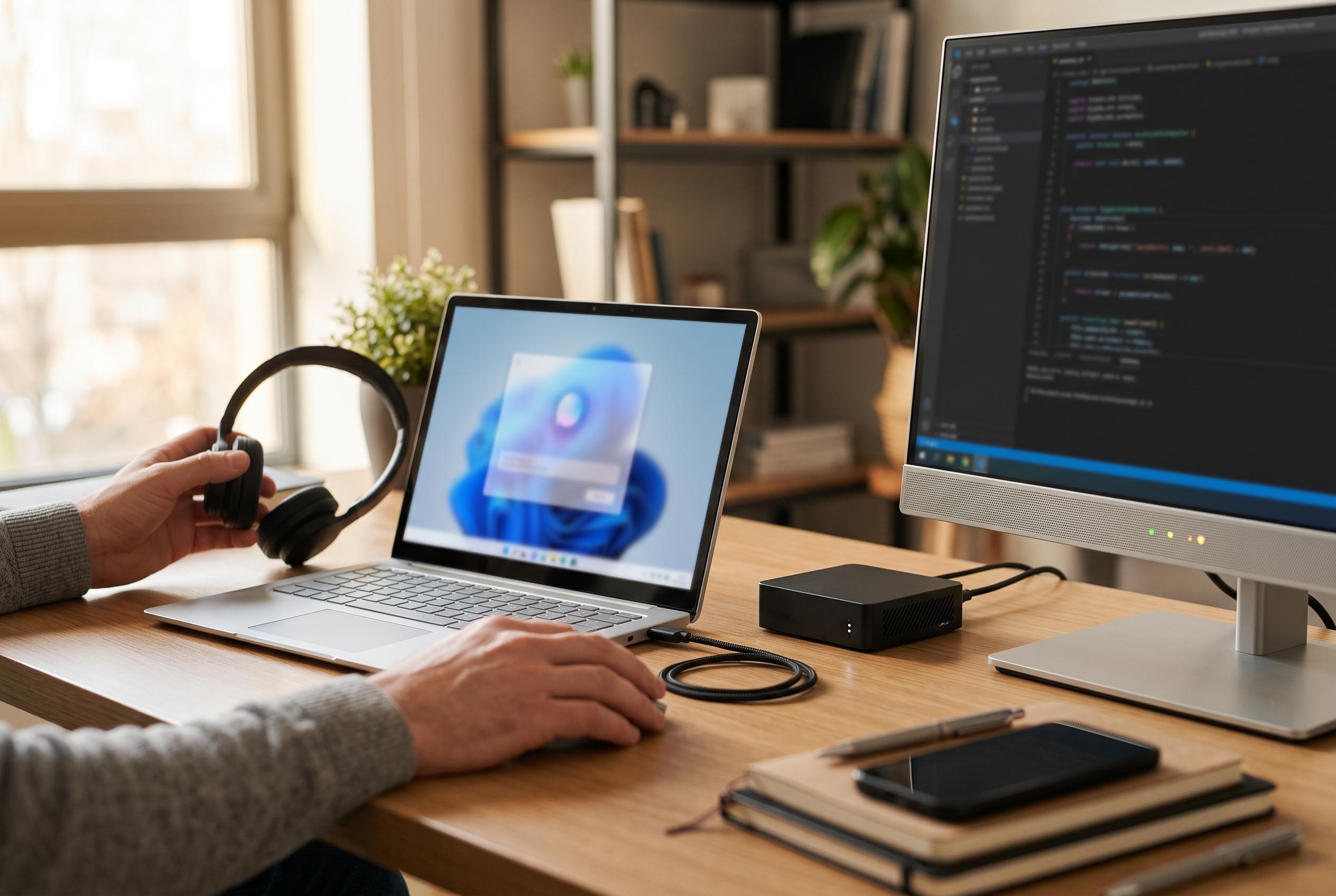

At its October event, Microsoft previews a future where Windows PCs can build and run AI-powered software locally, introducing new hardware and security measures to support hybrid intelligence and agentic applications.
Microsoft is pushing Windows towards a future in which a PC can build, run and control software with far more of the work handled on the device itself. At its Windows and Surface event on 7 October, the company set out a vision it calls “hybrid intelligence”: a mixture of local and cloud AI designed to make Copilot more capable while keeping sensitive work closer to the user. Microsoft says the approach is meant to be more secure and efficient, and to support a new class of agentic software across Windows, Surface and partner hardware. The idea is straightforward enough for users: describe the tool you need, and Copilot helps create it on your own machine. But the practical reality depends heavily on hardware, model size and how much of the workflow can genuinely stay local.
The clearest consumer-facing example is Code in Copilot, Microsoft’s feature for building apps and dashboards from written instructions. In its simplest form, that could mean asking for a sales dashboard from a spreadsheet or a small internal tool for a business task. Microsoft says the feature is intended to let users create software directly on Windows, rather than searching for an existing app that happens to fit the job. Yet the company also stresses that any generated output still needs review before it is trusted for important work. That caution matters, because the same Copilot environment is also being extended to act on files, troubleshoot issues and work with recent PC activity, which raises both usefulness and risk.
For developers, the shift is even more explicit. GitHub Copilot is being given the ability to decide whether a task should be sent to a local model or to the cloud, with developers able to override that choice if they want. Microsoft describes the arrangement as a hybrid system in which the PC handles some processing and cloud models handle the rest. In theory, that can reduce paid cloud usage for repetitive coding tasks and keep some sensitive material on the device. In practice, the company and GitHub both say local model use does not automatically mean offline use, and it does not disable telemetry. Microsoft’s earlier announcement of Code also places the feature within a usage-based billing model, so the promise of “unmetered intelligence” is more limited than the phrase suggests.
The engineering challenge is the size of the models involved. Microsoft has adapted MAI Code 1.1 Flash to run locally, but its own testing puts the model at 53GB, rising to 75.5GB at peak memory use when it handles the maximum text length it supports. That leaves very little room on mainstream laptops once Windows and other applications are running. The company’s answer is the new Surface Laptop Ultra, which pairs NVIDIA’s RTX Spark hardware with up to 128GB of shared memory and is aimed squarely at developers and power users. Windows Central reported that the machine is designed to run very large local AI models, with configurations that go well beyond ordinary consumer laptops. It is due to ship from 16 October at $2,599.99, although the entry model starts with only 24GB of memory, which is not enough for the local coding model Microsoft is showcasing.
Microsoft is also trying to control what these AI systems can touch. Its Execution Containers, or MXC, allow developers to define narrow permissions for an agent, such as letting it edit a project folder while blocking access to unrelated files or external destinations. Local sandboxing is already generally available in GitHub Copilot, and the company says integration with Agent 365, its management service for AI agents, is coming soon. That is a notable point of emphasis: the more a model can act on a device, the more important it becomes to isolate those actions properly. Microsoft is therefore pairing capability with restriction, presenting security controls as a central part of the platform rather than an afterthought.
The rollout will be gradual. GitHub Copilot’s automatic switching between local and cloud models is set to enter experimental preview later in October, while the new Windows Copilot capabilities will reach Copilot+ PCs over the coming months, depending on device and market. Windows Central said the event was framed around Windows, RTX Spark and Surface, with Satya Nadella, Pavan Davuluri and Jensen Huang all associated with the launch. Microsoft has not given a Kenya sales date for the new hardware, and owners of existing PCs will need to check which features arrive on their machines as the software update cycle continues. For buyers, the calculation is becoming more precise: the cost of extra memory and high-end hardware must be weighed against the cloud compute they hope to avoid.
Disclaimer: This content is intended for informational purposes only. Readers are advised to exercise their own judgement, conduct due diligence, or consult a qualified expert before acting on any information provided.