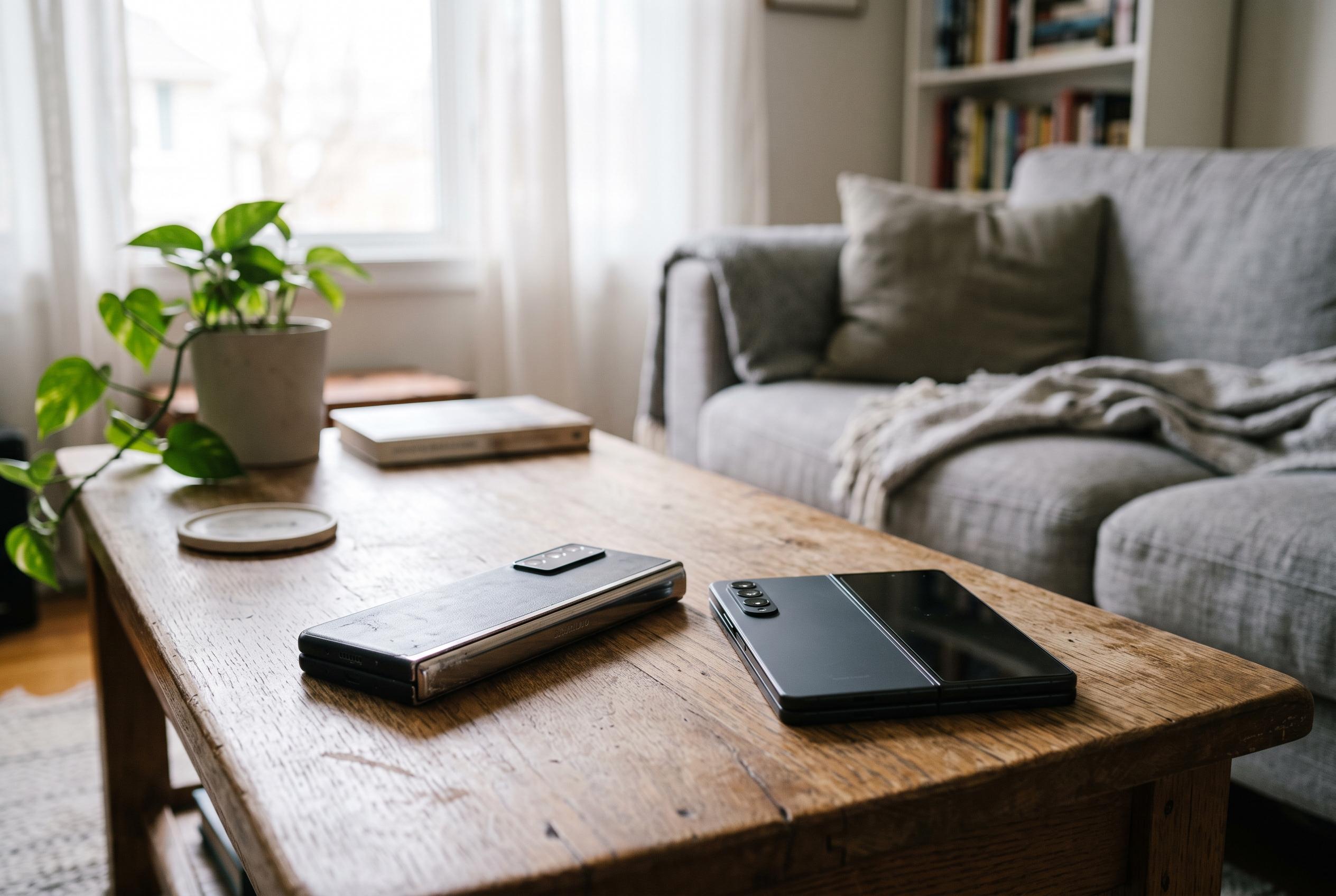

Huawei’s cheaper Mate X6 now undercuts the Mate X7 by 3,000 yuan, but newer hardware, broader storage options and a longer software runway make the premium more compelling for long-term buyers.
Huawei’s latest price cuts have turned its foldable range into a much clearer value equation, but also a more difficult buying decision. According to the price update cited by SMZDM, the Mate X6 has fallen to 8,999 yuan in its 12GB+256GB configuration, while the Mate X7 now starts at 11,999 yuan for the same memory and storage combination. That leaves a 3,000 yuan gap between the two models, and the real question is whether the newer handset justifies the premium. The answer depends less on the folding design itself than on how long the phone is expected to remain in service.
On paper, the two devices are closer than the price suggests. PhoneArena’s comparison shows both use LTPO OLED panels with 120Hz refresh rates, with the X7 offering an 8.0-inch inner display and 6.49-inch cover screen, versus 7.9 inches and 6.45 inches on the X6. The larger differences are under the bonnet: the X7 uses the Kirin 9030 Pro, while the X6 is built around the Kirin 9020. Huawei’s own specification pages and the third-party comparison also indicate that the newer model can be ordered with more memory and storage, up to 16GB and 512GB, whereas the X6 tops out lower. For buyers who keep a handset for several years, that gap in platform headroom matters more than the modest change in screen size.
System support is another important dividing line. The X7 ships with HarmonyOS 6, while the X6 is listed with HarmonyOS 4.3 and an upgrade path to HarmonyOS 5.0. That distinction may look abstract today, but it affects the usable life of the device as software features, security patches and app support evolve. In practice, a foldable bought as a long-term main phone needs a clearer upgrade runway than one that will be replaced quickly. On that measure, the newer model is the safer bet.
Huawei has also made the X7 the more refined device in physical terms. According to the comparison and Huawei’s specifications for the X6, the newer handset is slightly larger but also a touch thinner and lighter, at about 235 grams, compared with roughly 239 grams for the X6. The difference is small, but on a foldable it is felt every time the device is opened and closed. Huawei’s official materials for the X6 also emphasise durability, with second-generation Kunlun glass on the outer screen, an aircraft-grade aluminium frame and an IPX8 water-resistance rating. The X7 goes a step further on protection in some versions, with a higher dust and water-resistance rating and newer materials on the cover display.
The camera and battery story also tilts in the X7’s favour, though not enough to make the X6 feel obsolete. The X6 pairs a 50-megapixel main camera with a 40-megapixel ultra-wide lens, a 48-megapixel telephoto macro unit and Huawei’s multicolour sensor, while the X7 keeps the variable-aperture main camera and upgrades the telephoto macro module to 50 megapixels. Battery capacity rises from 5,110mAh on the X6 to 5,525mAh on the X7, with collector’s editions carrying slightly larger cells, but both phones still use 66W wired charging and 50W wireless charging. That means neither model is especially quick by current flagship standards, and both remain power-hungry in the way large foldables typically are. The X6 standard model also has a practical limitation: Huawei reserves satellite communication features more fully for the higher-tier version, which is worth checking for anyone who regularly travels beyond mobile coverage.
The storage question is equally important. At 8,999 yuan, the X6 is still sold in a 12GB+256GB configuration, which can feel tight on a foldable that behaves more like a compact tablet than a conventional phone. For users who stream video, install productivity apps and keep large media libraries, 256GB may be restrictive over a three- to five-year ownership period. In that sense, the cheaper model makes most sense for people who mainly browse, chat and watch content, and who would rather keep 3,000 yuan in hand for a tablet, earbuds or another accessory.
That is why the decision comes down to replacement cycle rather than raw specifications. For someone planning to change phones after two years, the Mate X6 looks like the more rational purchase. For buyers intending to keep the device longer, who care about software runway, photography and a slightly more polished build, the Mate X7 is the more defensible choice. Huawei’s own broader foldable line-up, including its triple-fold models, shows how quickly the company is spreading its technology across different price points. But within this two-phone comparison, the older device is now the value option, and the newer one is the safer long-term investment.
Disclaimer: This content is intended for informational purposes only. Readers are advised to exercise their own judgement, conduct due diligence, or consult a qualified expert before acting on any information provided.