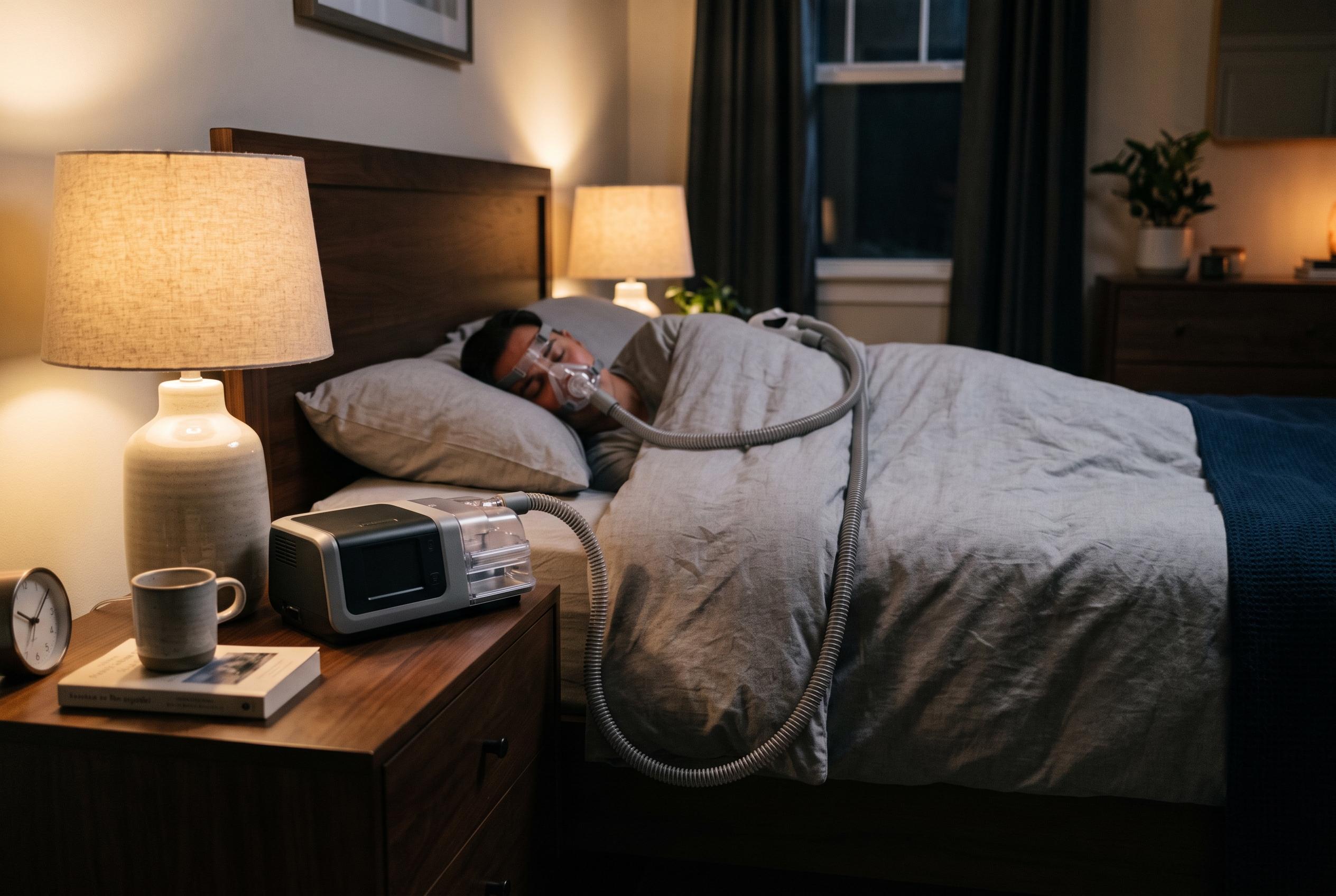

Battery runtime can range from one night to several, but heated humidifiers and tubing are often the difference between reliable backup and an early shutdown.
Reliable CPAP power is less about convenience than continuity. For people who rely on positive airway pressure therapy, a battery can make the difference between a full night of treatment and a disrupted one during travel, camping or a blackout. Sleeplay’s guide says most CPAP batteries will run a machine for roughly one to three nights, although the actual figure depends heavily on the device, the pressure setting and whether heated humidification is switched on. ResMed’s own battery and converter range is positioned in much the same way, with its Power Station II rated at up to 13 hours for AirSense 10 and AirCurve 10 devices. According to ResMed, the same family of converters can also power CPAP units from a vehicle or boat battery, which broadens the use case beyond simple emergency backup.
The practical way to estimate runtime is simple: divide battery capacity in watt-hours by the machine’s power draw in watts. Independent guides on CPAP power consumption put a standard machine without heated humidification at around 30 to 60 watts, while adding a heated humidifier and heated tube can lift demand to roughly 50 to 100 watts. That is why the same battery can behave very differently from one setup to another. In real use, DC power is also more efficient than running the machine through an AC inverter, because it avoids conversion losses.
Heated comfort features are the biggest battery drain. Both Sleeplay’s guide and independent power analyses identify humidification and heated tubing as the main factors that shorten runtime, with pressure level coming next. Sleeplay’s respiratory therapists also point to ambient temperature, sleep length and the exact CPAP model as meaningful variables. That aligns with broader guidance from battery calculators and off-grid solar guides, which advise users to test their exact setup rather than relying on generic claims. A battery that lasts through a cool, low-pressure night can empty far sooner in hot weather or under heavier therapeutic demand.
For buyers, the market has split into two clear categories. Lightweight travel batteries are designed for one or two nights and are easy to carry on a flight, while larger power-station-style units are aimed at multi-night off-grid use and home outage cover. ResMed’s portable power products sit in the travel and vehicle-power segment, while Sleeplay’s examples include compact lithium-ion packs such as the Medistrom Pilot Flex and heavier LiFePO4 units such as the EXP48PRO and EXP96PRO APEX. Solar charging is another dividing line: some batteries are built to accept foldable panels, which makes them more attractive for camping and RV use than for air travel.
Airline rules are another reason capacity matters. FAA guidance, as summarised in Sleeplay’s guide, allows lithium batteries up to 100 watt-hours without airline approval, while batteries between 101 and 160 watt-hours require approval from the carrier. Spare batteries must travel in carry-on bags, not in checked luggage. That means a smaller pack is usually simpler for flying, even if a larger one offers better endurance on the ground. For many travellers, the compromise is between fewer charging hassles in the air and more runtime once they arrive.
The more robust systems are best reserved for users who need resilience rather than portability. ResMed’s converters make it possible to draw power from a car or boat battery, while Sleeplay’s higher-capacity LiFePO4 models are pitched towards extended outages, storm season and rural or off-grid use. That is also where uninterrupted backup mode becomes important: if the battery is kept on charge while the CPAP runs, therapy can continue seamlessly when the mains supply fails. In practice, the right choice depends on a short list of questions: how many nights you need, whether you intend to fly, and how much of your comfort settings you are willing to sacrifice to preserve runtime.
Disclaimer: This content is intended for informational purposes only. Readers are advised to exercise their own judgement, conduct due diligence, or consult a qualified expert before acting on any information provided.