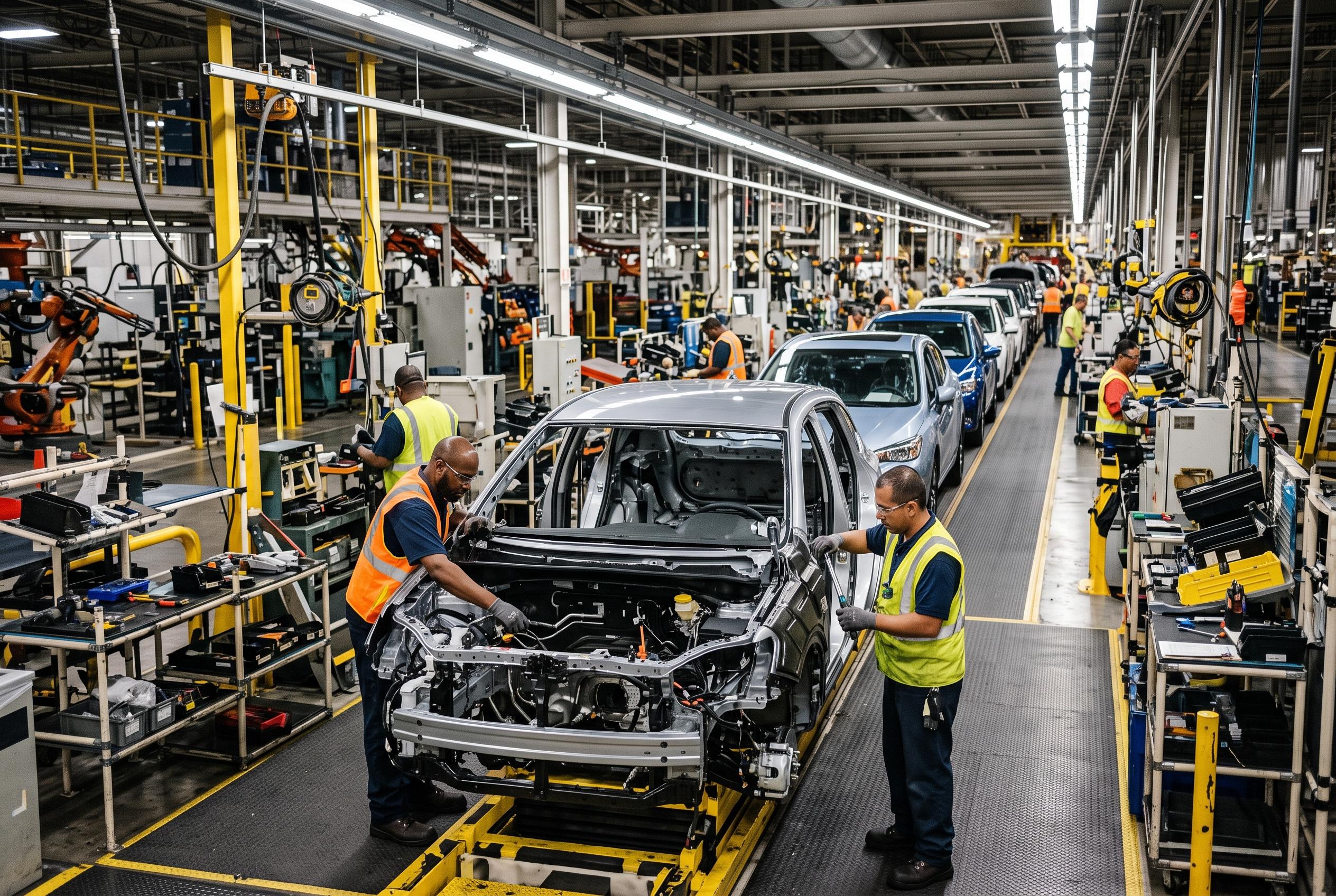

Hyundai Motor India is bringing forward third-shift operations at its Talegaon plant as it targets higher exports, launches new models and expands annual capacity beyond 1.1 million vehicles by 2030.
Hyundai Motor India is accelerating its manufacturing build-out at Talegaon as it sharpens its export ambitions and prepares a wider product cycle for the Indian market. The Hindu BusinessLine reported that the plant in Maharashtra is becoming central to the automaker’s ₹45,000 crore investment plan, which also envisages 26 product launches by FY2030 and exports accounting for about 30 per cent of Indian output. The move comes as Hyundai seeks to restore momentum in a market where competition has intensified and plant constraints have weighed on growth.
The company brought passenger vehicle production on stream at Talegaon on October 1, 2025, with an initial annual capacity of 170,000 units. Hyundai has now advanced third-shift operations to October 1, 2026, nearly two years earlier than originally planned, a sign that it is pushing utilisation faster than expected. According to the company’s figures and the BusinessLine report, Talegaon and Hyundai’s Chennai complex together now give the carmaker capacity for 994,000 vehicles a year, leaving it just short of the one-million mark. Hyundai expects that figure to rise to 1.14 million units by 2030.
The expansion is also reshaping Hyundai’s product allocation between plants. As Venue production moves to Talegaon, Chennai is being cleared for new models, including the Bayon petrol midsize SUV due to be launched next week and a compact electric SUV planned for FY2026-27. Hyundai Motor India managing director and chief executive Tarun Garg told investors that both vehicles will be built in Chennai, helping lift capacity use and margins. Company guidance suggests Chennai Plant 1, which is expected to run at about 72 per cent utilisation in 2026, could reach 90 to 92 per cent in 2027 as volumes increase.
Hyundai is leaning heavily on the new-generation Venue to strengthen its export base. Talegaon is intended to be the sole global production site for the model, which Hyundai plans to ship to about 35 markets, up from 28 for the outgoing version. By July, it had received orders from more than 30 overseas markets. The company aims to raise Venue exports from around 6,500 units currently to 15,000 to 20,000 a year. That ambition underlines how limited Hyundai’s SUV export mix has been so far: SUVs account for only 13 to 14 per cent of exports, versus roughly 70 per cent of domestic sales.
The timing matters. Hyundai reported a recovery in September, with domestic sales rising 10.9 per cent year on year to 57,166 units and exports increasing 10.4 per cent to 20,750 units, taking total monthly sales to a record 77,916 vehicles. For April to September, domestic sales were up 12.3 per cent to 305,146 units. Brokerages cited by BusinessLine remain constructive, with Motilal Oswal forecasting annual volume growth of about 9 per cent between FY2026 and FY2028 and exports rising about 12 per cent a year, while other analysts expect new models and added capacity to support market-share gains. Hyundai’s broader global strategy reinforces the same direction: Hyundai Motor Group has separately announced a $15.5 billion investment in India from 2026 to 2032, while Hyundai Motor Company has said it plans to localise 90 per cent of vehicle content in India by 2030 and expand its Indian supplier and engineering base.
Disclaimer: This content is intended for informational purposes only. Readers are advised to exercise their own judgement, conduct due diligence, or consult a qualified expert before acting on any information provided.