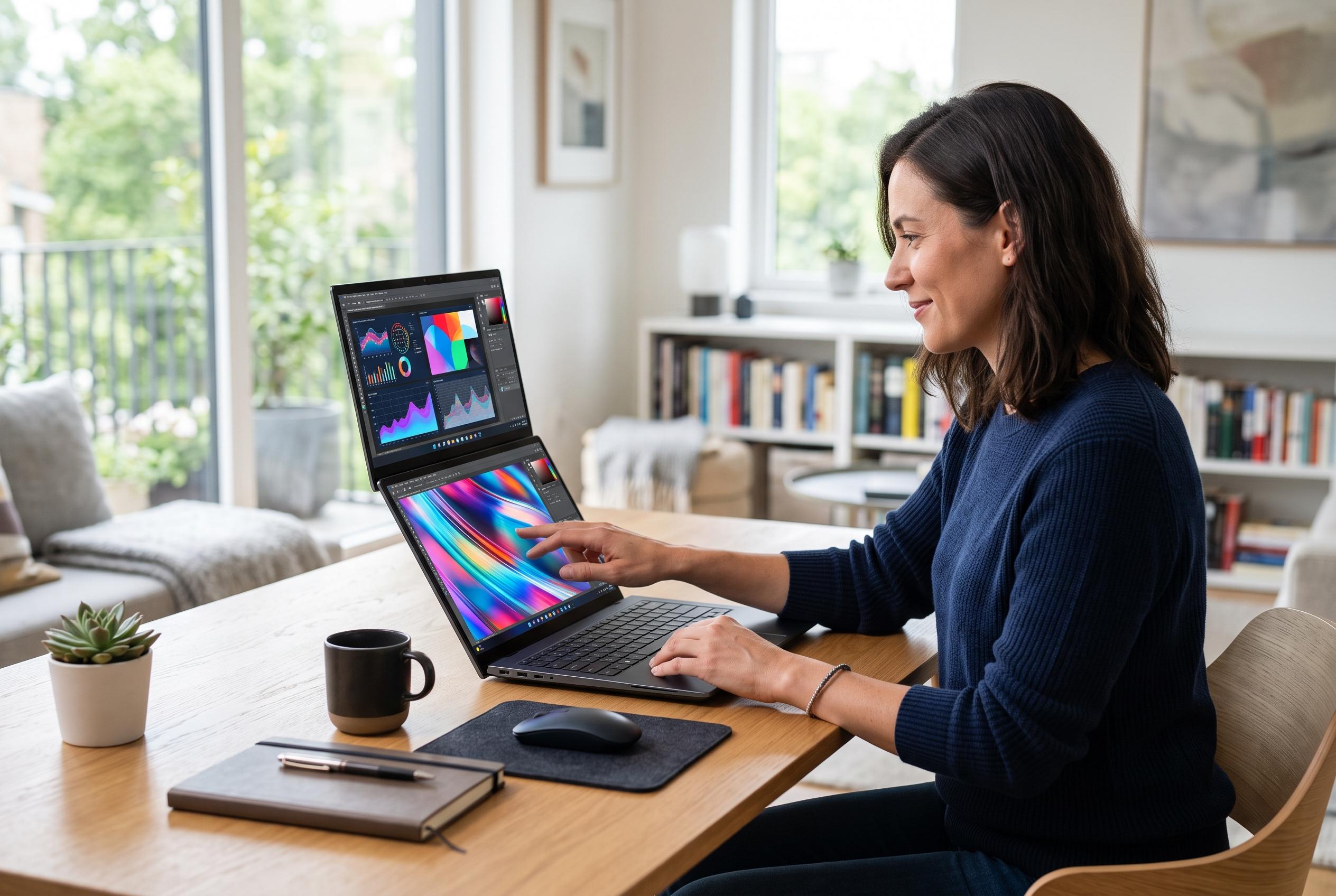

ASUS’s latest Zephyrus Duo combines a flagship RTX 5090, two 16-inch 3K OLED touchscreens and unusually strong battery life in a premium laptop costing from $4,499.99.
ASUS has made a speciality of unusual laptops, and the latest Zephyrus Duo continues that line with a dual-screen design aimed at both gamers and creators. The Russian review on 3DNews says the GX651AX has gone on sale in Russia, while ASUS’s own 2026 specification page places the line in the premium end of the market, with prices starting at $4,499.99. That positioning matters, because this is not merely a novelty device: it is built around high-end components, serious cooling and a form factor intended to replace more than one machine.
The model tested by 3DNews was the flagship GX651AX-SR119W, equipped with 64GB of LPDDR5X-8533 memory and a 1TB SSD, alongside Intel’s Core Ultra 9 386H and NVIDIA’s GeForce RTX 5090 with 24GB of GDDR7 memory. ASUS also offers a lower graphics option with the RTX 5070 Ti, but the review sample sat at the top of the range. The notebook carries a 90Wh battery, two Thunderbolt 4 ports, two USB-A ports, HDMI 2.1, a microSD slot and a detachable wireless keyboard. ASUS describes the display setup as two 16-inch 3K OLED touch panels running at 120Hz.
What makes the Zephyrus Duo distinctive is not only the second screen, but the way ASUS has integrated it into the chassis. 3DNews found the all-metal body solid, with both panels anchored firmly enough to resist flex. The lower display can also serve as a touch keyboard and trackpad, while the magnetic keyboard attachment held securely even during heavier use. The machine can be positioned in several ways, including the more familiar stepped layout, a tent configuration, and a portrait-oriented book mode. For content work, streaming and multi-window gaming, that flexibility is the central selling point.
The Russian review also praises the practical details. The keyboard is only 5mm thick, yet offers 1.7mm of travel and single-zone RGB lighting. The display surfaces use Corning Gorilla DXC glass, and the rear of the chassis is dominated by a wide exhaust grille for the cooling system. Internally, ASUS uses a vapour chamber, and access for upgrades is limited: the memory is soldered, while a second M.2 SSD can be fitted through a service hatch. That design choice fits the category, but it also means buyers should choose storage and memory carefully at purchase.
Both OLED panels use the same ATNA60HR07 matrix, and 3DNews measured strong colour performance, full coverage of sRGB and DCI-P3, and a peak HDR brightness of up to 1,000cd/m2. In its own testing, the publication recorded excellent accuracy and low colour error after calibration. TechRadar and Windows Central broadly describe the same display package, adding that the machine targets creators as much as gamers, while Notebookcheck also highlights the high-end OLED implementation and the 64GB memory option. In practice, the hardware is designed to make the most of the extra screen area rather than treat it as an afterthought.
Performance is where the machine most clearly justifies its size and cost. 3DNews reports that the Core Ultra 9 386H can draw around 71W in the performance presets, while the RTX 5090 reaches up to about 175W when graphics is pushed harder. In the lab’s gaming tests, the notebook delivered very strong results in modern titles at Full HD and WQHD, including triple-digit frame rates in lighter esports workloads and solid performance in demanding single-player games. The cooling system kept CPU and GPU temperatures in check, but noise rose sharply in the highest-performance modes. In quieter settings, the machine remained usable, though sustained multi-threaded speed fell back.
Battery life was another surprise. With one display active, 3DNews measured roughly 16 hours of web browsing and nearly 19 hours of video playback, which is unusually good for a machine of this class. Using both screens reduced endurance to a little over nine hours in mixed light-use scenarios, still respectable for a dual-panel gaming laptop. The overall verdict from the Russian review is that the Zephyrus Duo GX651AX is an expensive machine, but one that combines real utility with genuine power. ASUS’s own product page, as well as outside reviews from TechRadar, Windows Central and Notebookcheck, all point to the same conclusion: this is a niche product, but a highly capable one for users who can exploit both the performance and the extra display space.
Disclaimer: This content is intended for informational purposes only. Readers are advised to exercise their own judgement, conduct due diligence, or consult a qualified expert before acting on any information provided.